
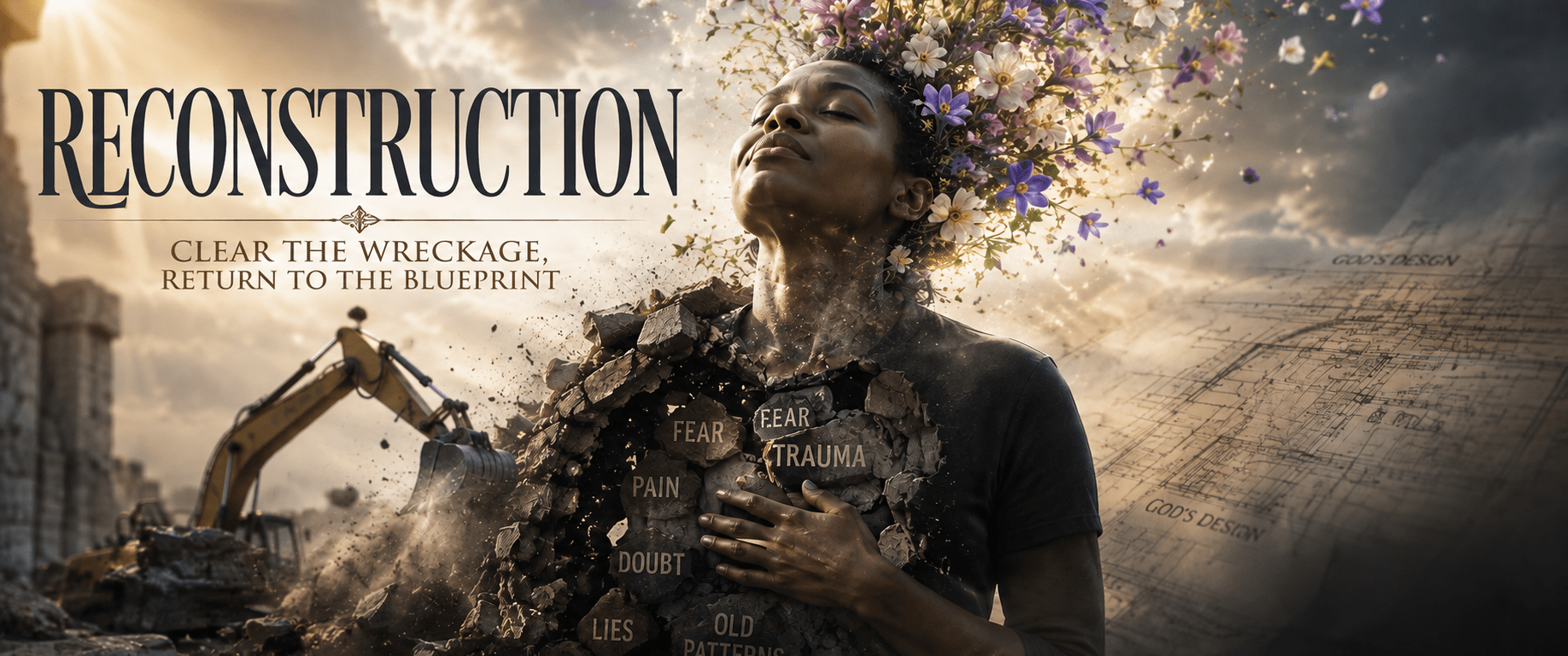
We often build from brokenness.
We grieve, then put ourselves back together again more times than we would like to admit.
When I see the word “reconstruction,” I notice the prefix “re,” meaning “again.” That gives me hope. Hope that we can return to the original design and blueprint of how we, as humans, were created to think, act, and feel.
The difficulties we face as a nation, as a culture, and as humankind have caused our nervous systems to exist in a constant state of flux simply because of the world we were born into. Our thinking has been shaped by how we responded to every situation we encountered—good or bad. At some point, we all break. We break from the pressure to sustain, perform, or unresolved fear or trauma.
While we are living from brokenness, we often believe that is the hardest part. Yet Scripture reminds us that God gives us “beauty for ashes” (Isaiah 61:3). Out of what is broken, beauty is promised. I believe that beauty comes through the rebuilding—the reconstruction.
The question is not whether reconstruction is necessary.
The question is: What are we rebuilding on?
Reconstruction Begins with the Blueprint
Before anything could be built in the ancient world, the cornerstone had to be carefully selected and precisely placed.
The cornerstone was the primary foundation stone positioned where two walls met. It was often larger, heavier, and more precisely cut than the rest. Its placement determined the angle of the walls, the height of the structure, and the alignment of the entire building. Everything else was measured from that one stone.
Scripture tells us that Jesus Christ is our Chief Cornerstone.
“…built on the foundation of the apostles and prophets, with Christ Jesus Himself as the chief cornerstone.” — Ephesians 2:20
If every stone in a building was measured from the cornerstone, perhaps reconstruction begins by asking ourselves a different question:
What have I been measuring my life against?
Before We Build, We Must Clear the Wreckage
When a building is demolished, it leaves behind wreckage: concrete, dust, steel, broken beams.
No one is surprised by the debris. It is the natural consequence of something being torn down.
Yet before the new design can be built, the wreckage must first be removed. The ground must be cleared. The foundation must be leveled.
As humans, we often do the opposite.
We rely on the narratives we’ve been given—or the ones we’ve developed over time. Instead of clearing away the wreckage, we simply build on top of it.
We read another article. We watch another YouTube teacher. We attend another workshop. Yet we often glaze over what still lies beneath the surface.
Too often, we build:
- Careers on rejection.
- Relationships on abandonment.
- Leadership on insecurity.
- Faith on fear.
- Communities on unresolved wounds.
We must clear away the wreckage of distorted thinking and unhealthy belief systems. Otherwise, what we build next will simply rest on yesterday’s brokenness.
Fear Is the First Obstacle to Reconstruction
After the wreckage is exposed, fear often arrives first.
Fear arrives in many forms:
- Fear of the unknown.
- Fear of repeating cycles.
- Fear of putting ourselves out there.
- Fear of trusting.
- Fear of hoping again.
Those same experiences that shaped our thinking continue to hang over us like dark clouds, threatening to bring another storm. Every time we dare to move forward, fear attempts to convince us to stay where we are.
“For God has not given us a spirit of fear, but of power and of love and of a sound mind.” — 2 Timothy 1:7
Fear wants us to believe reconstruction is too risky.
Faith reminds us that remaining in the rubble is even riskier.
Hope Is the First Sign of Reconstruction
Faith is often described as the opposite of fear, but I believe faith is first born from hope.
Hope whispers that something different is possible.
Have you ever seen a flower grow through concrete? Or water spring forth in the desert? That is what hope feels like.
I recently attended a conference where the speaker shared the story of the crocus flower. Unlike most vegetation that lies dormant throughout the winter, waiting for favorable conditions, the crocus blooms in one of the harshest seasons of the year.
It blooms anyway.
That image stayed with me.
It reminds me that flourishing isn’t always the result of perfect conditions. Sometimes flourishing is the decision to grow despite them.
Perhaps that is the invitation before us—not simply to survive this season, but to bloom in it.
When Hope Is Deferred, Skepticism Takes Root
Skepticism is often what grows when hope is repeatedly delayed.
“Hope deferred makes the heart sick, but a longing fulfilled is a tree of life.” — Proverbs 13:12
Many of our patterns of survival—how we keep ourselves emotionally and mentally safe—are filtered through the lens of skepticism.
“Nothing will ever change.”
“That’s only for certain people.”
“People like me don’t get those opportunities.”
Honestly, all we have to do is turn on the news or scroll through social media, and those skeptical thoughts are reinforced daily.
So we lie dormant. We refuse to grow. We refuse to rebuild. We refuse to reconstruct.
“Above all else, guard your heart, for everything you do flows from it.” — Proverbs 4:23
Our words, our choices, and even the world we help create flow from the condition of our hearts.
Reconstruction Begins Within
We want to talk about reconstructing society.
We want to rebuild communities, institutions, systems, and relationships.
But we cannot reconstruct what is happening around us without first addressing the emotional, spiritual, and mental wellness of the people shaping our communities, places of worship, cities, states, and nations.
We know society is broken.
But are we ready to tackle the real battle? Are we willing to unpack our skewed perspectives? Are we brave enough to allow our belief systems to be challenged? Are we willing to let go of the security blankets we’ve wrapped around ourselves and get to the root of our human condition?
Because if we don’t deal with these things first, what we build next will be contaminated. We will simply recreate what has already existed.
Communities are built by people. Families are built by people. Churches are built by people. Nations are built by people.
If the builders remain wounded, fearful, divided, and disconnected from their original design, we should not be surprised when the structures they create reflect the same condition.
Perhaps genuine reconstruction begins long before we rebuild our cities.
Perhaps it begins by allowing God to rebuild us.
Final Reflection
Reconstruction is more than rebuilding what has been broken.
It is returning to the Blueprint.
It is clearing the wreckage.
It is realigning our lives with the Cornerstone.
It is choosing hope over fear.
And it is becoming the kind of people who can build something healthier than what we inherited.
Beauty is not found in the ashes.
Beauty is found in what God builds from them.
The first step to reconstruction is not rebuilding.
It is laying a foundation worthy of what comes next.
Discover more from Three-Fifths
Subscribe to get the latest posts sent to your email.

