
Recovering America’s Democratic Memory
“Be true to what you said on paper.”
— Dr. Martin Luther King Jr.
Most Americans know that the Civil War ended slavery. Far fewer know what came next.
After four years of war, the United States faced a question far greater than how to rebuild the
South. It had to decide whether the promises written into the Declaration of Independence and
the Constitution would finally belong to all Americans or remain reserved for only some.
That question defined Reconstruction.
Too often, Reconstruction is remembered as a brief political era sandwiched between the Civil
War and Jim Crow. In reality, it was one of the most ambitious democratic projects in American
history. It was the nation’s first sustained effort to transform the ideals of liberty, citizenship, and
representative government into lived reality for millions of people who had been denied them.
Nearly a century before Dr. Martin Luther King Jr. urged America to “be true to what you said
on paper,” Reconstruction represented the country’s first major attempt to do exactly that.
The Thirteenth Amendment abolished slavery.
The Fourteenth Amendment established birthright citizenship & equal protection under the
law.
The Fifteenth Amendment protected Black men’s right to vote.
For the first time in the nation’s history, constitutional democracy began extending beyond the
boundaries it had inherited from slavery. Black Americans voted, served on juries, opened
schools, held local offices, wrote state laws, and entered the United States Congress.
Formerly enslaved people and their children became active participants in the government that
had once denied them the most basic rights of citizenship.
Reconstruction proved something many Americans have forgotten. Representative democracy
became stronger when more Americans, particularly African Americans, were allowed to
participate in it, the “American Dream,” right?
The Tale of One US Senate Seat
Sometimes history is best understood through a single moment.
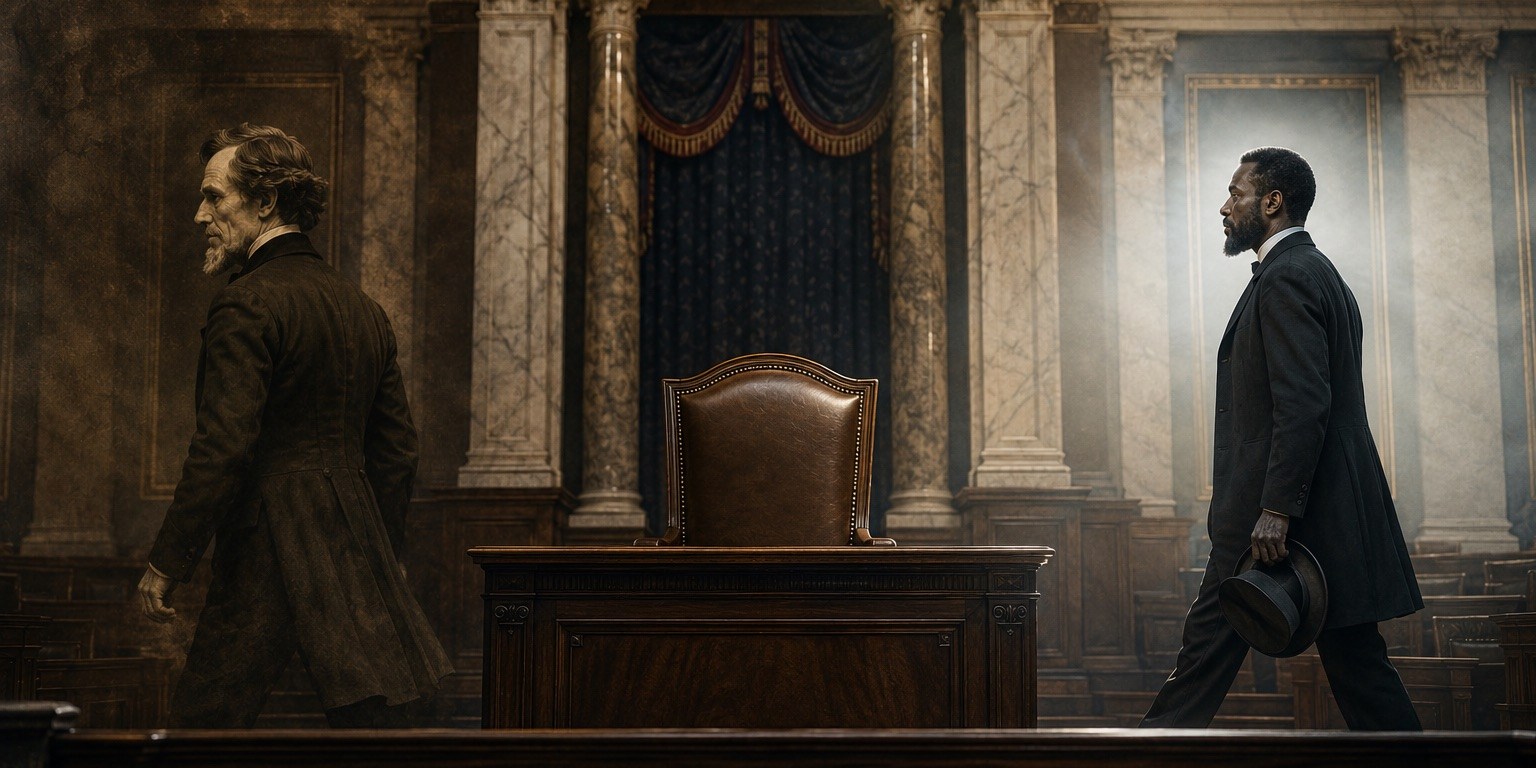
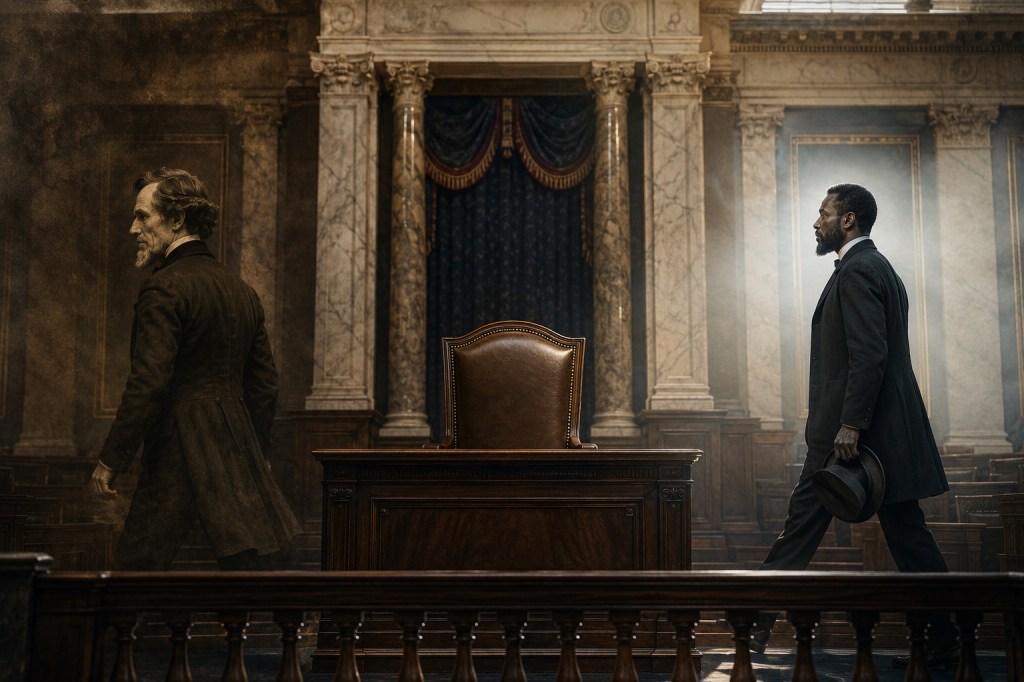
In 1861, Jefferson Davis resigned his seat in the United States Senate to lead the Confederate States of America. He left the Senate to preserve slavery and to wage war against the United States. Nine years later, that same Senate seat was occupied by Hiram Rhodes Revels. Revels, a minister, educator, Civil War chaplain, and advocate for equal citizenship, became the first Black United States Senator in American history. One Senate seat. Two visions of
America.
One man abandoned the Union to preserve slavery and a republic built upon racial hierarchy.
The other entered that very Senate because slavery had been abolished, symbolizing a nation
beginning to recognize that citizenship and the responsibilities of self-government, belonged to
all Americans.
No image better captures the promise of Reconstruction. Revels did not arrive through charity or
lowered expectations; he arrived through elections and representative democracy.
He was one of more than twenty Black Americans who served in Congress during
Reconstruction. Many had been born into slavery. Others had fought for the Union, organized
schools, led churches, practiced law, or built businesses before entering public office.
They weren’t asking for any special treatment other than being treated like the Americans they
were.
Click here to meet the Congressmen of the Reconstruction Era Reconstructing Patriotism
The story of Reconstruction also challenges us to rethink patriotism, especially in 2026.
The same people whose enslavement had once been recognized under American law now
pledged allegiance to the Constitution that finally recognized them as citizens. Instead of seeking
revenge African Americans instead sought representation, registered to vote, ran for office,
debated legislation, expanded public education, and strengthened local communities.
Their participation was rooted in the belief that America’s ideals were worth claiming, not only
for themselves, but for future generations. There may be no greater act of patriotism than
believing in a nation’s promises after that nation has denied them to you.
Reconstruction’s Black legislators did not ask America to become another country; it held up a
mirror which raises an uncomfortable question:
What does it say about our national memory that monuments so often honor those who defended
slavery while the Americans who expanded democracy during Reconstruction remain largely
absent from our public landscape?
History is not only about what we remember. It is also about what we choose to forget and how
we forget.
The Whitelash of Supremacy
Reconstruction did not collapse because formerly enslaved Americans proved incapable of
citizenship.
It collapsed because white supremacy refused to accept Black citizenship.
As Black political participation expanded, organized campaigns of racial violence, voter
intimidation, and political terror sought to reverse those gains. Across the South, democratic
participation became increasingly dangerous for Black Americans. States adopted new legal
barriers to voting, segregation became entrenched, and opportunities created during
Reconstruction were systematically dismantled.
But white supremacy sought more than political control; it sought control over memory, by
legislation and force.
If future generations aren’t taught or forget that Black Americans had successfully governed,
legislated, and participated fully in constitutional democracy, then exclusion could be portrayed
as natural rather than imposed.
The attack on Reconstruction was therefore both political and historical.
It challenged not only who could participate in democracy, but whose contributions deserved to
be remembered. That struggle over historical memory did not end in the nineteenth century.
It continues whenever Americans “debate” the reality of history and overlook the true story of
African Americans in this country
Ohio’s Responsibility
For Ohio, this history carries particular significance. Ohio produced leaders who fought to
preserve the Union and also became part of the political compromise that effectively ended
federal enforcement of Reconstruction.
The Compromise of 1877 resolved a disputed presidential election by recognizing Ohio’s
Rutherford B. Hayes as president while withdrawing federal troops from the South. Whatever
Hayes’s personal intentions, the result was unmistakable. Federal protection for Black civil and
political rights rapidly weakened, opening the door to decades of disfranchisement, segregation,
and racial violence.
That history belongs to Ohio, but it’s not unique; it’s the story that belongs to the nation.
Understanding Reconstruction requires celebrating its achievements while honestly confronting
the decisions that allowed those achievements to be dismantled and systematically designed to
last of future generations.
Unfinished Reconstruction
In the 250th year of independence, Reconstruction deserves to stand alongside the Revolution, the
Civil War, and the Civil Rights Movement as one of the defining chapters of the American story.
It demonstrated that constitutional democracy could grow and that representative government
became stronger when it reflected more of the American people. The clearest demonstration is
the reminder that democratic progress is never permanent and must be fought for with the
regression we’ve experienced this year alone.
Every generation decides whether the promises written into our founding documents will be
expanded, defended, narrowed, or ignored. That is why Reconstruction still matters.
It offers more than a simple story of triumph or failure; it’s hard evidence of the American
Dream. Evidence that the United States once chose to extend its constitutional promises to
people who had long been denied them.
Evidence that formerly enslaved Americans entered the institutions of government, pledged
allegiance to the Constitution, and helped strengthen the nation.
If we hope to prepare the next generation to inherit the full American story, then the architects of
Reconstruction must finally be restored to their rightful place in our classrooms, our public
memory, and our understanding of what it truly means to be an American.
Despite Reconstruction’s profound impact on American democracy, only one monument, Robert
Smalls, that’s currently dedicated to African American members of Congress from that era.
There are over 2000 Confederate symbols, monuments, and markers across the US.
Perhaps reconstructing patriotism begins by recovering historic memory.

Educator & Future Public Servant
(Inspired by those who led with truth)
Discover more from Three-Fifths
Subscribe to get the latest posts sent to your email.

