
“If you get rid of unfair practices,
Isaiah 58:9-12 The Message Translation
quit blaming victims,
quit gossiping about other people’s sins,
If you are generous with the hungry
and start giving yourselves to the down-and-out,
Your lives will begin to glow in the darkness,
your shadowed lives will be bathed in sunlight.
I will always show you where to go.
I’ll give you a full life in the emptiest of places—
firm muscles, strong bones.
You’ll be like a well-watered garden,
a gurgling spring that never runs dry.
You’ll use the old rubble of past lives to build anew,
rebuild the foundations from out of your past.
You’ll be known as those who can fix anything,
restore old ruins, rebuild and renovate,
make the community livable again.”
Call it the dream, the Dream Act; whatever dream and positive result we cling to, there must come a time of change. Purveyors of Hope, from Purveyors of Hope, Mother Teresa, Nelson Mandela, Brittany Packnett Cunningham, Letitia James, Jamar Tisby, Martin Luther King, Tereza Lee, to name a few, Hope has always been in the imagination if not always manifested, yet resonated in the hearts of men and women in America and the world.
It existed in the sphere of Hope for a world in desperate need of it. After the storm of the War Between the States, there came a moment in history called Reconstruction. It was a twelve-year window and a glimpse into a Shangri-La of peace and tranquility never experienced on Turtle Island (America) since the European footprint graced the land.
It was a time when met application through fairness, representation, legislation, and unique expressions of every voice, i.e., “Lift Every Voice,” rising to the unabashed splendor of a multiracial democracy in its purest form. The more perfect union, yet without women’s right to vote, among other blemishes. That said, the trajectory and potential had America headed in the right direction.
However, some would not let it be so. The illicitly craven only in America, call it made in America, American-made hatred. The same imagination that captivated nations, exposing the base ambiguities of social orders poisoned by spellbinding methods of hatred of the others. We called it “Jim Crow,” according to the Jim Crow Museum, named after Throughout the 1830s and ’40s, the white entertainer Thomas Dartmouth Rice (1808-1860), who performed a popular song-and-dance act supposedly modeled after an enslaved man. He named the character Jim Crow. All of this was in the name of separate but equal, which in actuality was far from equal. These behaviors later played out in divisive policies such as apartheid in South Africa, and the unimaginable acts of the Holocaust of Jews in Nazi Germany.
The backlash would come in the form of a veracity that within months the beauty of Reconstruction was but a faded memory. With one stroke of a pen, removing Union troops from the South ushered in dark nights filled with ghost-like incantations in human form ( white Ku Klux Klansmen covered in white) meant to frighten the superstitious former slave population like a white storm that never relented.
The interim years were filled with struggles over voting rights and equality in education. Nearly a century after the end of the Civil War, Brown v. Board of Education in 1954 was a landmark decision that set the course for what would become the civil rights movement. The very next year, in 1955, Rosa Parks refused to ride in the back of the bus, marking the beginning of that movement. Emmit Till’s grotesque mutilation and death brought a haunting face to the movement that would shock the nation into looking at itself as it never had before, and the civil rights movement marched on.
With Freedom Riders, lunch counter sit-ins, and its leaders, Dr. Martin Luther King, along with others, guiding this movement into the halls of Congress, it could be viewed as a second Reconstruction. This period went on through much of my life and was highlighted by the 8-year presidency of the first president of color, Barack Obama. The civil rights movement was seen as the fulcrum point from which society would move toward real and lasting change, or that’s what it seemed at the time, if not for a few interruptions along the way, such as King’s assassination, along with Medger Evers, and Malcom X.
In 2020, in the middle of a pandemic, it seemed as though the whole world stopped and took a deep breath for the ones George Floyd could not take. Protests broke out nationwide and even spread worldwide. In one very loud outcry from a world symphony of outcries, humanity was finally beginning to act like humanity. Now, people around the world, including America’s urban and suburban communities, marched in unison, and Major corporations echoed “Black Lives Matter.” Though society had so much farther to go to get to a society free of racism.
Sinister voices began to say, “Enough of a black president and the exotic legion of others, black radicals, illegal aliens, and socialists all trying to replace us with good red blood Americans,” or that’s how some would characterize it. Outside their leadership circles, they would take these thoughts and filter them through more sanitized and palatable language to gain support from the uninformed, disengaged, and indifferent. To this group, civil rights was still viewed as the ultimate threat to the centuries-old power structure. Their movement was birthed, morphed, and reconstituted itself many times over to put an end to all of this cultural change, through its various aliases, such as the Southern Strategy, the Moral Majority, the Tea Party, White (political) evangelicalism, QAnon, Christian Nationalism, white nationalism, and the reconstituted America First dynamic.
All this resistance to change was articulated in the anonymous Project 2025; remember, it was the one that no one would admit knowing what it was about. This manifesto was established by its authors to take America off the so-called knife’s edge of Socialism, Communism, Cosmopolitanism, One World Government, or whatever frightening euphemism you would like to use to ultimately take us back to the 1950s and put a stop to any type of social Reconstruction
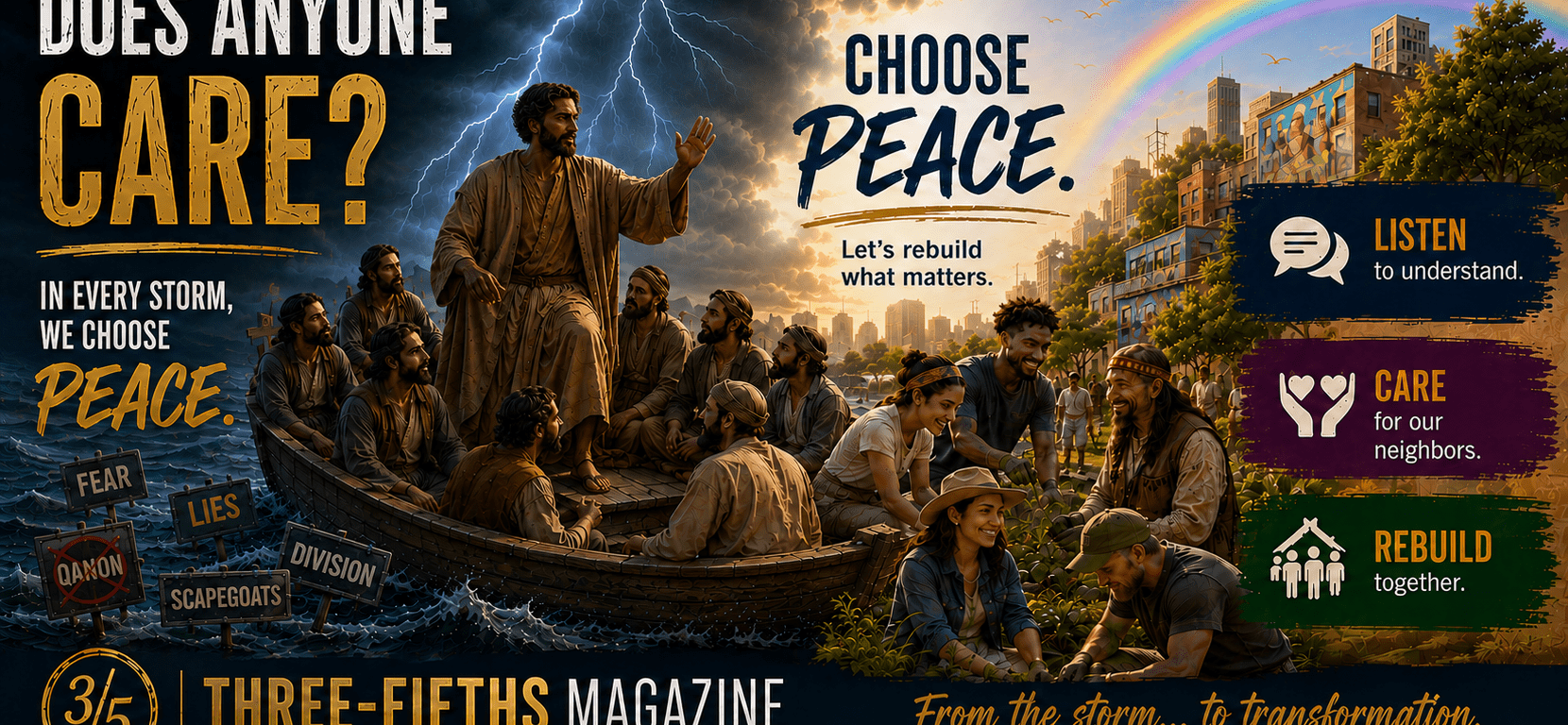
In recent years, America has weathered storms unlike any in modern memory. The COVID-19 pandemic exposed deep inequities. Political polarization strained relationships between neighbors and even families. The resurgence of white nationalism challenged hard-won progress toward racial justice. The rise of conspiracy movements such as QAnon demonstrated how misinformation can distort reality, erode trust, and divide communities. Each of these storms has left behind rubble—not only in our institutions but in our relationships. Isaiah 58 asks a question that is just as urgent today as it was centuries ago: What will we build from these ruins?
That question may be at the heart of America’s current storms:
Does anyone care?
When people feel ignored, abandoned, unheard, or betrayed, fear creates an opening. Into that opening can rush conspiracy, misinformation, scapegoating, and extremism. Movements such as the QAnon phenomenon and its so-called storm captured the imaginations of many as one manifestation of what happens when fear, distrust, anger, and the hunger for hidden explanations converge. The storm becomes more than a political problem. It becomes a crisis of meaning.
Scripture reveals this in Mark 4:39, in the midst of a great storm upon the Sea of Galilee. In this storm, Jesus was in the bottom of the boat, comfortably sleeping. Questions about what comes next were already settled in his mind. The mission was set to get to the other side. Our mission is set to get to the other side. He had a method for making the madness of the storm stop. The simple words of Jesus were “peace be still.” Before we can reconstruct our communities, we must learn to quiet the storms that have overtaken our minds, our relationships, and our public life. Jesus’ command, “Peace, be still,” is not a call to ignore injustice or avoid difficult conversations. It is a call to refuse fear, outrage, misinformation, division, and to not lay aside the power to determine who we become. As we prepare to enter a new time of Reconstruction, let Isaiah 58 then show us what comes next:
We Are Called To
Dismantle Injustice,
We are called to dismantle injustice. And that is what we are doing at Three-Fifths Magazine. We have freedom of speech in America. Let’s use it and not take that fundamental right for granted. By rejecting blame, we empower care for the vulnerable, as minority communities and immigrants take the brunt of criticism for the downfall of our fragile society. In cultures where the powerful feel threatened about losing or sharing power, the rise of scapegoatism takes front stage.
Rebuild The Ruins,
Rebuild the ruins of dashed hopes. “Even if the hopes you started out with are dashed, hope has to be maintained.” Seamus Heaney. Rebuilding defines the intensity of that hope. For with every rebuild, improvements change the dynamic. No matter what memories and how endearing they were, there always remains something better, something to fill in voids, imperfections, and neglected parts of the last rebuild. The overreach that lost the energies of potential Allies and Advocates can be trimmed away in favor of a more perfect Union, Society, or Community.
And Make Our Communities Livable Again.
It is possible we pay our attention upon things above. No, this is not a sermon but a soliloquy of hope, not just a publication but a movement drafted out of a tapestry that each one of us can take part in if the above lifts us above our own individual wants and needs to a higher place of preferring our brothers’ and sisters’ needs above our own.
This kind of energy is contagious and perpetuates the love in our hearts to that highly elusive and seemingly mythical Beloved Community.

The Message Bible
NAACP
the Jim Crow Museum
Discover more from Three-Fifths
Subscribe to get the latest posts sent to your email.


