
No society simply survives a storm. Every society reconstructs. The only question is what it reconstructs. Some rebuild institutions while leaving injustice intact. Others restore public order while preserving the assumptions that fractured it in the first place. Still others mistake visible activity for genuine transformation, believing that replacing damaged structures is the same as renewing the values that gave those structures life. History suggests otherwise. Reconstruction is never neutral. Every act of rebuilding reveals what a people believe is worth preserving, what they are willing to abandon, and whose humanity they intend to protect. Before reconstruction reshapes institutions, it reshapes the moral world from which those institutions emerge.
American history offers repeated testimony. After the Civil War, the nation attempted to reconstruct the Union, yet many of the moral assumptions that sustained racial hierarchy survived emancipation. The Civil Rights Movement dismantled legalized segregation, but legislation alone could not cultivate the habits of dignity, mutual responsibility, and shared belonging that democratic life requires. More recently, political polarization, public distrust, and cultural fragmentation have reminded us that crises create opportunities for change but never guarantee wisdom. Reconstruction falters whenever societies rebuild systems without examining the convictions that produced them.
Frederick Douglass understood that emancipation alone could never complete the work of freedom. Throughout Reconstruction, he insisted that citizenship required more than removing legal barriers; it demanded recognition of equal human dignity and the moral courage to protect it. His speeches repeatedly challenged the nation to resist the temptation to settle for symbolic progress without structural commitment. Douglass recognized that a democracy unwilling to reconstruct its moral convictions would eventually retreat from its democratic promises. His warning continues to speak beyond the nineteenth century. Every generation faces the same temptation to celebrate visible change while neglecting the deeper work of cultivating the moral habits that sustain justice once public attention has moved elsewhere.
The most enduring reconstruction begins where blueprints cannot reach. Every institution is a moral autobiography. Before it tells us how a society is organized, it reveals what that society loves, fears, rewards, and refuses to see. Institutions arise from deeper convictions about justice, power, responsibility, and belonging. Schools reveal what a society believes education is for. Churches reveal what they believe faith demands. Courts reveal whose rights deserve protection. Democracies reveal who truly belongs within the promise of citizenship. Long before reconstruction becomes visible in brick, legislation, budgets, or policy, it has already begun in the unseen architecture of moral conviction. We always build from somewhere, even when we have forgotten where that “somewhere” came from.
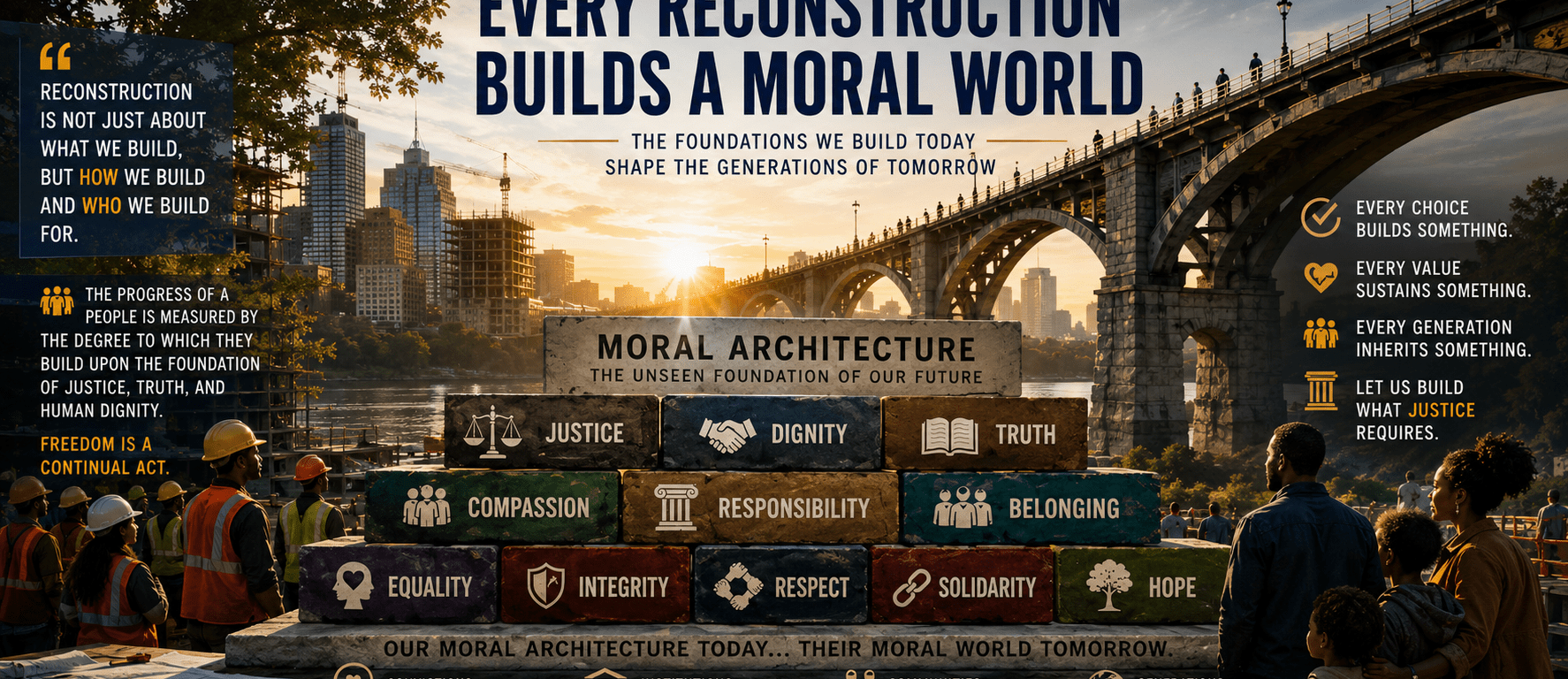
Reconstruction therefore begins with work that cannot be measured by budgets, elections, or ribbon-cutting ceremonies. It begins with the quiet reconstruction of moral architecture—the convictions that shape how people understand justice, responsibility, truth, and the dignity of their neighbors. Like the unseen framework supporting a building, moral architecture is rarely noticed until it begins to fail. When those convictions weaken, institutions eventually weaken with them. Reconstruction cannot be delegated to governments alone. It belongs wherever character is formed. Democracies are rebuilt each time citizens choose honesty over expediency. Teachers reconstruct by cultivating intellectual honesty rather than mere performance. Parents reconstruct by teaching that human dignity is not earned but recognized. Faith communities reconstruct by valuing truth more than institutional comfort. Communities are renewed when neighbors refuse suspicion and choose shared responsibility. History remembers extraordinary leaders, but reconstruction is sustained by ordinary people whose daily decisions quietly become a nation’s moral foundation.
The greatest danger after any storm is mistaking survival for success. Survival preserves life. Reconstruction determines its direction. We can rebuild roads while neglecting trust. We can modernize institutions while leaving untouched the habits of exclusion that will eventually weaken them again. We can celebrate progress while overlooking the patient work required to sustain it. Justice is not an achievement that one generation permanently secures for the next. It is a discipline that must be practiced repeatedly, renewed intentionally, and defended whenever convenience tempts us to lower our moral expectations. Democracy is not inherited automatically; it is cultivated deliberately. Reconstruction endures only when a people become as committed to forming character as to repairing structures.
The question before us is not whether reconstruction is necessary. Every generation inherits that responsibility. The deeper question is what kind of moral world our reconstruction will leave behind. Storms will come again. They always do. Buildings will rise, institutions will change, and new leaders will emerge. Yet long after today’s debates have faded, another generation will inhabit the moral architecture we are building now. Storms do not decide the future. Reconstruction does. Our most enduring legacy will not be the structures we rebuild after the storm. It will be the values we choose to build into them. Reconstruction is never completed by one generation. It becomes a trust passed from one generation to the next. We inherit more than institutions. We inherit the responsibility to decide whether justice will become more deeply rooted or quietly abandoned.

Discover more from Three-Fifths
Subscribe to get the latest posts sent to your email.

