
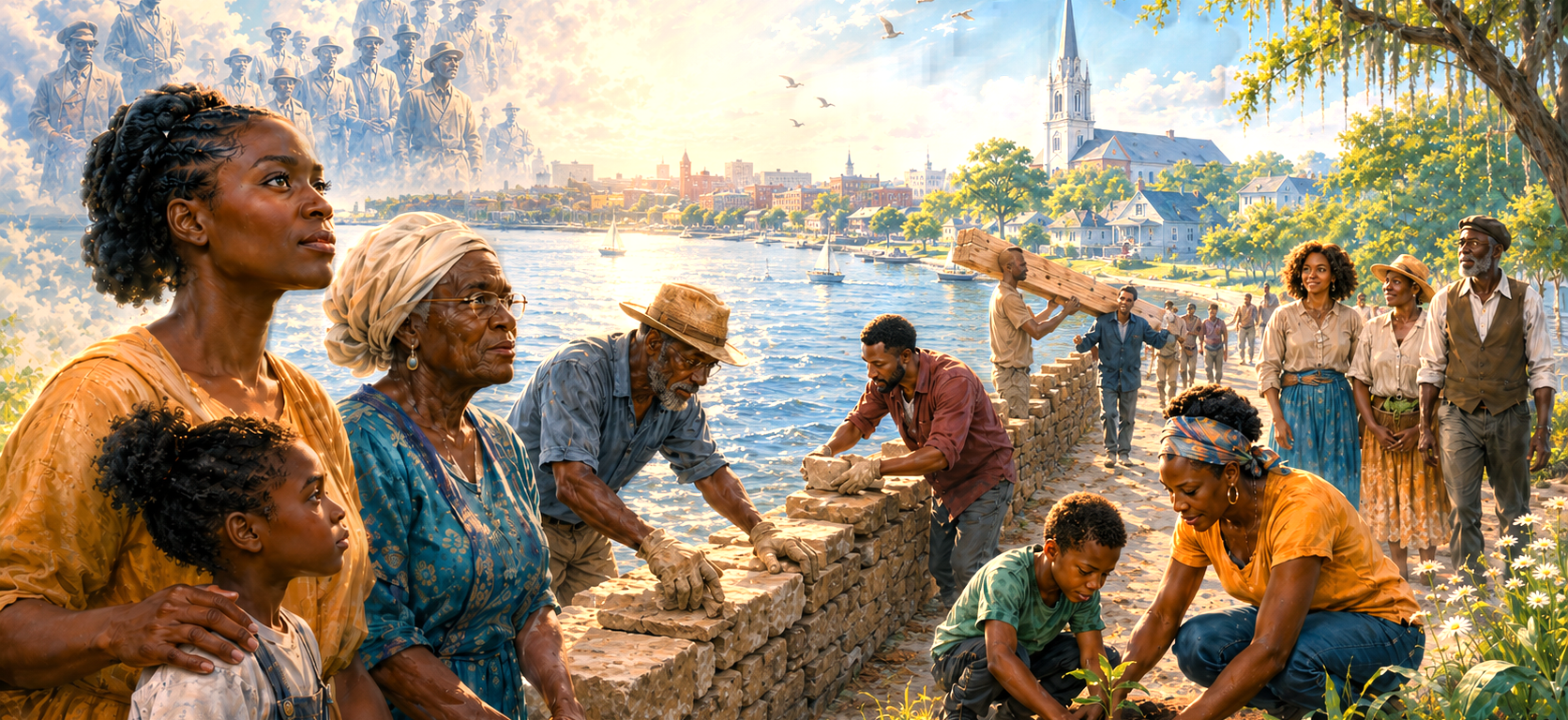
“Let us rise up and build.”
Nehemiah 2:18, KJV
Dear Reader,
I am a native of Wilmington, North Carolina.
My family and I are what I call geographical ancestors of 1898. We are not descendants looking back at a distant place. We are still there.
My family still lives, works, worships, owns businesses, and raises children in the city where white supremacists overthrew a legally elected, multiracial government on November 10, 1898.
This is not just history. It is grief, inheritance, hope, and a love letter to the city that shaped me.
Some storms leave broken windows and flooded streets. Others leave a city standing while tearing something vital from its people.
Wilmington did not disappear after 1898. The river still moved. But the city had changed.
Black residents were killed. Families fled. Elected leaders were forced from office. The office of The Daily Record, a Black-owned newspaper, was burned for challenging white power. The men who seized control called their violence order.
Imagine folding your child’s clothes into a sack while smoke rose over a business your family built. Imagine realizing those claiming to protect the city had decided your citizenship could be taken.
Now imagine that your family stayed.
Generations later, your people still walk those streets, worship, raise children, and believe Wilmington can become more than what happened there.
That is the Wilmington I know.
The violence traveled through lost land, broken businesses, displaced families, silenced voices, and stolen political power.
It traveled through the body.
Fear changes sleep. Grief settles in the chest. Chronic stress raises blood pressure and teaches the body to stay alert after danger has passed.
That is why Reconstruction is also a health and wellness issue.
When people lose political power, they lose influence over schools, housing, hospitals, safety, transportation, and public spending. Communities without political power often live inside decisions made without them.
Reconstruction is not simply repair.
Repair can place the same roof over the same cracked foundation. Reconstruction asks whether the foundation must change.
Wilmington rebuilt after 1898, but not justice. White political control strengthened. Black voting power and businesses weakened. Segregation hardened.
The people who created the storm also designed what followed. People can rebuild injustice and call it progress.
Deuteronomy commands:
“That which is altogether just shalt thou follow, that thou mayest live.”
Deuteronomy 16:20, KJV
Justice is connected to the life of families, neighborhoods, and future generations. A city cannot claim reconstruction while justice remains outside the blueprint.
Nearly seven decades later, the Voting Rights Act of 1965 became another attempt at reconstruction. It did not erase Wilmington’s violence or restore what was stolen.
But it built protections around a right repeatedly promised and denied.
A right without protection is only a promise. A promise without accountability is easily broken.
The Act confronted literacy tests, intimidation, and discriminatory registration systems.
In 2013, Shelby County v. Holder weakened a central protection by making the preclearance formula unusable.
It is the difference between inspecting a roof before entry and investigating after it collapses.
The United States of 2026 is not Wilmington in 1898. The moments are not identical. But history does not need to repeat exactly to warn us.
In 1898, Black political participation was called a threat. Today, voting debates often arrive through technical language about district lines, identification, registration, polling places, and election administration.
Not every election-law disagreement attacks democracy. Still, Wilmington teaches us to examine effects.
Who finds it harder to vote? Whose representation is weakened? Who bears the burden after a harmful policy shapes an election? Who benefits when people become too tired or distrustful to participate?
Reconstruction requires vigilance as much as vision.
Nehemiah gives us a spiritual model.
When he learned Jerusalem’s walls were broken and its gates burned, he wept, mourned, fasted, and prayed. He did not skip grief.
Then he inspected the ruins before inviting the people to rebuild.
“Ye see the distress that we are in. Come, and let us build up the wall of Jerusalem.”
Nehemiah 2:17, KJV
He named the distress before announcing the vision. The people answered, “Let us rise up and build.”
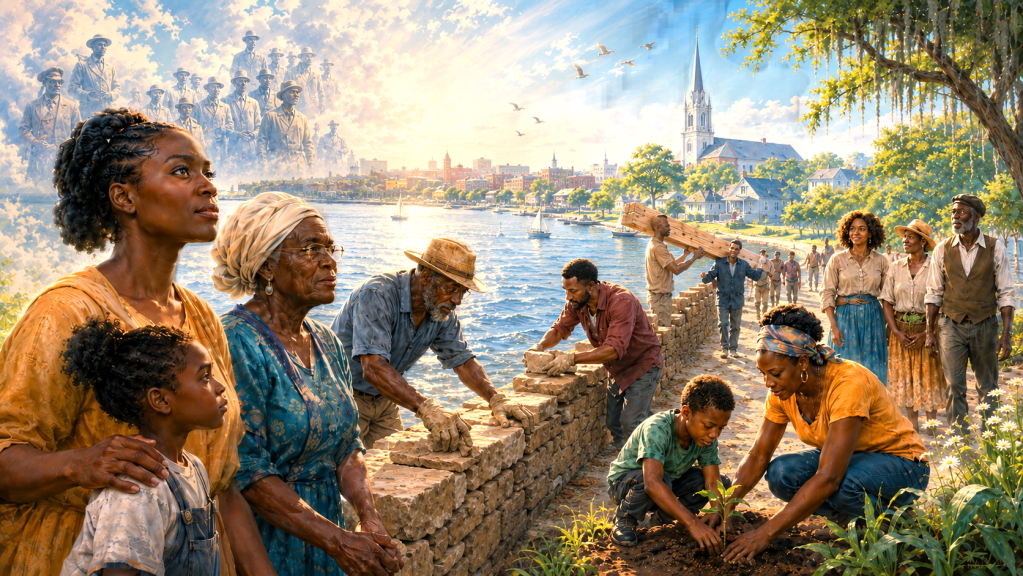
Nehemiah did not rebuild alone. Families, workers, faith leaders, merchants, and public officials repaired different sections.
We are not responsible for the entire wall. But we are responsible for the section within our reach.
Some will preserve the truth of 1898. Others will teach, register voters, support Black-owned businesses, care for elders, serve, write, preach, organize, and raise children who know they belong wherever decisions are made.
But Nehemiah also warned that a wall can rise while injustice remains.
During the rebuilding, poor families were losing land, falling into debt, and struggling to feed their children. Nehemiah confronted leaders who profited from their hardship.
A city is not restored because its walls stand. The people inside must be able to live, eat, rest, vote, speak, and belong.
A hospital may be modern while patients are dismissed. A memorial may stand while descendants remain outside decision-making rooms.
A wall is not enough.
James 2:17 says:
“Faith, if it hath not works, is dead, being alone.”
James 2:17, KJV
Hope must become visible. It should tell the truth, protect people, support businesses, teach history, and defend the vote.
Wilmington, I love you enough to tell the truth about you.
My hope is not that you forget 1898. My hope is that we remember it so truthfully that we refuse to rebuild its conditions.
I hope Black history is not treated as a side story. I hope the inheritors of 1898 help shape policy, investment, healthcare, and the city’s future. I hope trust is earned through action.
I hope our children inherit more than resilience.
I hope they inherit protection, power, truth, and possibility.
The fire did not have the final word.
Memory can become instruction. Grief can become architecture. Hope can become practice.
Each of us can find the section of the wall within our reach, even now.
I am a native of Wilmington, North Carolina.
My people are still there.
Still living. Still working. Still worshiping. Still raising families. Still building.
That is why the story does not end with the fire.
It continues with us standing before what was broken, tools in our hands, hope in our bodies, and enough love for those coming behind us to finally build differently.

Fawn N. Rhodes, MPH, ACUE
Founder and Principal, Rhodes To Wellness, LLC
Founder and Writer, The Public Health Griot™
Community Health Engagement Strategist
Faith-Based Health Equity Advocate
Doctoral Student in Global Health Equity
Meharry Medical College School of Global Health
Discover more from Three-Fifths
Subscribe to get the latest posts sent to your email.

