
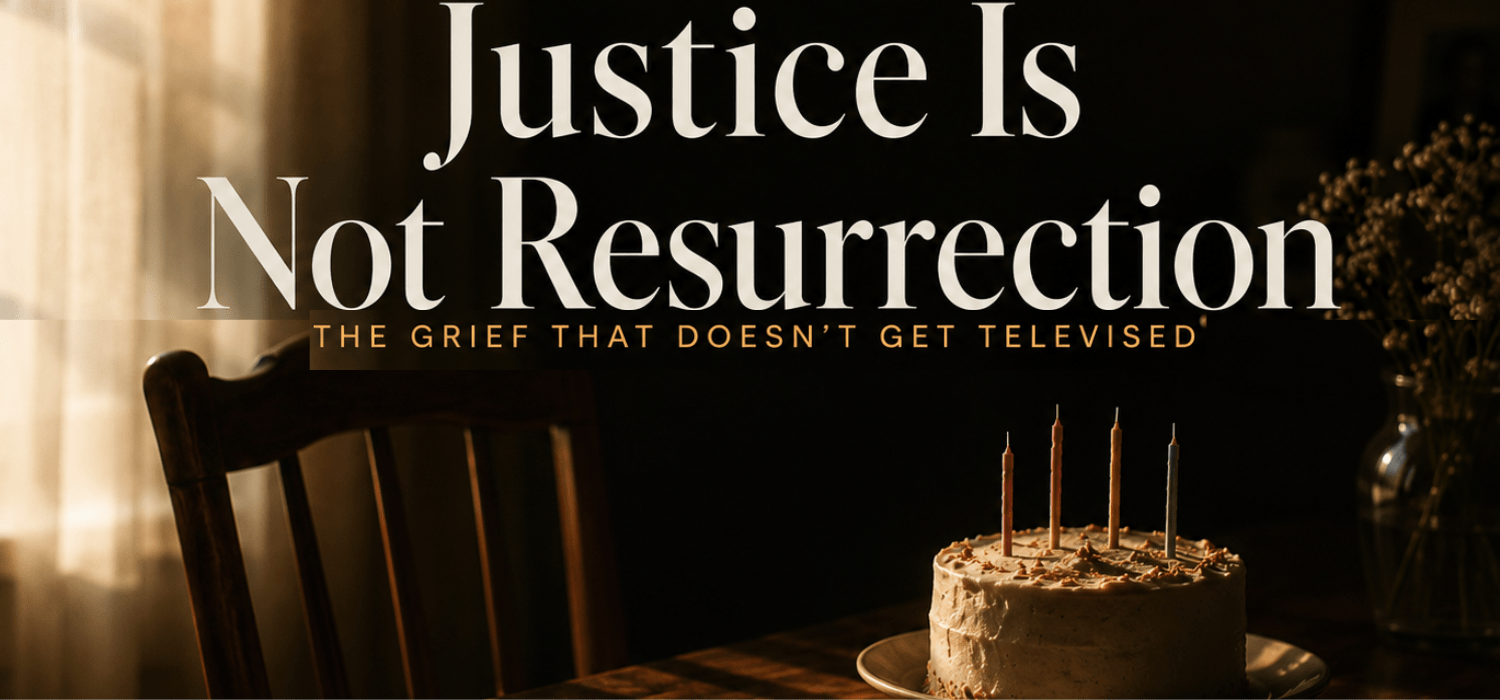
On May 23, my brother Andre would have turned 53.
Birthdays have a way of exposing the truth about grief in ways that anniversaries, court dates, and public statements never quite do. A birthday is not about what happened. It is about what should still be happening. It is about the call you should be making. The text message that should be coming through. The laughter that should still exist. The plans that should still be unfolding.
Birthdays force you to sit with absence in a deeply human way.
The public remembers headlines. Families remember birthdays.
People remember the breaking news alert. The media coverage. The outrage. The public debates. The opinions from people who never knew your loved one but somehow feel qualified to dissect their life, their decisions, their humanity. People remember the trial. The verdict. The statements made outside courthouse doors. The language of justice.
Families remember the silence that comes after all of that is over.
They remember the empty space at the table.
They remember hearing a name and feeling their body tighten before their mind even processes why.
They remember what was taken, not as a public event, but as a personal fracture that permanently altered the shape of life.
There is something this country gets wrong when it comes to justice and grief.
We often speak about legal accountability as though it is the emotional conclusion to tragedy. As though a verdict marks the end of suffering. As though truth being acknowledged in a courtroom somehow translates into healing for the people left behind.
It does not.
Justice matters. Let me be clear about that.
Accountability matters. Truth matters. Naming harm matters.
But justice is not resurrection.
A courtroom can validate wrongdoing. A legal process can establish responsibility. A verdict can acknowledge what happened in ways that matter deeply, particularly when systems have historically failed to do so.
But none of that brings a person back.
None of that creates one more birthday.
None of that restores the ordinary moments that make up a life.
Justice cannot return a brother.
It cannot give you one more conversation.
It cannot recreate future memories that were stolen before they had the chance to happen.
That is where the public understanding often falls short.
People tend to experience public tragedy in chapters. Something happens. There is outrage. There are calls for accountability. There may be protest. There may be public discussion. Eventually, some version of legal resolution arrives, and for many people, that is where the emotional relationship with the story ends.
Families do not get that ending.
There is no clean separation between what happened and what comes next because grief does not operate in neat timelines.
There is only before.
And after.
And after is not the same thing as over.
As a psychologist, I understand trauma from a professional lens. I understand how trauma lives in the nervous system. I understand how grief can show up physically, emotionally, cognitively, and relationally. I understand hypervigilance. Triggers. Emotional exhaustion. The way the body stores experiences long after the immediate event has passed.
But lived experience teaches something different.
Lived experience teaches you that trauma does not care about public timelines.
It does not care that the trial is over.
It does not care that people have moved on to the next story.
It does not care that enough time has passed for others to feel emotionally distant from what happened.
Trauma has its own language.
Sometimes it sounds like silence.
Sometimes it looks like exhaustion you cannot explain.
Sometimes it is the tension in your body when certain dates approach.
Sometimes it is the emotional weight of realizing life kept moving while part of you remains tethered to something unfinished.
And then there is the complexity of public grief.
There is something uniquely painful about losing someone in a way that becomes public consumption.
When loss becomes public, grief changes.
Your loved one is no longer simply your loved one.
Their name becomes content.
Their life becomes debate.
Their death becomes political narrative.
Strangers develop opinions based on fragments, headlines, assumptions, and commentary. People discuss humanity through the detached language of news cycles and social media discourse, while families are left trying to survive something deeply intimate.
That creates a second wound.
Because while you are grieving, you are also witnessing the public reinterpretation of someone you loved.
You are watching people reduce a full human life into moments, narratives, or arguments.
You are trying to process private pain while navigating public noise.
That kind of grief is layered in ways many people never have to consider.
And for Black families, there is another reality layered on top of that pain.
There is the emotional labor of surviving racial trauma in public spaces.
There is the exhaustion of having to explain pain that should not require explanation.
There is the expectation that you will be resilient, composed, articulate, strong, and somehow able to transform grief into advocacy while still carrying the unbearable weight of loss.
Black grief is often expected to be instructive.
But grief is not a lesson plan.
Loss is not a performance.
Pain is not owed to public consumption in a digestible format.
One of the most damaging myths we continue to hold onto is the idea of closure.
Closure sounds comforting because it suggests completion. It suggests emotional resolution. It suggests that pain has a natural endpoint if the right things happen.
But some losses do not fit neatly into that framework.
Love does not disappear because legal proceedings end.
Absence does not become less real because accountability occurred.
Grief does not ask permission to revisit you years later.
Some losses permanently alter the architecture of your life.
You do not move past them in the simplistic ways people often expect.
You adapt.
You carry.
You rebuild around absence.
You create meaning where you can.
You learn to breathe inside a reality you never asked for.
That is not closure.
That is survival.
My brother’s birthday just passed.
He would have been 53.
That fact sits outside every legal outcome, every public discussion, every statement about justice.
Because at the center of all of this is still a human truth.
He should still be here.
Justice matters because truth matters.
Justice matters because accountability matters.
Justice matters because harm should be named.
But justice cannot restore stolen time.
It cannot create future birthdays.
It cannot bring laughter back into a room in the same way.
It cannot return the people we love.
Families live in the afterlife of what the public calls resolution.
That is the grief that does not get televised.
Discover more from Three-Fifths
Subscribe to get the latest posts sent to your email.


