
The Archetypal Cell
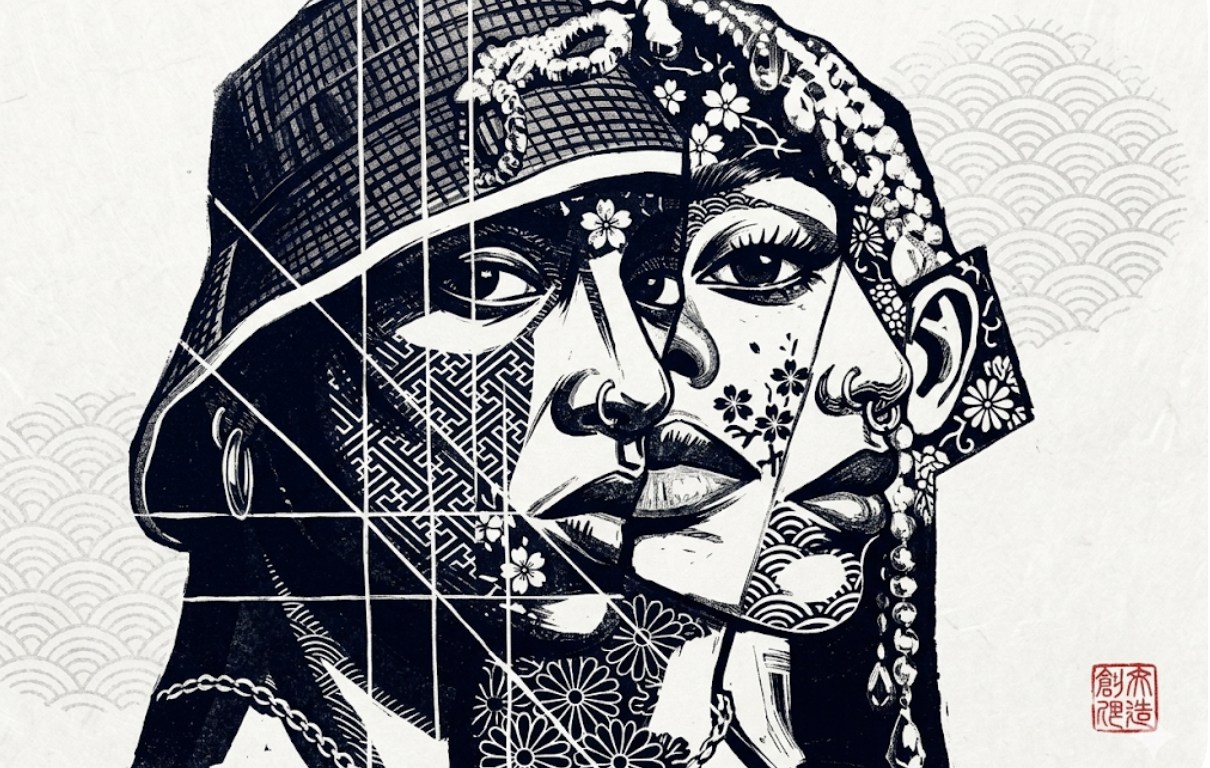
The contemporary discourse of identity, particularly as filtered through the now-ubiquitous lens of “intersectionality,” often celebrates self-knowledge as the pinnacle of liberation. To name oneself is to claim power; to articulate one’s position at the crossroads of race, gender, and class is seen as an act of emancipatory mapping. Yet this narrative of identity-as-freedom overlooks a darker, more foundational truth explored with devastating precision by Frantz Fanon, Jean-Paul Sartre, and, in a crucial but often-overlooked intervention, James Hillman. Identity, when forged in the crucible of an oppressive social gaze or, more insidiously, within the deep archetypal structures of a culture’s imagination, can become the very architecture of one’s prison. Reading Kimberlé Crenshaw’s intersectionality not as a simple celebration of multiplicity but as a diagnostic tool for structural misrecognition reveals a haunting synergy with these thinkers. Together, they illustrate that identity becomes a path to imprisonment when it is an externally imposed verdict, an internalized pathology, a performative cage, or—as Hillman reveals—an unconscious archetypal destiny written into the cultural psyche itself.
The Foundational Prison
To understand the full depth of identity’s carceral potential, one must begin not with the individual’s experience of the gaze, but with the mythological bedrock that makes that gaze possible. This is the profound contribution of James Hillman’s 1986 essay, “Notes on White Supremacy: Essaying an Archetypal Account of Historical Events.” Hillman, a foundational figure in archetypal psychology, argues that white supremacy is not merely a socio-political ideology or a set of conscious prejudices. It is, more fundamentally, embedded in the Western psyche through universal, positive archetypal meanings historically associated with “whiteness.” These associations—divine radiance, spiritual purity, moral innocence, completeness, and luminosity—form a “fantasy of supremacy” that is psychologically primordial and inescapably intrinsic to the concept of whiteness within the Western cultural framework.
Hillman posits that this framework creates a “White unconscious,” a collective psychic stratum where “white” is imaginatively construed as primary, best, and whole. This is not about skin color in a literal sense, but about a deep-seated symbolic ordering of reality where light dominates dark, purity supersedes complexity, and the singular “best” negates fertile multiplicity. The Indo-European root of “white” means “to shine,” and this luminosity becomes the anchor for a value system that privileges clarity over ambiguity, the ideal over the real. Hillman’s analysis suggests that before a Black person is seen through Fanon’s colonial gaze or an individual is trapped in Sartre’s hell of interpersonal judgment, the very symbolic language and imaginative patterns of Western culture have already constructed a hierarchy that will imprison them. The prison, therefore, has an archetypal blueprint; the bricks of prejudice are mortared with mythological meaning.
The Three-Tiered Cage
With Hillman’s archetypal analysis as our foundation, we can now see the prisons described by Fanon, Sartre, and Crenshaw not as discrete structures, but as interconnected levels of a single, oppressive system.
1. The Archetypal Prison (Hillman)
This is the deepest, most pervasive layer. It is the cultural unconscious that equates whiteness with goodness, divinity, and completeness. This symbolic order provides the foundational justification for all other forms of imprisonment. It makes racial hierarchy feel natural, even sacred, because it is rooted in seemingly universal archetypes of light and dark. The “white mask” Fanon describes is not just a social performance but an attempt to conform to this archetypal ideal of radiance and purity. The failure to achieve it is thus a psychological as well as a social damnation.
2. The Institutional and Interpersonal Prisons (Crenshaw & Sartre)
Built upon this archetypal bedrock are the concrete structures of law and the dynamics of interpersonal relation. Crenshaw’s intersectionality exposes how institutions like the legal system act as carceral agents by employing Hillman’s reductive categories. The law’s demand that a Black woman prove discrimination either as Black or as a woman forces her into a single-axis identity cage that mirrors the archetypal preference for purity and singularity. Her complex reality is illegible because it contradicts the archetypal fantasy of neat, hierarchical categories. Similarly, Sartre’s hell in No Exit dramatizes the interpersonal torture that occurs when individuals internalize the need to be seen as a coherent, “ideal” self. Garcin, Estelle, and Inez are trapped because they seek validation for identities that are already predefined by social—and, ultimately, archetypal—scripts: the hero, the beautiful woman, the predator. Their “hell is other people” because those others hold the mirror of a judgment that is itself shaped by the deeper cultural imagination Hillman dissects.
3. The Psychological Prison (Fanon)
This is the internalization of the archetypal and institutional sentences. Fanon’s Black Skin, White Masks provides the most visceral anatomy of this final, personal layer. The Black subject, born into a world structured by Hillman’s “white unconscious,” experiences the “epidermalization of inferiority.” His skin becomes a prison cell because it marks him as the antithesis of the archetypal ideal—the dark, the obscure, the complex. His desperate donning of a “white mask” is an attempt to psychologically escape this archetypal damnation by assimilating into the luminous ideal. This creates the double bind that is the essence of psychological imprisonment: to be Black is to be condemned by the archetypal order; to aspire to whiteness is to hate oneself and chase an archetypal fantasy that can never be fully inhabited.
Synthesis: The Integrated Mechanism of Confinement
The power of this integrated analysis lies in how each thinker illuminates a different facet of the same carceral mechanism:
- Hillman provides the deep symbolic and psychological blueprint for supremacy.
- Crenshaw exposes the bureaucratic and legal enforcement of that blueprint through rigid categories.
- Sartre dramatizes the interpersonal enforcement of those categories through the torturous gaze.
- Fanon articulates the catastrophic internalization of the entire system within the colonized psyche.
The path to imprisonment is thus a journey from the depths of cultural fantasy to the surface of personal agony. It is the condition of being “overdetermined from without,” first by archetype, then by law, then by the other, until finally the cell is built inside the self.
Liberation Through Imaginative Disruption
True freedom, hinted at by all four thinkers, requires dismantling this integrated structure at every level. It is not enough to change laws (though Crenshaw shows we must), or to seek authentic self-definition (though Fanon yearns for it), or to courageously leave the room of others’ judgments (though Sartre’s characters cannot). Hillman’s work suggests that liberation also demands an archetypal revisioning—a conscious, psychological engagement with and disruption of the deep fantasies that equate whiteness with supremacy.
This involves recognizing that the “white unconscious” is a pathology of the Western imagination itself, a literal-minded confinement to one set of symbols that denies the soul’s inherent multiplicity. The fight for justice, therefore, is also a fight for the imagination. It requires cultivating what Hillman might call a polytheistic psyche, one that can hold blue’s melancholy, black’s fertile potential, and silver’s reflective complexity—as explored in his companion work on alchemical colors—without subordinating them to a tyrannical, blinding white.
Ultimately, for many, identity remains less a road to liberation and more the walls of the cell itself. To escape requires not just breaking the physical bars of discrimination or the interpersonal bars of the gaze, but also dissolving the archetypal bars in the cultural unconscious that make those other prisons seem like inevitable features of the human landscape. It is a demand that we improve the system’s vision—and our own imaginative capacity—by refusing to let a partial, archetypal picture be mistaken for full reality.

References
Hillman, J. (1986). Notes on white supremacy: Essaying an archetypal account of historical events. Spring, 29–58.
Fanon, F. (1952). Peau noire, masques blancs [Black skin, white masks] (C. L. Markmann, Trans.). Éditions du Seuil. (Original work published 1952; English translation published 1967)
Sartre, J.-P. (1944). Huis clos [No exit]. First performed in Paris, May 1944.
Crenshaw, K. (1989). Demarginalizing the intersection of race and sex: A Black feminist critique of antidiscrimination doctrine, feminist theory and antiracist politics. University of Chicago Legal Forum, 1989(1), 139–167.
Discover more from Three-Fifths
Subscribe to get the latest posts sent to your email.


