
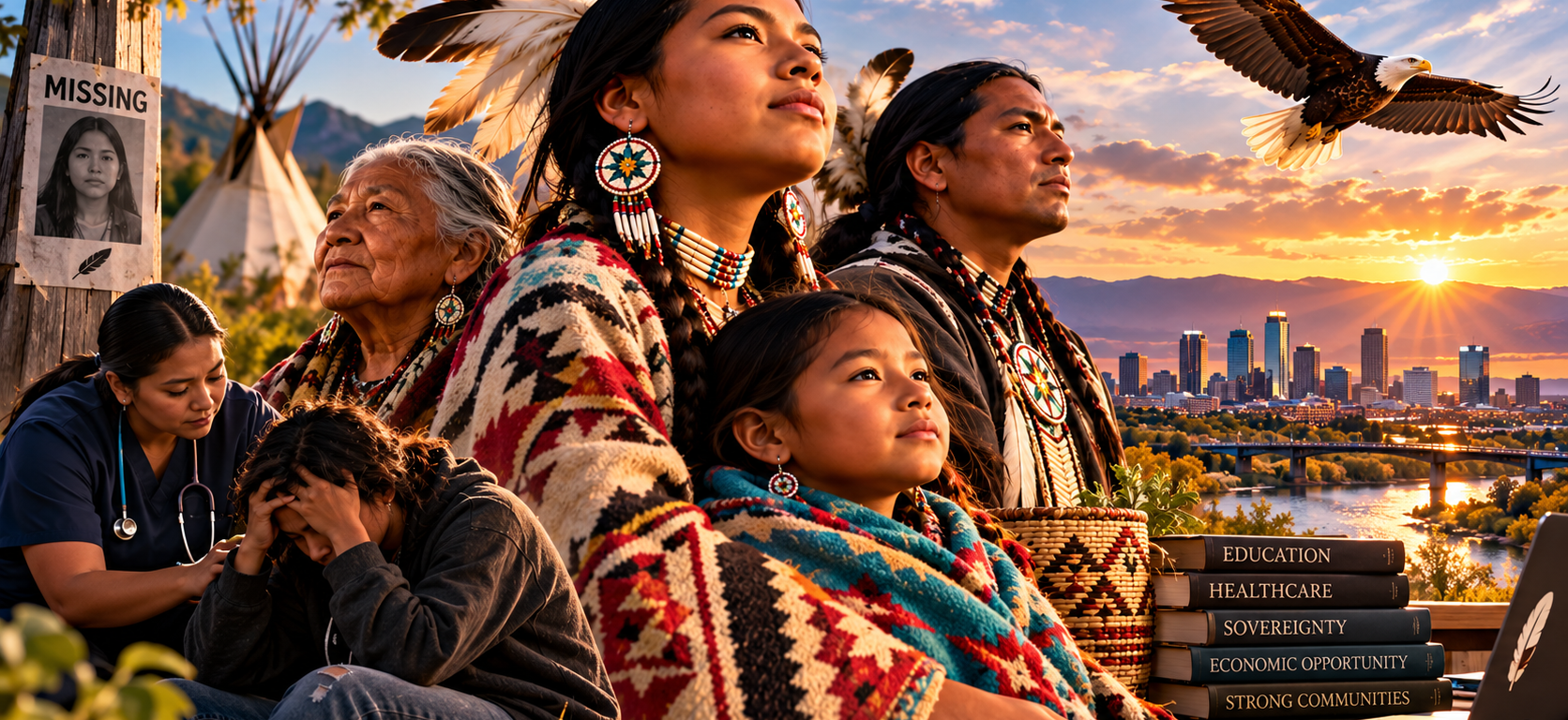
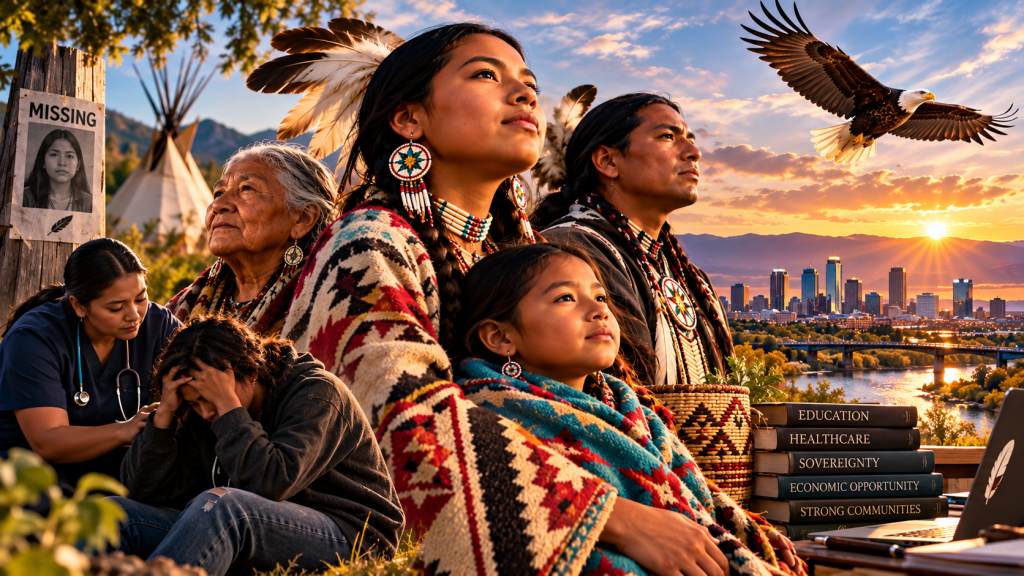
Every November, America remembers we exist.
Our photographs appear in classrooms. Our dances are celebrated, our beadwork admired, and our history briefly finds its way into conversations that rarely happen the other eleven months.
And I wonder, when December comes, what changes?
I am proud to be Kiowa, Cherokee, and Arapaho. Proud of the languages, traditions, and people who refused to disappear, even when this country tried to erase them.
But I struggle with the contradiction of celebrating our resilience while overlooking the circumstances that continue to demand it.
Our ancestors were removed, murdered, and stripped of their homelands. Children were punished for speaking their languages. Entire generations were forced to rebuild lives from what remained.
And yet, we are still here.
But surviving should never have been the measure of our success.
According to the U.S. Census Bureau, nearly one in five American Indian and Alaska Native people lived in poverty in 2024 [1]. The Centers for Disease Control and Prevention reports that the 2024 suicide rate for non-Hispanic American Indian and Alaska Native people was 22.5 deaths per 100,000, compared with approximately 14 nationally [2]. As of June 2026, approximately 1,485 Native people were listed as actively missing in the FBI’s national database, according to the Department of the Interior [3].
Those numbers represent families struggling to eat, parents burying children, and relatives desperately searching for answers.
I’ve spent years working with tribal nations and families in crisis. I’ve seen people fight through systems that were supposed to help them, only to find another closed door.
Our communities need more than recognition. We need accessible mental healthcare, stronger responses to missing and murdered Indigenous people, investment in tribal economies, and opportunities for our children to build lives beyond survival.
November should be more than a reminder of what was taken from us. It should be a reminder of what we have every right to expect for the generations coming behind us. Safe communities. Healthy families. Strong tribal governments. The freedom to speak our languages, practice our traditions, and build prosperity on our own terms.
These are not unreasonable expectations. They are the foundations of a future our ancestors fought to make possible.
And we must acknowledge what our people are accomplishing. Across Indian Country, our nations are reclaiming languages, strengthening sovereignty, creating businesses, and shaping futures that generations before us could only dream of.
We are not a people frozen in history. We are living nations, with voices, knowledge, and the determination to decide what comes next.
So celebrate with us this November. Attend our powwows. Support Native artists. Listen to our elders. Learn whose land you stand on.
But when the music stops, don’t let your concern stop with it.
Our heritage is not a thirty-day exhibit. Our struggles do not disappear December 1st, and neither do we.
We are still here. And thirty days will never be enough.
Sources
[1] U.S. Census Bureau. (2024). American Community Survey, 1-Year Estimates, Table C17001C: Poverty Status in the Past 12 Months (American Indian and Alaska Native Alone).
https://data.census.gov/table/ACSDT1Y2024.C17001C
[2] Centers for Disease Control and Prevention. (2026). Suicide Data and Statistics. 2024 suicide rates by race and ethnicity.
https://www.cdc.gov/suicide/data/index.html
[3] U.S. Department of the Interior. (2026). Indian Country Missing and Murdered Indigenous Persons Crisis. FBI National Crime Information Center active missing-person records, June 2026.
https://www.doi.gov/ocl/indian-country-mmip-crisis
Discover more from Three-Fifths
Subscribe to get the latest posts sent to your email.


