
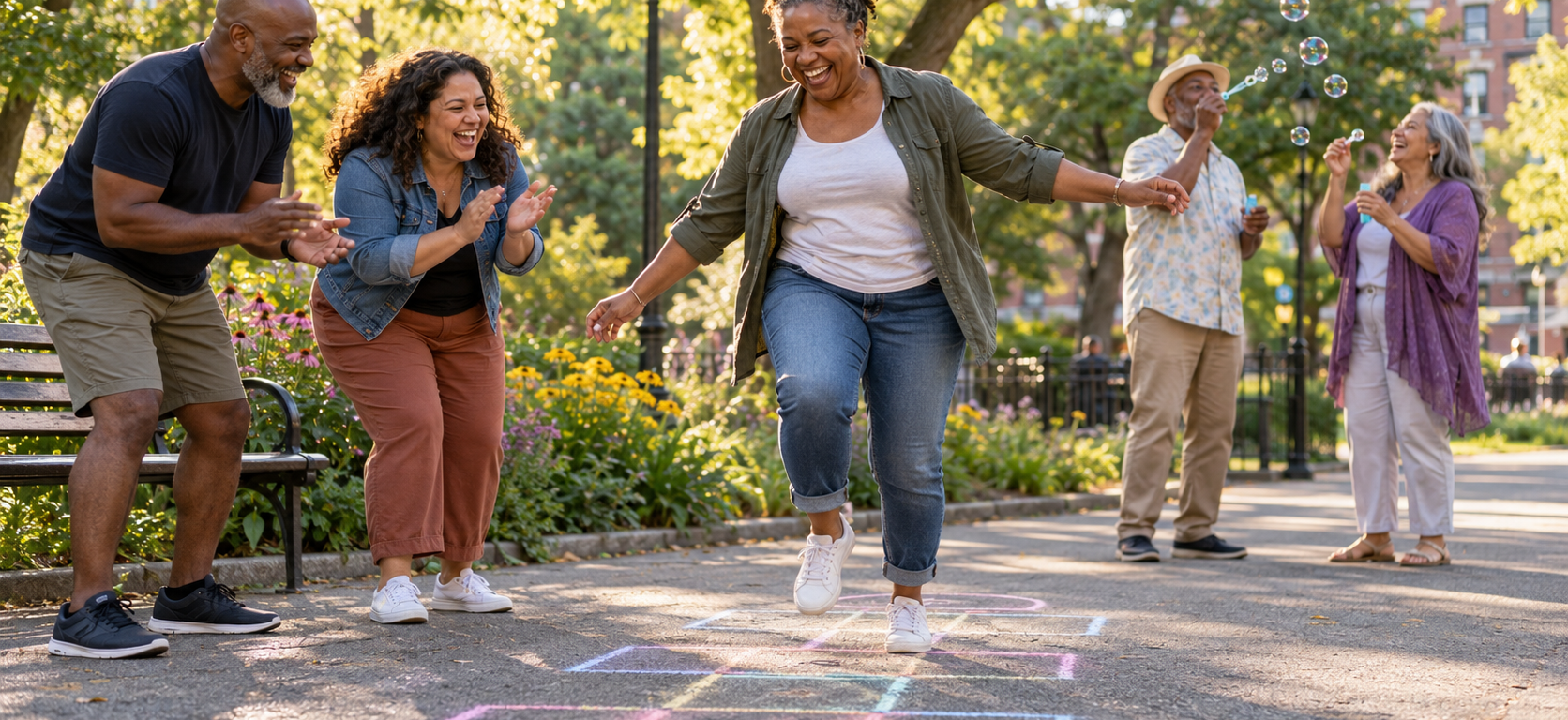
Exploring the neurobiology of play, the weight of adult life, and the pathways back to happiness.
Play is as natural to the human experience as breathing (Korin, Babis, & Ben-Shalom, 2023). People throughout human history, from every culture of the world, play (Ray, 2011). It starts immediately for all humans, and it happens naturally. No one teaches children to play-they naturally know how, starting in infancy, using play to learn vital information. Then, as they grow, they use it as a communication device and a way to create social bonds, playing with other children. Their play gets more complex when they start creating their own games and stories, interweaving their cultural experiences and personality into their play to practice social interactions. As Dr. Garry Landreth said, “birds fly, fish swim, and children play.” (Landreth, 2023)
So, when do we lose that drive? What factors impact that overwhelming desire and urge to play? Do we grow out of it? Is it suppressed? As we look around our world, we do, on occasion, see adults attempting to integrate play, rest, and leisure into their everyday lives (Schaefer, 2003). Systems designed specifically for adults leverage the use of play to improve performance. Educational institutions incorporate play in university classrooms, hoping to improve engagement with material (Lauricella & Edmunds, 2023). CEOs have “hacked” this system as well, noticing integrating play into the workplaces significantly improves employee morale and creates a positive office culture (Herold, 2022). However, after we leave a game night with friends or an enjoyable leisure activity, we say, “we should do this more often.” If play is so beneficial, why don’t we do it more?
The Neurology of Play
Humans have integrated play into daily living from the beginning, making it a part of our evolutionary process and survival. We have benefited from play, and research has repeatedly shown that we have a biological need and obligation to continue integrating it into our lives. (Brown, 2014)
Our current world has the same monotonous rhythm: wake up, get ready for work, go to work, work, leave work, make dinner, prepare for tomorrow’s workday, go to sleep early so you can wake up early the next day, wake up, and so on. Wash, rinse, repeat. And unfortunately, we fill any deviation from that schedule with stress, worry, and anxiety. Play provides relief from those activities, reducing cortisol levels in the brain and body (Trezza, Baarendse, Vanderschuren, 2010). Years of research have been dedicated to the exploration of using play reduces this stress and improves mental health including famous examples such as Patch Adams, the doctor whose revolutionary approach of using clowning and humor with his patients at a psychiatric hospital showed significant improvements (Clark, 1017).
Similarly, oxytocin, often called the “love hormone”, is also released during social play to increase bonding among people. Although it is called the love hormone, oxytocin also plays an important role in our platonic relationships, creating bonds between friends as well. When we play, oxytocin is released and we feel closer to those around us, helping us feel more connected to our social circle, reducing feelings of isolation and loneliness. (Panksepp, 2011, 2013)
Beyond the reduced stress and increased social bond, play is simply fun (Landreth, 2023). During play, our brains experience an increase in dopamine, the hormone associated with pleasure (Trezza, Baarendse, Vanderschuren, 2010). This is why children take part in it so much. How often are children told to “stop playing” when they are supposed to be quiet in class or sitting still during a long religious service? They are actively seeking stimulation through that rush of dopamine and play gives that to them. Adults are better able to resist that urge for a more suitable time. However, healthy forms of dopamine release are important to ensure we don’t go reaching for unhealthy sources such as “doom scrolling”, binging junk food, compulsive shopping or even more potentially dangerous activities such as substance use. (Trezza, Baarendse, Vanderschuren, 2010)
This dopamine release also allows play to increase learning. Researchers have long understood that children learn best through play, creating new neuropathways to practice different techniques and integrate new information. This neuroplasticity is not just present in children but adults as well. Professors in universities have reaped the benefits of using play to solidify information to adults for years, understanding the impact of play on knowledge integration. Play allows adults to practice new techniques in a low-risk environment (Clark, 2017).
One may ask, with this research that shows the importance of play, even in adulthood, why do we see such a lack of playfulness in our later years in life?
Lack of Play in Adulthood
We can’t address the “why don’t we play” without the recognition that play changes as we grow. Spontaneous, free play turns more organized and structured. Action figures are put away, and board games are pulled out. We no longer play “tag” but will engage in a round of pick-up basketball. Adults struggle when not provided a structure surrounding their play – they lose spontaneity and non-productive pieces that we often see if children play. Furthermore, we reduce the amount of time we dedicate to play, spontaneous or otherwise, resulting in reduced play overall. (Schaefer, 2003)
Play is like a muscle-if you don’t work it out, it is more challenging to regain that skill. As we grow older, we view other activities as more important and significant, choosing those activities over play, working out that “play muscle” less. Play is overshadowed by more “productive” things (Clark, 2017). One only feels as though they can take part in rest and relaxation once their work is done. And in the demanding environment of our current world, when is our work truly done? That history of play being seen as idle play goes back to the influence of Eurocentric Christianity in the 1600s, when children were viewed as innately sinful and adults were charged with guiding them towards good (Chudacoff, 2007; Ray, 2011). Play was seen as “idle” and a vehicle towards sin. Adults were encouraged to supervise and control play, tamping down children’s natural proclivity to be spontaneous and non-goal directive. This negative perception of idle time persists even today.
Similar to our concerns with productivity, adults are just busy people. And getting adults together is difficult. Unlike children who see their friends in school daily, adults tend to see close friends sparingly and only on special occasions or during carefully planned events. We spend the majority of our time with colleagues, and we tend to experience a culture of “professionalism” surrounding those relationships. Play takes vulnerability. That is difficult to achieve when one is worried about how a coworker perceives them. This social interest starts early – in adolescence, teens start worrying about this “cool factor” and how they are perceived (Korin, Babis, & Ben-Shalom, 2023). This significantly reduces their engagement in spontaneous play such as dress up, figures, and dolls, and is quickly replaced with more organized play such as sports, board games, music, and arts.
Another factor that affects play is accessibility – so many activities in our society are reserved for those with privilege and play is no exception. Those in marginalized communities get less opportunity to take part or are actively discouraged.
Play in Marginalized Communities
Marginalized communities experience significant barriers when it comes to play. From a systemic, purposeful reduction in access to play by oppressors to decreased opportunities due to life circumstances, play is less accessible for those in these communities (Lange, Bolt, Vos, Volker, 2024).
Marginalized communities throughout human history have found themselves at a disadvantage when it comes to leisure time and this is no accident from the viewpoint of the oppressors – when folks aren’t given an opportunity to rest and are forced to focus purely on survival, they are easier to control and remain oppressed (Li, Huang, Li, & Zhang, 2024). This inaccessibility is clear in all oppressed groups throughout the history of the world from the enslaved peoples of Ancient Rome to the American immigrants of 1900s.
A large factor in modern inaccessibility is the cost of play and leisure time. One may just initially think of the idea of purchasing supplies to play but it goes far beyond that. Play takes time, and time itself is expensive. The opportunity to take a “day off” is a foreign concept to those living paycheck to paycheck or without the luxury of paid time off. All time is carefully accounted for within the need to survive. And when one is trying to survive, there is no time for recreation. (Lange, Bolt, Vos, Volker, 2024).
Not only can time and cost be a factor but even if individuals of these communities had the time and money to take part in activities, they were still actively turned away. Marginalized communities have historically not been welcomed in leisure activities, whether from exorbitant costs or purely just restricted access such as membership restrictions as country clubs or social groups based on race, ethnicity, religion, sexuality, and more. It is important to point out, in some places these rules still exist but are unspoken and enforced in other ways. (Shinew, Floyd, & Parry, 2004)
Last comes from a factor of pure physical safety. For particular members of marginalized communities, particularly our Black and Brown children, playing in public spaces becomes unsafe in early adolescence. They are targeted in the streets while trying to enjoy the community and we have countless new stories that prove this. As they grow into adulthood, they are forced to be vigilant of where or how they play to ensure personal safety. (Pinckney, Outley, Brown, & Theriault, 2019)
Although play tends to be more difficult for those in marginalized communities, there is also an increased richness and exceptionality that comes with the play created within these groups as they find both physical and emotional safety together as a unit.
The opportunity to play within one’s community may be one of the most important concepts of all. As previously mentioned, play connects us as people. There is a plethora of literature that supports how play can reduce loneliness and isolation among those in a similar group to one another. Those who are consistently feeling “othered” are finally able to be in community with those they can relate to. Additionally, those within the community tend to have shared play activities and behaviors, having similar traditions and cultural experiences. Playing within a person’s “cultural language” provides an improved experience. (Shinew, Floyd, & Parry, 2004)
How to Bring More Play into Your Life
In my work as a play therapist, adults come to me asking how they can bring more happiness and spontaneity back into their lives. Helping people reconnect with that “inner child” is one of my greatest joys. The key, though, is learning to see the world with a sense of child‑like wonder again. And if there’s one thing children do not enjoy, it’s chores. So, the practices below aren’t meant to feel like tasks on a wellness checklist. They’re gentle shifts in attitude — small ways of approaching your day that open the door to curiosity, playfulness, and delight.
1. Return to your roots: I always encourage folks to go back to “that toy” they enjoyed as a child as their first step. Think about what that toy was. Remember the hours you spent playing with it. Or think of the toy you always wanted but were never able to get. And, sometimes, it’s buying the toy for yourself – because you deserve it. Allowing yourself to experience playing through your past often brings back that part of ourselves.
2. Be bored: Play and creativity are closely linked. Creativity significantly increases when we provide space for it within our own minds. Mindless scrolling on our phones or filling every moment of our days with being “productive” will negatively affect our ability to be innovative and spontaneous. We tend to reach for our phones during that boring time while we are waiting for the technician to change our tire or waiting for the nurse to call us back to the exam room. Allowing yourself to be bored allows your mind the space to wander and play.
3. Take the detour: Sometimes we go from A to B and can think of all the reasons not to stop. “I’ll be late” or “I really need to get home and finish the dishes”. Allowing yourself to stop at that bookstore you always drive by but never stop in. Or stopping in that vintage antique store. Or that new clothing store that opened in your neighborhood. Giving in to the urge to “detour” can do wonders for our sense of adventure.
4. Find a playmate: Often our biggest issue with play is we have no one to play with! Think of the times we sat on the front porch, waiting for our friends to come home so we had someone else to hang out with. Find someone who will engage in leisure time with you.
5. Do the thing, no matter how silly you feel: You see the kids go to the trampoline park and think “that looks fun, but what are people going to think about the 50-year-old who goes jumping”. Or you want to learn the latest dance craze on social media. Or you want to paint on a canvas. But that little voice tells you that you’re too old or people will judge you. Working through those feelings, even with the smallest step, can build your confidence and heal that inner child in ways you never knew were possible.
Conclusion
Play is such a vital part of our human existence that the United Nations includes it in the Rights of the Child. Article 31 states that children have the right to engage in play and recreational activities. Yet as we grow, that importance is overshadowed by responsibilities, productivity, and the pressure to “keep going.” The truth is that rest, leisure, and play are not luxuries — they are necessities for a regulated nervous system, healthy relationships, and a meaningful life.
Reclaiming play in adulthood is an act of resistance against burnout culture and oppression. It’s a commitment to your own humanity and inner child. So let this be your invitation: choose one small moment this week to follow curiosity, to pause, to wander, or to delight. Protect your playfulness fiercely — and encourage the community around you to do the same.

References
Brown, S. (2014). Consequences of play deprivation. Scholarpedia, 9, 30449.
Chudacoff, H. (2007). Children at play: An American history. University Press.
Clark, C. (2017). Play and wellbeing. Routledge.
Herold, K. (2022). It pays to play: How play improves business culture. Lioncrest.
Korin, O., Babis, D., & Ben-Shalom (2023). A lifetime of play: Group medical clowning with older adults. Health & Social Care in the Community
Landreth, G. L. (2023). Play therapy: The art of the relationship (4th ed.). Routledge.
Lange, S. Bolt, G. Vos, S. Volker, B. (2024). Inclusion of the marginalized: The case of sport participation. Journal of Global Sport Management 10(3), 431-463.
Lauricella, S., & Edmunds, T. (2023). Ludic pedagogy: A seriously fun way to teach and learn. Rowman & Littlefield.
Li, Y., Huang, Y., Li, R., & Zhang, K. (2024). Historical redlining and park use during the COVID-19 pandemic: Evidence from big mobility data. Journal of Exposure Science & Environmental Epidemiology, 34(3).
Panksepp, J. (2011). Cross-species affective neuroscience decoding of the primal affective experiences of humans and related animals. PLoS One 6.
Panksepp, J., & Panksepp, J. B. (2013). Toward a cross-species understanding of empathy. Trends in Neurosciences, 36(8), 489-496.
Pinckney, H. P. IV, Outley, C., Brown, A., & Theriault, D. (2018). Playing while Black. Leisure Sciences, 40(7), 675-685.
Ray, D. (2011). Advanced play therapy. Routledge.
Schaefer, C. E. (2003). Play therapy with adults. Wiley.
Shinew, K. J., Floyd, M. F., Parry, D. (2004). Understanding the relationship between race and leisure activities and constraints: Exploring an alternative framework. Leisure Sciences, 26, 181-199.
Trezza, V., Baarendse, P. J. J., & Vanderschuren, L. J. M. J. (2010). The pleasures of play: Pharmacological insights into social reward mechanisms. Trends Pharmacological Science, 31(10), 463-469.
Discover more from Three-Fifths
Subscribe to get the latest posts sent to your email.

