
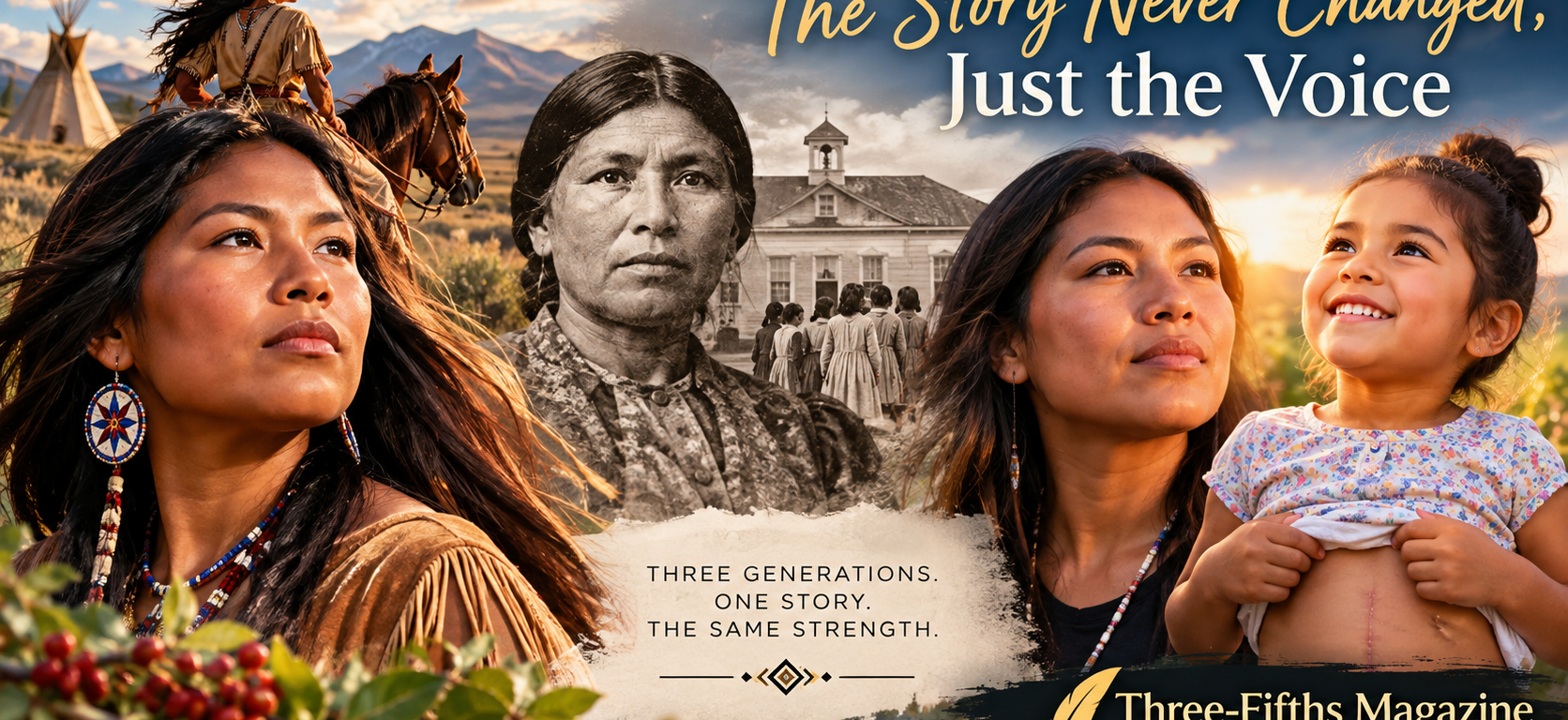
There are stories we inherit before we understand what they mean. They live in the names we carry, what our grandparents taught us, and sometimes in what they never had words to say.
One of those stories begins with an Arapaho woman named Bent Mouth.
History tells us that many generations ago, Bent Mouth was captured by a Ute war party while she and her husband were gathering berries to season dried meat. She was taken from her people and forced into a life she did not choose. She learned the Ute language and ways, but she did not forget who she was or where she came from. When she escaped, she found the fastest horse she could and rode through the night and into the next day, trying to get home.
Eventually, she encountered a French pioneer named Henry North, who helped hide her and helped her continue toward the Arapaho people. According to history, Bent Mouth and Henry North later had a daughter, Julia North. Julia became the mother of Ella Thunder Miles.
Ella was taken as a little girl to Darlington boarding school. Spoken history says she was punished for speaking Arapaho. Her mouth was washed with soap.
She was speaking the language of her family, carrying something handed down to her, and someone tried to teach her to be ashamed of it.
The National Park Service documents that Native children in the federal boarding school system were removed from their families and communities and subjected to policies intended to strip away their languages, religions, and cultures. At schools across the system, Native children were often prohibited from speaking their languages, and punishment was used to enforce those rules.
Captain Richard Henry Pratt, founder of the Carlisle Indian Industrial School, expressed the philosophy behind this system in an 1892 speech: “Kill the Indian in him, and save the man.”
Ella did not need an explanation. She lived the reality behind those words.
I knew that little girl as NeiWoo, the word for Grandma in Arapaho.
I remember crying as a child because I wanted to visit her. I remember gathering around her to pray when she passed. Some memories never leave you.
And then there is my Ella.
I named my daughter after my grandmother.
Ella came into this world eight weeks early. She was born with her intestines separated and could not pass what she was taking in. My baby went to the NICU.
She was so small, and she was fighting. I knew I was looking at a miracle.
Today, if you ask her what is on her tummy, she will tell you, “My miracle scar.”
She does not remember what happened to her. She talks about what was left behind after something she survived.
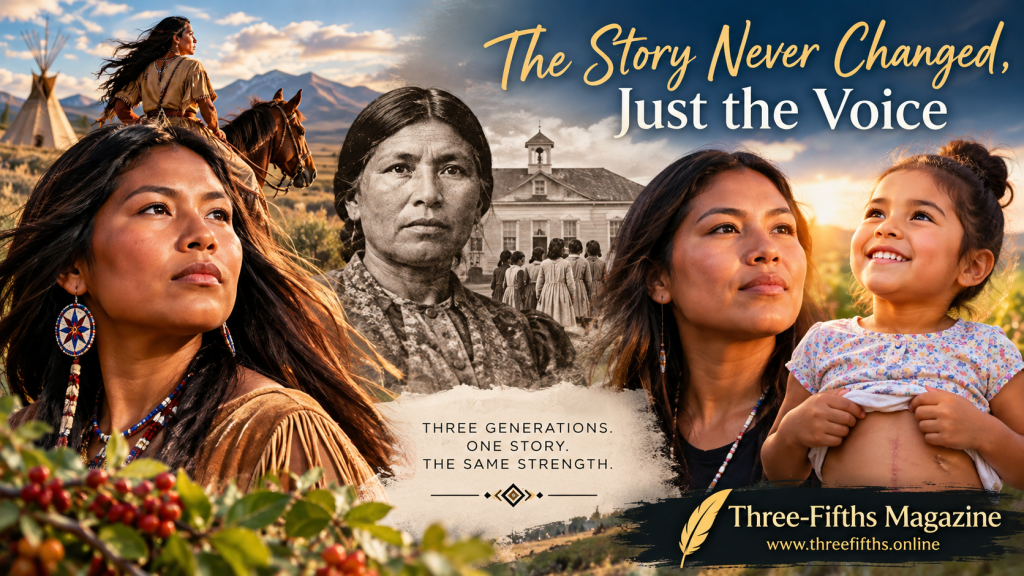
When I think about Bent Mouth, my grandmother Ella, and my daughter Ella, I see a story carried from one generation to the next. Bent Mouth fought her way back to her people. Through her daughter Julia, that family line led to my grandmother. My grandmother was taken from hers and punished for speaking the language that connected her to home. Years later, I gave her name to my daughter, who came into this world fighting for her life.
Three women, separated by generations, each carrying a different part of the same story.
I do not believe names are always just names. Sometimes they are reminders, promises, or something we carry forward without realizing it.
The story never changed. Just the voice.
Maybe that is why truth has become so important to me. Telling the truth is not always comfortable. Sometimes it means admitting that something hurt or walking away from a place where belonging requires you to stay quiet.
There is a difference between keeping the peace and keeping the truth quiet.
For me, being anchored in truth means knowing that what is true does not become less true simply because it is difficult to hear. Jesus said in John 8:32, “And you will know the truth, and the truth will set you free.” I think about that freedom differently when I look at the women in my family. Sometimes freedom is finding your way home. Sometimes it is holding onto your identity when someone tries to take it from you. And sometimes it is finally finding your voice and being willing to use it.
That is one reason Three-Fifths matters to me. It gives people room to tell the truth of what they have lived and creates space for history, faith, culture, justice, and perspectives that may not always be heard. Listening does not require us to have lived someone else’s experience. Sometimes it simply requires us to be willing to hear it.
A story can change a life. I know because stories have changed mine.
Bent Mouth’s story reminds me that courage can look like riding toward freedom. My grandmother reminds me what it means to hold onto who you are. My daughter reminds me that even hard beginnings can become something beautiful.
I think about my daughter’s “miracle scar,” my grandmother’s hand in mine, and the Arapaho woman whose life made mine possible.
Maybe being anchored in truth means knowing what I have been given, what I have survived, and what I carry forward.
Three-Fifths gives me a place to help tell stories that refuse to disappear.
Continue to Grow with us as we grow as A Voice of Clarity
Sources & Further Reading
Family History Manuscript
Personal family history documenting Bent Mouth, Henry North, Julia North, Ella Thunder Miles, and subsequent generations.
The Oklahoman, “Ella Thunder Miles Non-Na-Say (Lead By the Hand) Millsap,” Dec. 3, 1991
Obituary documenting Ella Thunder Miles’ family relationships and life history.
National Park Service, Carlisle Federal Indian Boarding School National Monument
Historical context on federal Indian boarding schools, assimilation policies, and suppression of Native languages and cultures.
The Holy Bible, Proverbs 12:19, English Standard Version
Discover more from Three-Fifths
Subscribe to get the latest posts sent to your email.


