
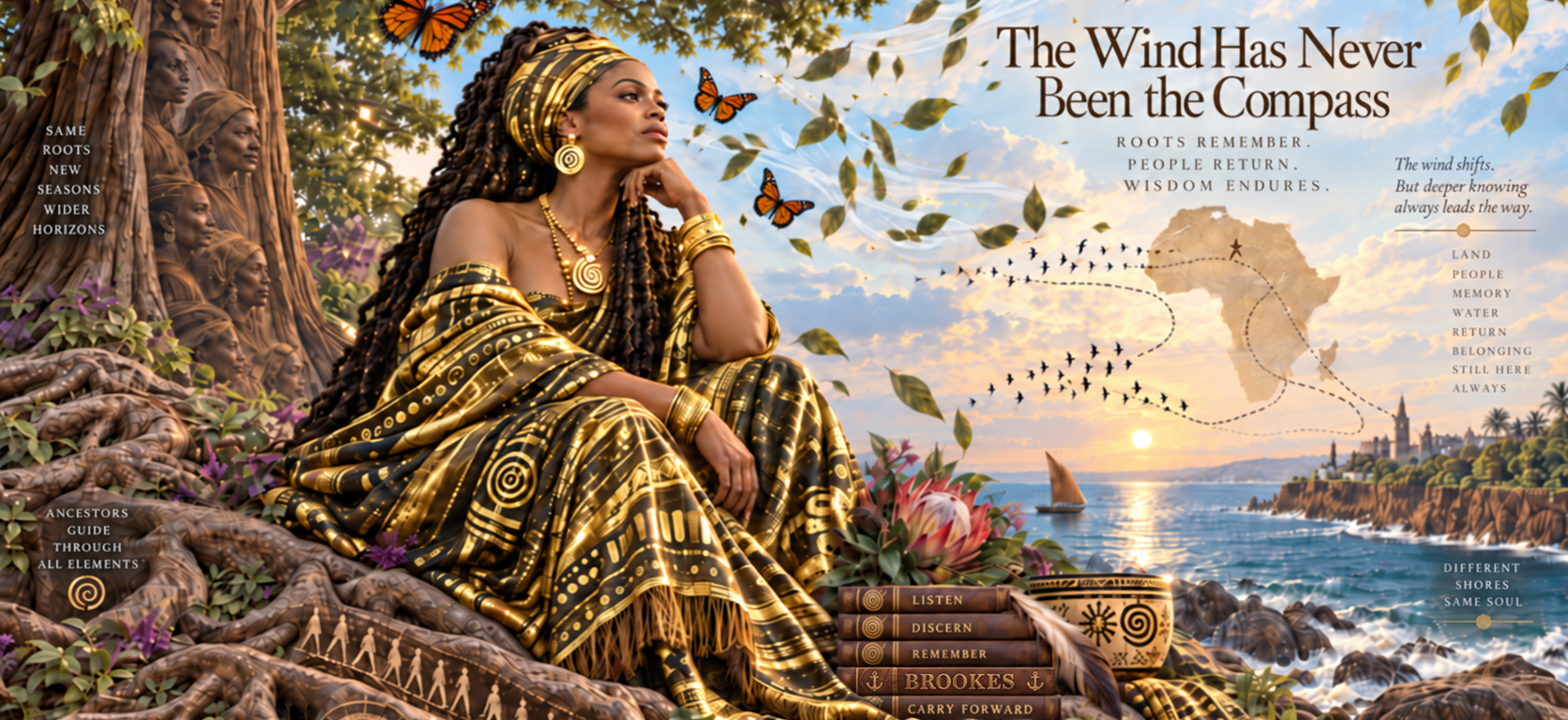
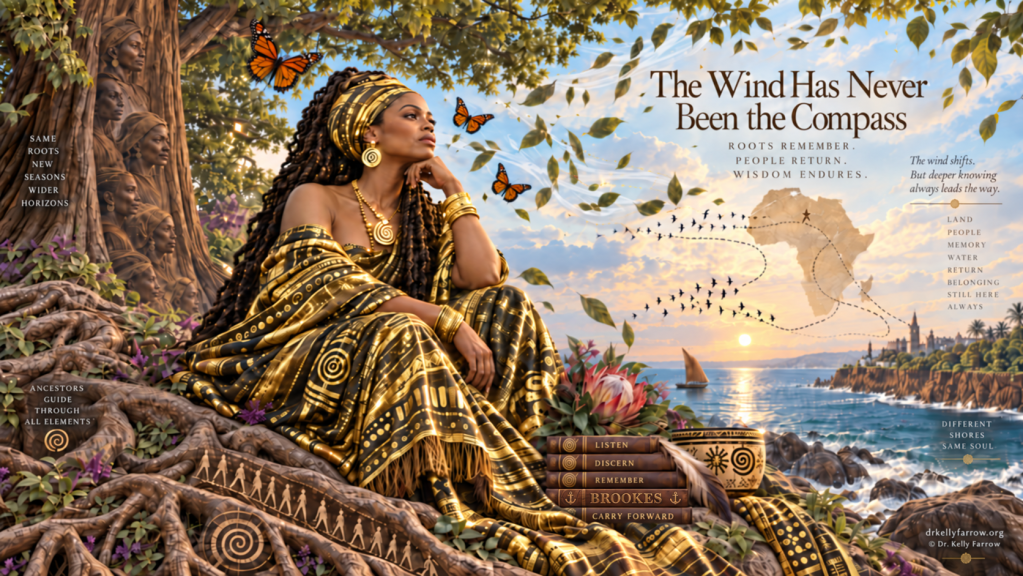
Every autumn, the winds begin speaking in another register. Leaves loosen. Branches show their architecture. What once looked full and green begins to reveal what has been holding it all along. I keep thinking about the Monarch Butterfly, its wing thin and flame marked, moving through air that could easily overwhelm it. Yet there is wisdom in that small body, a migratory knowing deeper than muscle. The Monarch does not command the wind. It reads it. It lets the air become passage without surrendering its direction.
The miracle is that no single Monarch carries the whole migratory cycle alone. The migration is generational. One generation begins what another must continue. Monarchs move north through successive generations, laying eggs along the way so their offspring can take up the next stretch of the route toward the northern United States and Canada. Later in the year, a different migratory generation begins the long return south, living far longer than the ordinary few weeks of most Monarchs so it can complete what its body was born knowing. The elders do not finish everything. They carry what they can, release what must continue, and leave the route alive in those who come after them. The Monarch gives me a way to think about how my people remain oriented when the conditions around us change. The wind may shift, but some forms of knowing travel deeper than weather. They orient the body. They preserve direction. They allow one generation to carry forward what another could not complete. Blackness has a knowing. Not as racial instinct or biological inheritance, but as diasporic inheritance carried through body, story, ritual, relationship, spiritual memory, and the practices by which a people have learned to remain themselves.
It is moving, generational, rooted in our ancestors and carried through the Diaspora, much like the Monarch’s journey of knowing and movement.
Root Memory Across Rupture and Relationship
The Monarch journey hovers like ancestral memory to me. Not memory as nostalgia, but memory as direction. Memory as pattern. Memory as an inheritance carried in the body before language has time to explain it. I have come to think of this as root memory, an embodied orientation that helps a people recognize who they are and where they are being called when circumstances begin to shift. Root memory is not genetic destiny. It survives through bodies, practices, relationships, stories, spiritual inheritance, and the ways a people teach one another how to remain themselves across generations.
The Monarch teaches us that what endures is not always announced. At times, it is embedded. It lives in the wing, the nerve, the route, the timing, the return. Something delicate can still be entrusted with a journey too large for one lifetime. There is resonance here with African diasporic people, but I want to be precise. The Middle Passage was not a migration. It was forced removal, rupture, captivity, and violence. Our ancestors did not choose the crossing. The ancestors were torn from continent, homeland, language, and kin. Many did not make it back to the continent, to the soil, to the ancestral geography that first held their breath.
Yet rupture did not erase transmission.
Their descendants have carried what they could not complete. We have crossed waters they were forced across. We have touched land they remembered in fragments. What survived did not always survive intact, but something traveled. Memory traveled. Song floated. Prayer rolled over waves. Story migrated. The body retained what history worked to sever. I have stood in Ghana, in the flow of the Last Bath, and felt something in my body recognize what history tried to sever, because story, prayer, song, memory have lived on in me. I am the next migration of the Monarch’s journey; I am the descendant who carries farther the path the elders could not complete.
The Monarch teaches continuation. The Sequoia teaches relationship.
The Sequoia tree offers another witness. Above ground, each tree appears singular, ancient, towering, and deeply rooted. Beneath the surface, its roots spread outward, reaching into the same ground as the trees around it. The roots teach another kind of depth, not only downward reaching, but relation, reach, and connection.
The strength of the Sequoia is never only in its height, just as the strength of the forest is never only in the magnificence of a single tree. Beneath what the eye can see, roots spread outward through shared soil, reaching into ground inhabited by other roots, shaped by the same water, weather, and earth. The Sequoia may rise individually, but it rises within relationship. The forest teaches us that rootedness is not isolation. It is belonging deep enough for individual strength to be held within communal ground. Root memory works that way. It is not the private possession of a solitary voice, but a living inheritance carried through relationship, memory touching memory, elder reaching descendant, witness strengthening witness, one generation’s knowing entering the soil from which another generation finds the courage to rise.
Diasporic root memory carries that same relational knowing across rupture, distance, water, language, and generations. A people dispersed from ancestral soil do not become rootless simply because the ground beneath them has changed. Memory endures. Ritual travels. Story survives. Song crosses water. The body recognizes what history tried to scatter. Even across oceans and centuries, something remains in motion. What one generation cannot hold alone, another receives through relationship, memory, and the living web of a people who keep finding one another across time and distance.
Within Wind Shear, Beyond Drift
Rootedness, then, is not the absence of movement. The Sequoia holds through relationship. The Monarch moves through inherited orientation. Each offers a different language for surviving changing conditions without surrendering the deeper intelligence that gives direction. Wind shear names the moment when the surrounding air changes in speed or direction, altering the conditions through which a body must move. Drift begins when those surrounding forces start determining where that body is carried. There is something here for human life, particularly for those of us whose histories have required us to remain ourselves within atmospheres repeatedly organized to dislocate, rename, and redirect us.
The question is not whether we will feel the shift. We will. Bodies feel atmosphere. Communities feel atmosphere. Generations feel atmosphere. The deeper question is whether the conditions surrounding us will become the authority by which we locate ourselves. Root memory offers another possibility. It allows us to register what is changing without becoming indistinguishable from the change, to remain responsive without becoming unmoored.
That feels like the work of being anchored.
Not frozen. Not hardened. Not unmoved by the world. Anchored.
Rooted enough to discern what is shifting, what is passing, what is performance, and what is trying to call us home. This is where root memory becomes more than recollection. It becomes discernment.
My work on embodied discernment begins here, in the understanding that discernment does not happen in the mind alone. The body takes part. It registers tension, release, warning, resonance, memory, and recognition before language catches up. Embodied discernment asks us to attend to what the flesh is telling us when conditions shift, to notice what tightens, what settles, what opens, what resists, and what quietly knows. The body becomes one of the places where truth is tested and revealed, not apart from spirit or intellect, but in conversation with both.
In a season when headlines churn and public voices clamor for our fear, information alone cannot tell us who we are. We need an orientation deeper than the noise, a knowing capable of recognizing when the language around us is trying to rename us, distort us, or make us strangers to ourselves.
My participation in SAND’s Liberation Psychology cohort is sharpening this question, particularly the relationship among root, memory, embodiment, and the ways people survive systems designed to distort their sense of self. Liberation Psychology is pressing me to consider what happens when domination reaches beyond institutions and enters the interior life, shaping what people have been taught to believe about themselves, their bodies, and their own knowing. My National Geographic field devotions approach the question from another direction. Wildlife keeps returning me to creation as one of my sacred texts, a world in which knowing often precedes explanation. Alongside my work in embodied discernment, I find myself attending more closely to migration, animal knowing, wing, pattern, instinct, and return. Together they keep drawing me toward a language older than human systems, a sacred literacy carried in body, movement, relationship, and the created world itself.
In The Crow Sees Me, I named this as sacred literacy, the kind that arrives before the page and keeps speaking through creation. I wrote, “There is a literacy older than the page.”
That sentence has become a bridge for me. It holds the body and the route, the current and the root, the ancestral intelligence that moves before language has arranged itself into explanation.
Nature keeps reminding me that fragile does not mean powerless. A Monarch’s wing can look too delicate to matter, yet it belongs to a movement larger than itself. A Sequoia can rise toward heaven while much of what sustains it remains beyond the naked eye.
The world keeps teaching me that what endures does not always arrive loudly. It can be patterned. Feathered. Rooted. Carried quietly in the body until the season calls it forward.
In When Memory Knelt, I wrote, “Memory moves.” I still believe that.
So does Spirit. So does language. Even what has been buried keeps finding ways to travel through current, soil, migration, rhythm, body, and breath. What one generation receives, another may have to carry farther. What one life cannot finish, another may recognize as direction.
The Root Remains
That is why Three Fifths Magazine matters in this hour. It is one expression of the kind of root system I am describing, a place where Black thought, witness, grief, joy, clarity, and sacred imagination can gather without being flattened into reaction. It gives us room to encounter shifting conditions without allowing those conditions to become our compass. It offers historical perspective when the present tries to pretend it invented itself and spiritual discernment when volume masquerades as wisdom. The work is larger than any publication. Still, publications can become part of the ecosystem that keeps memory connected to public witness, clarity connected to community, and rooted voices in conversation with one another.
The winds are shifting. They always do. However, not every shift is a threat, and not every storm is a prophecy. Some things bend because they are alive. Some things migrate because memory has given them direction. Some things remain because their roots know what the season has not yet revealed. The Monarch does not finish the journey in one body, but the journey continues. Many of our ancestors were denied the possibility of returning to the continent, but what they carried did not disappear with them.
The route did not die because one generation fell. The knowing passed through blood, breath, prayer, grief, song, story, stubborn aliveness, and became deeply rooted in Joy.
Perhaps, that is what rootedness asks of us.
Not immobility.
Not refusal to change.
Not pretending the wind is not blowing.
It asks us to know what must move and what must remain.
What is rooted may be covered for a time. It may be shouted over.
It may be tested by weather. But the root remains.

Discover more from Three-Fifths
Subscribe to get the latest posts sent to your email.

