

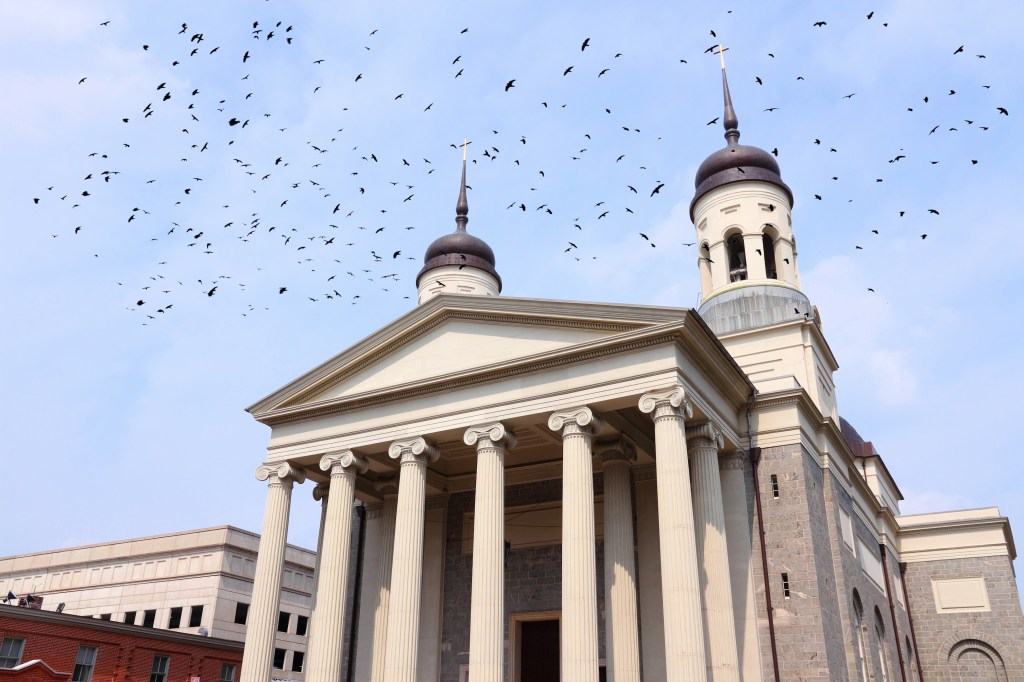
B-More “Pigeons”
From Toronto and New York, to London and Venice, and onto Cape Town and Mumbai, pigeons are nearly omnipresent in many of the world’s urban centers. However, crows are the pigeons of Baltimore and surrounding areas. When you live near Baltimore, it doesn’t take long to observe that crows rarely fly in a straight line. They usually don’t fly solo for long either.
Crows tend to travel in flocks called “mobs” or “murders.” Crows have good memories and seem to communicate their learned experiences to their mobs, so they’re not your average bird brains. This shared memory helps them to find food efficiently, avoid danger, fend off potential predators, and sometimes exact revenge.
Crows are also known for their curiosity, which is one of the reasons for their non-linear flights. They are checking out unusual sights and sounds. They collect discarded and sometimes unguarded human artifacts. Is that object a potential food source, or nesting material, or is it just entertaining?
The journey of meaning-making and community building has been non-linear for Black people in America. We’ve been on an eclectic exploration of philosophy, theology, politics, the arts and sciences. We know all those disciplines have been weaponized against us – but we beat those swords into plowshares and the whole world tries to mimic us. We repurpose the instruments, restructure the syntax, and redefine the denotation. We encode cultural memory in song, sermon, and slang. Then we recode it all in response to the linguistic larceny known as cultural appropriation.
When you’re born Black in America you either have to examine theology as “an inspired, inventive, imaginative, and improvisational act of composition that brings spirituality into conversation with the whole of life” – or answer “Yes” to William R. Jones’s question Is God a White Racist? and surrender all to the yoke of MAGAvangelicalism – or throw Christianity out with the baptismal water.
Drunk on 2nd Gen Theopoetics
My work flows from the intersection of history, agitation, and hope as articulated in pieces like MLK and Me: A Haiku Litany, We Should’ve Listened to Malcolm, and Linguistic Revolution: the creative democratization of definitions. The goal is to have some fun while making the academy accessible to the masses outside the classes.
Accessibility is a key trait of the theological genesis story that I was birthed from. Here I will build on Dr. Olumwatomisin Olayinka Oredein’s introduction to Theopoetics in Color. This book confirmed my intuition that theopoetics “might merely be another name for that which marginalized voices have been saying and doing theology for decades – centuries, even” (Theopoetics in Color, 11)
I had been swirling, sniffing, and sipping the theopoetic wines of Stanley Hopper and Amos Wilder, Emily Dickenson and Mary Oliver, and many others. Suddenly, like the HNIC of the wedding party in John chapter two, I finally experienced a theoretical bouquet I could savor. I previously drank The Bottom: A Theopoetic of the Streets until drunk, but Dr. Charles Lattimore Howard was pouring out theopoetics in practice, more than theory.
Let’s get back to Oredein’s beginnings where she writes that theopoetics has “two genesis stories. . . The first has reactive origins in primarily White philosophical thought and liberal theology. Its thrust is relevance. The second has responsive origins in the cultural cues and theological ideologies of minority communities and their respective cultures. Its thrust is liberation” (Theopoetics in Color, p. 2-3).
Oredein says that one of the problems with the first kind of theopoetics, also referred to as “traditional” or “liberal” theopoetics, is that participation is “limited to process theology students and experts” (p. 5). In contrast, participants in liberative theopoetics “do not need theoretical or theological prowess or even a terminal degree to offer a rich contribution. . . It is accessible because it is done everywhere” (Theopoetics in Color, p. 7).
Ethnic versus the United Status Quos of Theopoetics?
A second problem Oredein identified is related to the first. In order for the liberative theopoetics of minoritized people to receive recognition, “we have had to unnecessarily perform the appropriate tricks of White Western canon memorization and expertise in order to even begin thinking and talking about the discourses that are close to our bodies and mean something to us” (Theopoetics in Color, p. 10).
Even James Cone lamented that he had to quote Europeans to prove he was “academically informed in theology and philosophy” in the development of Black Theology. Although in a theopoetic twist, he bragged that “I made them say what I wanted them to say” (Said I Wasn’t Gonna Tell Nobody, 17).
To study outside of the White Western canon is similar to when Black folks look for hair products in retail stores. They (not we, since I have a much simpler hairstyle now that only requires a razor) must find them in the “ethnic” section. Similar “ethnic” signage is found in many grocery stores for Latin American, Asian, African, or Caribbean foods. The same goes for categories in a lot of bookstores.
These categories are helpful when it comes to finding what you need. However, the practice implies that food and hair products not labeled “ethnic” are the norm, the standard, the status quos. Those foods, or hair products, or books not labeled according to specific ethnicities are considered universal, objective, or more importantly in the United States – they are American.
Ethnic studies are considered tangential, optional, elective – but rarely part of the academic core. Sometimes admired as exotic, yet denigrated as subjective. After a few short decades of celebration, ethnic studies are increasingly viewed as un-American. This is nothing new when it comes to literature. As Langston Hughes said, “We Negro writers, just by being black, have been on the blacklist all our lives. Censorship for us begins at the color line.”
Bootlegs and B-sides
To borrow from the vinyl age, the B-side of this reality is that mandatory recitation of the “White Western canon” enables Black folks to make artistic connections that the dominant culture finds surprising, sometimes shocking. We have to be versed on White culture, even though we have a culture of our own.
White America has the privilege of only listening to one side of the record and feeling like that’s the complete sonic spectrum. When the B-sides reach the consciousness of the general (White American) public, as began happening in the aftermath of George Floyd’s lynching, there’s always swift and severe censorship, disqualification, and demonization like we’re experiencing under the political and legal bludgeoning of “woke,” “CRT,” and “DEI.”
This is part of the meaning of Paul Laurence Dunbar’s “We Wear the Mask” and W.E.B. DuBois’s “double-consciousness.” This is what Marcus Garvey was referring to in his “Look for me in the whirlwind” speech when he said:
“They [White people] do not know what we are capable of. They do not know what we are thinking. They are thinking in terms of dreadnoughts, battleships, airplanes, submarines. You know what we’re thinking about?… That is our own private business.”
Of course, Garvey was demonized and deported after he built up the international circulation of the weekly Negro World to print runs of 200,000 and had folks flaunting their unapologetic Blackness. Maybe we should keep our best stuff on the bootleg market?
Converting the Colonial Christ and Canonizing Melanated Saints
Mr. Garvey was an example of what Dr. Oredein meant when she wrote, “another theopoetic angle has always coexisted from the space of imagination” (Theopoetics in Color, 6). A recurring theme of Garvey’s book, Message to the People, was that Black people need to look at God with new spectacles as well as canonize our own saints. He advocated the revision of history, psychology, theology and every other intellectual discipline so we can highlight our accomplishments and purpose in this world, while refuting any notions of inferiority.
Oredein asked, “Who gets to tell us about the veracity of our God-framing” (Theopoetics in Color, p. 12)? This question is essential for Black existence. We’ve been engaged in word wars, narrative naumachiae (ancient Roman naval battles), for almost 600 years since Pope Nicholas V wrote some bull called “Dum Diversas” in 1452. Ever since we were “stolen from Africa” and “brought to America,” Blacks have been “fighting on arrival, fighting for survival” (Bob Marley, Buffalo Soldiers).
The struggle hasn’t only been for the liberation, wellness, or longevity of our bodies – but for preserving and passing on that part of ourselves that elevates humans above the humus from which we were crafted. There were daily duels for dignity, using the sword of the spirituals. Black preachers wielded sermonic spears dipped in prophetic sarcasm on a weekly basis.
As if they were in written dialogue, Michael Harriot replies to Oredein’s question in Black AF History, 133: “Perhaps the best way to contextualize the contemporary Black tradition of faith is to realize that, for the most part, the new Black residents of America did not convert to Christianity or Islam; Christianity and Islam converted to African America, and morphed into new expressions of spirituality” that emphasized “the essential precepts of survival and resistance.” Michael Harriot, Black AF History, 133. To which, I imagine Oredein exclaiming, “Hallelujah!”
Rhetoric and Rifles
There were over 250 slave revolts in Colonial America and the antebellum United States, but freedom’s fight required more than muskets and machetes. Even when carnal weapons were used, they were preceded by spiritual arms training by preachers like Nat Turner, Denmark Vesey, and Gabriel Prosser. State-sponsored illiteracy couldn’t prevent Sojourner Truth or Harriet Tubman from becoming rhetorical masters at “pulling down” internal “strongholds” and “casting down arguments” that exalt themselves against God’s image-bearers (2 Corinthians 10:4).
The ancestors weren’t just tearing down; they were also building up. Like Nehemiah on the wall, they were equipped with tools along with their swords and spears. They were doing reconstruction, not just deconstruction – because there’s a season for both (Jeremiah 1:10 & Ecclesiastes 3:3).
As Patrick B. Reyes explains, they were “cultivating the inner life” in order to find “the space where we can dream of worlds not inhabited by colonization.” Reyes adds that “the building of interior worlds is no easier than building them in the material world” (Theopoetics in Color, 23).
It is this colorful, non-linear, eclectic, constructive flight that makes me appreciate the Three-Fifths community.

Discover more from Three-Fifths
Subscribe to get the latest posts sent to your email.


