
When I Realized Something Was Wrong
I struggled with depression, anxiety, and a dysregulated nervous system well into my early 40s—all while going to church faithfully, volunteering, and supporting others at home, at work, and serving in ministry.
It wasn’t until I began battling chronic migraines, a stomach ulcer, and high blood pressure that I realized I needed to pay serious attention to my emotional, spiritual, and mental health.
I had to become concerned with my soul—my life literally depended on it.
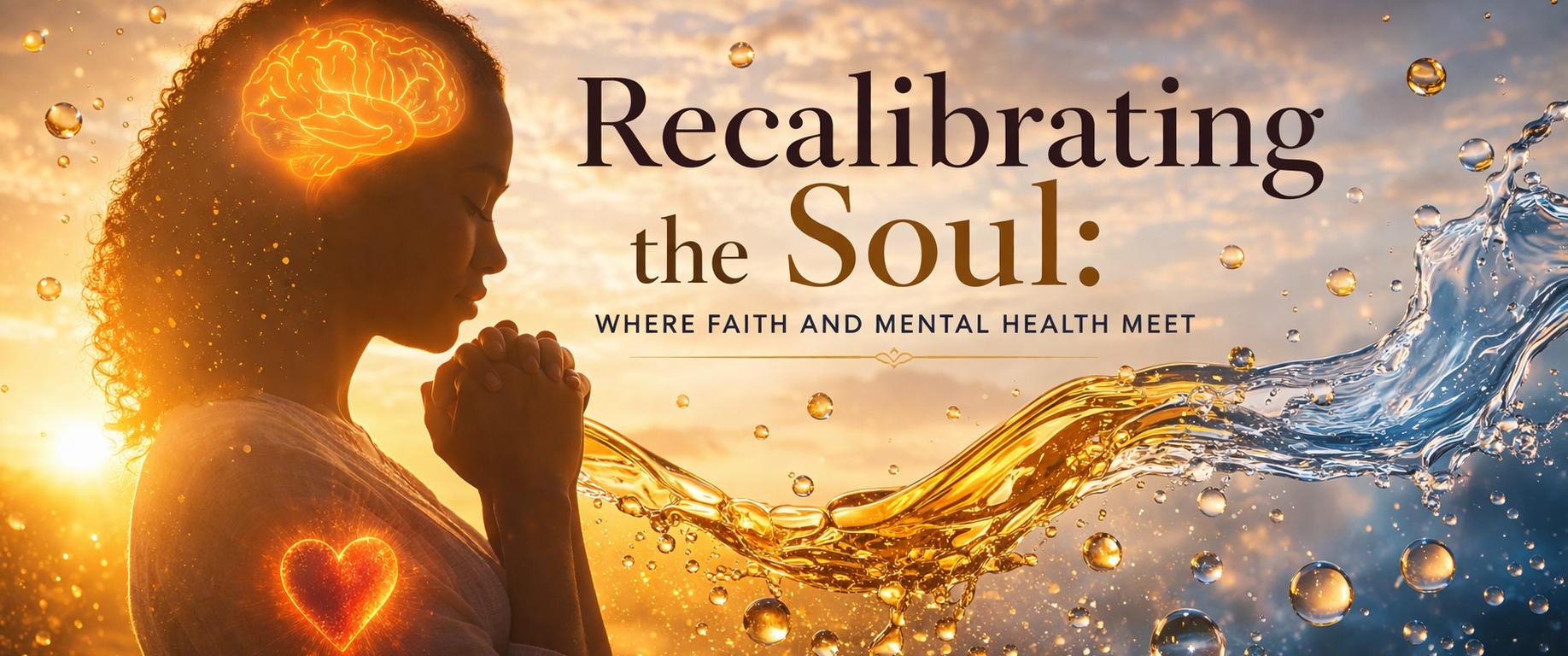
Recalibration for me meant looking at my whole self, which included my soul. Focusing on only one area led to a deficiency in another, which meant I had to find a way to integrate faith and mental health practices. However, in church culture, the two can often appear to be as opposite as oil and water.
The Oil and Water Problem
Did you know that it’s possible to get oil and water to mix? You may be skeptical, but if you use any kind of lotion or hand cream, you experience the miracle of what brings these two together: an emollient. This is how we get oil and water to mix and stay together for long periods of time.
You need an emollient.
Oil and water can only be mixed together if there is an emollient that will bind the two together.
Here’s how an emollient works: it has a lipophilic tail and a hydrophilic head. The hydrophilic head is drawn to the water like a magnet, while the lipophilic tail is drawn to the oil—almost like they are holding hands, binding the two together to form a stable solution, like a hand cream.
If you’ve ever baked a cake and forgot the eggs, your cake will most likely fall apart or crumble because the egg binds all the ingredients together—the mixture isn’t stable. My life was crumbling because I didn’t know how to align my faith with mental health practices.
Where Faith and Mental Health Finally Meet
So then the question we should be asking is: how do we get faith and mental health to hold hands? What binding agent will bring these worlds together?
Our soul is the common ground.
“Beloved, I wish above all things that thou mayest prosper and be in health, even as thy soul prospereth.” — 3 John 1:2
The binding agent that brings both together is our soul—our mind, will, and emotions.
Mental health, emotional health, and spiritual health must be aligned and in sync in order to achieve stability and balance. When I started seeing how important my mental health was in my faith, I knew I had to make some adjustments. I needed to recalibrate.
What Recalibration Really Means
The definition of recalibration is the process of realigning, adjusting, or restoring something back to its proper standard, balance, or intended function after it has become off-course or out of sync.
We must consider that every experience we’ve had up to this point in our lives has affected our minds and emotions.
With each experience, a memory is formed in our brain—one that we carry with us.
These experiences don’t just remain in our thoughts; they can also settle within our bodies and impact our body systems.
I discovered this after spending time in therapy. Many of us don’t realize that our minds and bodies are connected, and that when we are in a mental health challenge, it can affect our immune system—making us more susceptible to illness, inflammation, and physical discomfort.
I couldn’t understand why, when I was stressed and battling anxiety, I would often find myself fighting a cold, experiencing aches in my hands or knees, or dealing with an upset stomach.
But even after this, I still had a hard time bringing that “oil and water”—faith and mental health—together. So I started to do some research. I wanted to see how faith and mental health practices could support one another. Here’s what I discovered.
Faith and Mental Health in Practice
We begin by recognizing what both sides can agree on—and that is the importance of mental and emotional well-being.
Joshua 1:8 – Meditate on His truth day and night
→ Mental Health Practice: Mindfulness & Cognitive Focus
Philippians 4:8 – Fix your thoughts on what is true, noble, right, pure, lovely, and admirable
→ Mental Health Practice: Cognitive Reframing
Psalm 30:5; Psalm 126:5 – We may sow in tears, but reap joy in the morning
→ Mental Health Practice: Emotional Processing & Hope-Based Resilience
Romans 12:2 – Be transformed by the renewing of your mind
→ Mental Health Practice: Neuroplasticity & Thought Pattern Renewal
These are not just spiritual practices—they are also practices that support the renewal (recalibration) of the mind, emotional regulation, and overall well-being.
Both faith leaders and mental health professionals are concerned with the human soul—the binding agent.
Therapists and psychologists encourage positive thinking, emotional processing, and identifying root traumas and triggers.
Scripture speaks of renewing the mind, guarding our thoughts, and God searching the heart.
Creating Daily Alignment
When we prioritize spiritual practices like reading the Word, meditation, and prayer, we begin to ground our souls and restore our thought patterns back to their original standard.
Taking intentional moments to breathe deeply, we supply our brains with the oxygen needed to think clearly and regain focus.
A Needed Shift in Perspective
There has to be a shift in our thinking within our faith-based communities.
It is not one or the other. One of my close friends uses the phrase: “Both/And.”
Which means I can be an active member of my church, serve others, and see a therapist.
I can teach a sermon on Sunday morning and still be part of a grief counseling group.
I can have a deep relationship with my Creator and still struggle with fear in different seasons of my life.
I can weep at night, experience joy in the morning, and still need additional support as I walk through the healing process.
Where True Recalibration Begins
“I couldn’t pray away what I needed to process.”
To know that it is possible to bring our mind, will, and emotions back into alignment with their original design is a promise that only faith can fully deliver.
Just like oil and water, faith and mental health support can seem like they don’t mix—but they can and they will when we honor the fullness of the human condition and the need for holistic well-being.
Therefore, mental health practitioners must remain open to the significance of spiritual identity and practices.
And houses of worship must embrace the role of mental health professionals and the transformative work they do beyond the four walls of the tabernacle.
Together, this is where true recalibration begins.

Minister|Life Coach|Cosmetologist
Author Bio
Quiana L. Gibson is a Purpose and Identity Coach, certified life coach, licensed minister, and cosmetologist with over 20 years of experience in ministry, mentorship, leadership development, and personal care. She is the founder of Good Work Coaching, Quiana L. Gibson Ministries, and QLynn Beauty, where she serves clients holistically—supporting both inner healing and outward confidence.
Through her work, Quiana equips women with faith-based strategies and practical tools to help them heal, grow, and live aligned with their God-given identity and purpose.
Quiana is the author of “Don’t Stress, God’s Ready When You Are” and is passionate about bridging the gap between faith and mental health through teaching, coaching, and real-life application. Her approach focuses on recalibrating the whole person—mind, will, emotions, and spirit—so individuals can experience lasting transformation and wholeness.
Discover more from Three-Fifths
Subscribe to get the latest posts sent to your email.

