
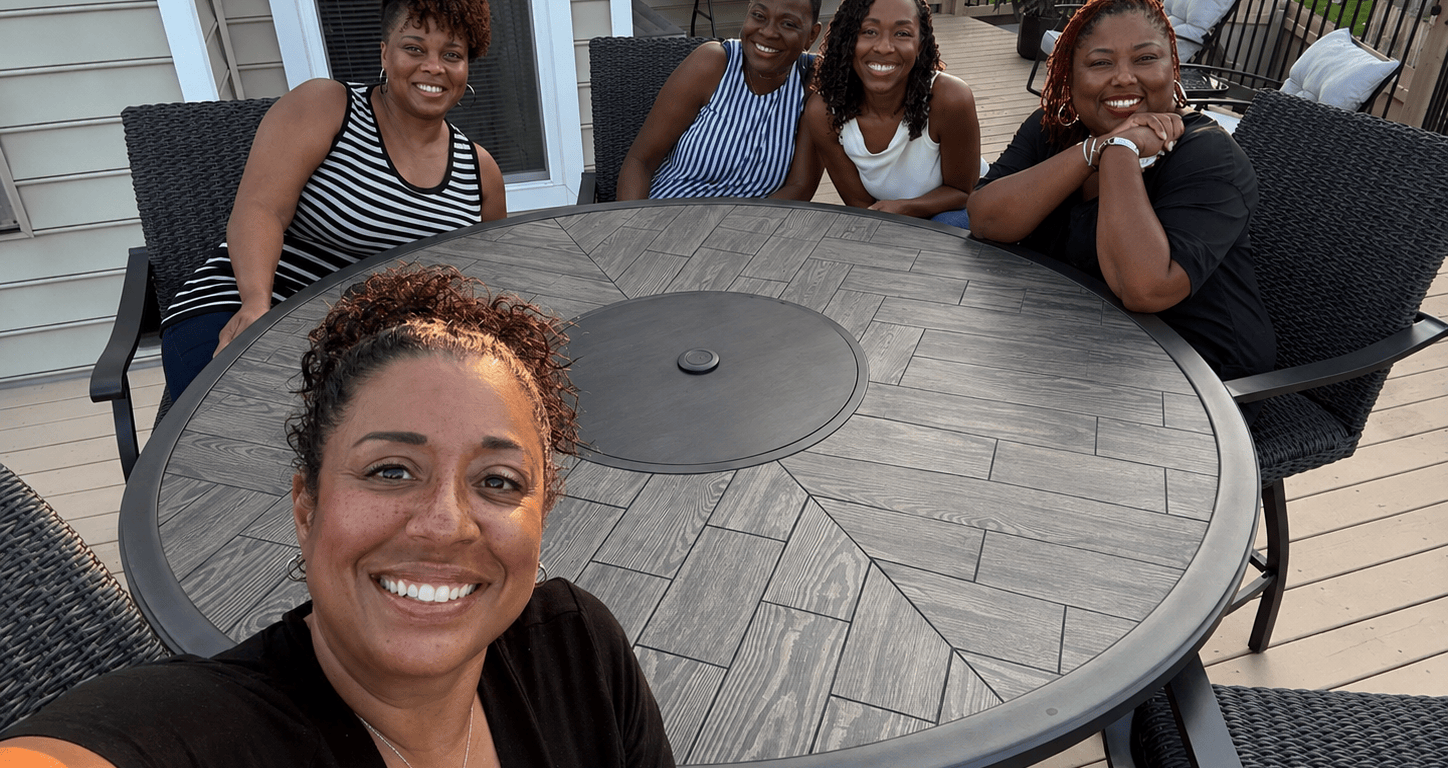
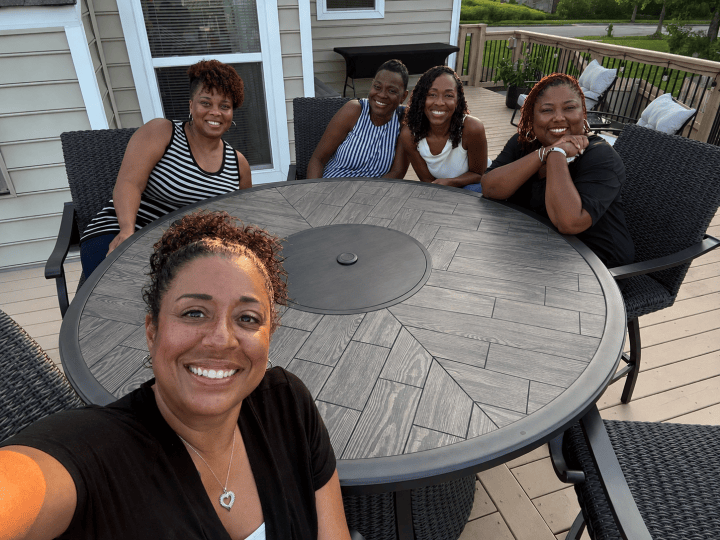
Five Black women. Seventeen years of shared history. A sisterhood built on faith, laughter, accountability, and the freedom to be fully ourselves.
There is something special about finding your people. Not just people you enjoy, but people who see you, challenge you, celebrate you, and remind you who you are when life gets complicated. For Black women, especially those navigating professional spaces, that connection can be both affirming and necessary. Even with advanced degrees, established careers, and seats at professional tables, we can still experience marginalization, isolation, and the unspoken expectation to remain strong, capable, and composed. The world often celebrates our strength without making enough room for our vulnerability.
Our sisterhood grew out of shared professional spaces and relationships developed over time. We are five Gen X Black women in leadership roles in the helping professions. Some of us have known one another for 17 years; others joined along the way. Over the past three years, we’ve become especially intentional about staying connected. We’ve laughed, cried, grown, celebrated accomplishments, navigated difficult seasons, and held one another accountable. Our friendship has become more than a social circle. It is a place to land, a space where gratitude is expressed through presence, honesty, and care. We remind one another that we don’t have to navigate every challenge alone, that joy is worth protecting, and that receiving care is just as important as giving it. Here, gratitude becomes a practice of resistance, and collective care becomes a radical act of survival.
And trust me, this sisterhood has five distinct personalities, perspectives, and ways of showing up for one another. Our current seasons of life even have different soundtracks. Mine is Marvin Sapp’s Praise Him in Advance, a reminder to trust God and remain grateful even when I cannot see how things will work out. Jawana, our firecracker, finds comfort in Safe in His Arms, while Lisa, our nurturer, chooses Jill Scott’s Golden. Daneisha, our accountability queen, brings the energy of Koryn Hawthorne’s Look at God alongside T.I.’s Let ‘Em Know. Nakeia, our logical thinker, turns to an entire album, Wheels of Light by Beautiful Chorus, to stay grounded through life’s uncertainties. Five women, five soundtracks, and different ways of finding our footing. Our faith, confidence, affirmations, and music remind us that wellness looks different for everyone. But our need for support runs deeper than self-care. It challenges the expectation that Black women must always be strong, even when we’re running on empty.
Beyond the Strong Black Woman
Black women are often celebrated for our resilience. We are admired for how much we carry and how consistently we show up when life gets hard. There is power in that resilience, but there is also a cost when strength becomes an expectation rather than a choice. Jawana captured this reality with Malcolm X’s words from 1962: “The most disrespected person in America is the Black woman. The most unprotected person in America is the Black woman. The most neglected person in America is the Black woman.” More than six decades later, those words still resonate. Our strength can be recognized while our needs go unmet. Lisa reflected on how we can be perceived as angry rather than vulnerable, leaving little room to express sadness, disappointment, or fear without being misunderstood. Daneisha described resilience as both a blessing and a burden, while Nakeia highlighted the expectation that Black women must be everything to everyone while minimizing their own needs. When we keep showing up, others may assume we’re fine. Sometimes, no one thinks to check on the woman who always seems to have it together. I’ve learned that we are not meant to be resilient every moment of every day. Sometimes we need to pause, break down, or admit we simply don’t have the capacity to be strong. And that is okay.
Our sisterhood reminds us that we don’t have to perform strength for one another. As we’ve gotten older, we’ve become more comfortable protecting our peace. I’ve learned to stop feeling guilty about resting. Lisa has become more comfortable taking up space without shrinking her voice to make others comfortable. Jawana has learned she doesn’t have to answer every call or solve every problem. Daneisha embraces accountability conversations, while Nakeia trusts her instincts without overexplaining her decisions. Different lessons, but a common thread: caring for ourselves is not a betrayal of our responsibilities to others. Sometimes, the most powerful thing we can do is stop carrying what was never ours to carry alone.
The Freedom of Being Seen
One of the greatest joys of friendship among Black women is being understood without having to explain everything. For me, being seen means we can get straight to the point. We don’t have to explain why a microaggression is a microaggression. Sometimes, all it takes is a look or a familiar expression for someone to understand. There is freedom in not having to explain, defend, or debate your experience. Jawana values having a safe space where she can say, “I’m not okay,” without being judged or expected to hold everything together. Daneisha describes being seen as being free, vulnerable, multifaceted, and real. No armor. No fake smile. Just space for all that we are. Nakeia reminds us that healing becomes possible when we no longer feel pressured to have everything together.
That acceptance matters because we are more than our professional titles and responsibilities. We are women who lead teams, support families, and care for others, but we also get tired, have doubts, make mistakes, and need someone to pour into us. Being seen means being recognized as a whole person, not simply for what we accomplish or what others need from us. And sometimes, being seen means having someone who loves you enough to tell you the truth. Our friendship isn’t about agreeing with everything one another says or does. It’s about creating space for honest conversations, extending grace, and holding each other accountable. We can challenge one another without withdrawing our love. We don’t have to get everything right to remain connected.
Healing Means Unlearning, Too
Healing has required each of us to reconsider beliefs and behaviors that once felt necessary but no longer serve us. I’ve had to unlearn allowing other people’s behavior to make me question who I am. Lisa has learned that people may break our trust, and we can still survive and thrive, even when others don’t reciprocate the care we offer. Jawana has worked to release the need to constantly prove she is smart enough, good enough, or successful enough. She recognizes that her value is not tied to her accomplishments. She doesn’t have to earn her worth; she is already enough. Daneisha has challenged the belief that it is better to be seen and not heard, along with the expectation that Black women must be superwomen. We are allowed to rest, speak up, and put ourselves first. These lessons reinforce what we continue to learn together: we can care deeply without abandoning ourselves, set boundaries without overexplaining, and pursue our goals without tying our worth to achievement. Healing doesn’t mean we never struggle with these lessons again. It means becoming more aware of what we need, more willing to honor it, and more comfortable allowing the people who love us to support us along the way.
And Yes, We Have Fun!
For all the meaningful conversations, personal growth, and accountability, our friendship isn’t one long therapy session. We know how to have a good time, too.
If my girlfriends were giving out wellness awards, I’d proudly accept “Mrs. Most Likely to Book a Trip.” Lisa would win “Most Likely to Keep You Laughing,” while Jawana would take home “Most Likely to Set a Boundary and Stick to It.” As she reminds us, when she says no, it’s a complete sentence, not the start of a negotiation. Daneisha would be crowned “Queen of Memes Sent to Validate Each Other,” and Nakeia, affectionately known as our “Activities Director,” would win “Most Likely to Create Experiences.”
These playful awards reveal something important about how we care for one another. Sometimes support looks like a difficult conversation. Sometimes it’s a meme that says exactly what you were thinking, a trip on the calendar, or a friend making sure you get out of the house and enjoy yourself. We make room for laughter alongside hard conversations and celebration alongside reflection. Wellness isn’t just about surviving what life brings. It is also about enjoying the life we are building.
The Village We Continue to Build
When I reflect on our friendship, I’m grateful for the years that brought us together and the intentionality that keeps us connected. Our village grew through shared experiences, difficult conversations, laughter, faith, and a willingness to keep showing up. We’ve learned that being strong doesn’t mean being invulnerable, being supportive doesn’t mean being available every moment, and being a good friend sometimes means offering the accountability someone needs rather than simply telling her what she wants to hear.
Most importantly, we’ve created space to be our full selves. We can be accomplished and still need support. We can be confident and still have doubts. We can care for others and still choose ourselves. We can be strong and still need rest. For Black women, friendships like these are more than a welcome addition to life. They can be a powerful source of connection, affirmation, and healing in a world that doesn’t always make room for our vulnerability. We deserve relationships where we are celebrated for our strength without being confined by it, where our boundaries are respected, our laughter is shared, and our well-being matters just as much as what we do for others.
I’m grateful that we continue to build that kind of village together. We don’t have to carry everything alone, prove our worth, or wait until life slows down to make room for rest, connection, and joy. Sometimes, we just need our people, a little faith, a good laugh, an honest conversation, and maybe a trip to look forward to.
That’s the village we built. And we’re still making room for more life within it.

Discover more from Three-Fifths
Subscribe to get the latest posts sent to your email.


Awesome article!
LikeLike
Awesome article! It encouraged self-worth, taking the lead, and finding resilience in each day, and alongside friends and family.
LikeLike