
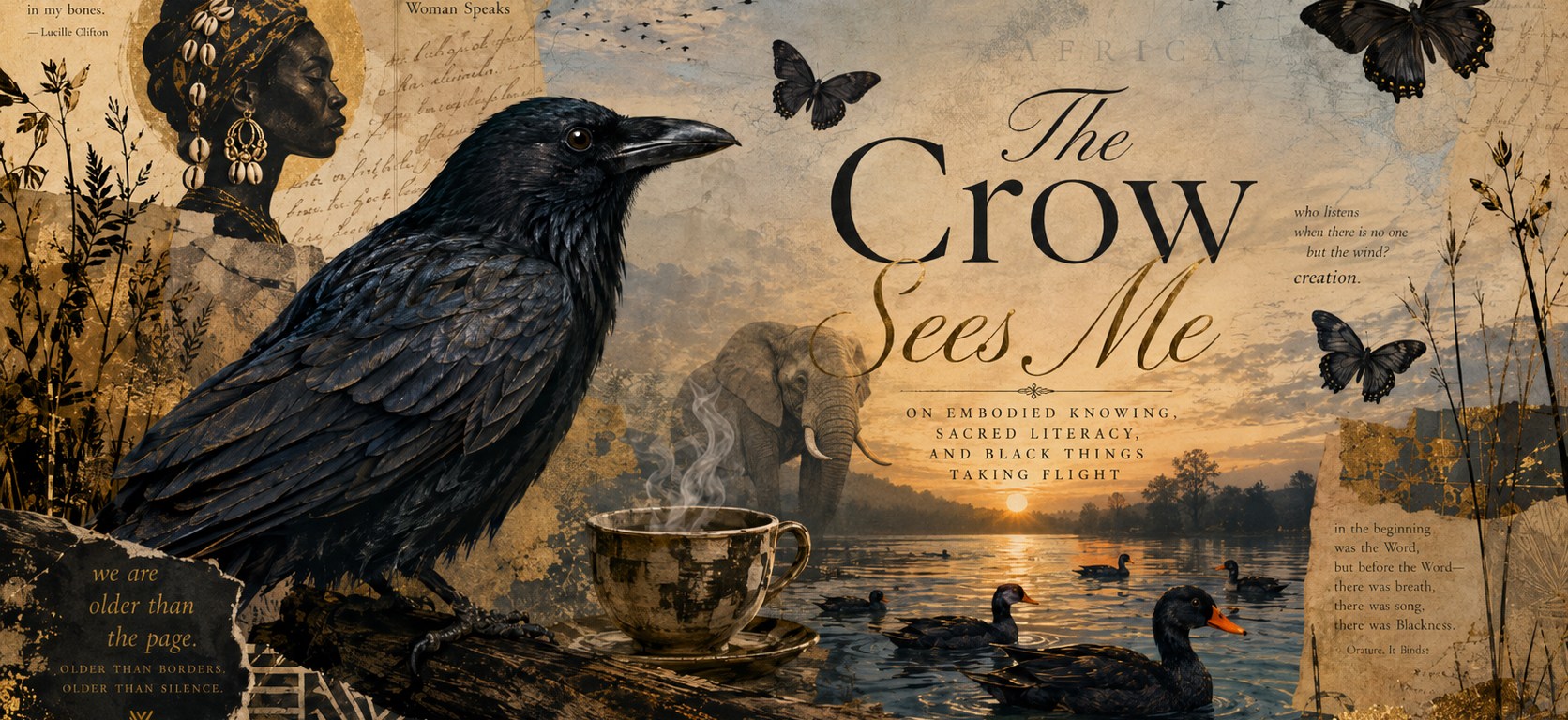
The Crow Sees Me, Embodied Knowing, Sacred Literacy, and Black things taking flight.
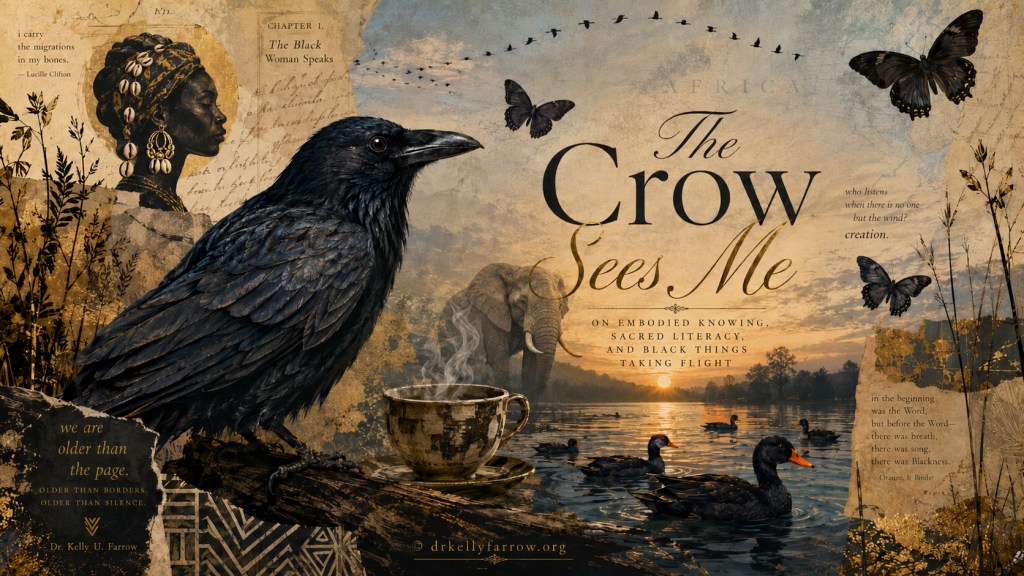
There is a crow who comes near enough to be noticed while I am sitting and having my morning tea.
He is loud. Persistently so.
Some mornings I find myself watching him and wondering where his people are. Eventually, he finds them. He lifts, crosses whatever small distance separates solitude from company, and disappears into a gathering that was apparently there all along.
I had never thought much about his movement beyond that.
This is curious because I have spent years watching the natural world move. I love National Geographic. I know something of butterflies crossing astonishing distances, whales following ancient routes through water, elephants moving across southern Africa according to patterns held somewhere deeper than instruction. I have watched geese carve their geometry into the sky, and hummingbirds perform the impossible, their tiny bodies moving backward when most birds cannot.
Yet somehow, when I thought of migration, I did not immediately think of the crow.
That realization unsettled me. Why did some creatures enter my imagination as organized, strategic, intentional, even majestic, while this Black bird registered first as noisy, unruly, roaming?
What had I been taught to see, hear, and interpret?
The question followed me into a writing circle in Oak Bluffs, where a conversation about the September theme for Three Fifths Magazine, As the Crow Flies: Soaring Towards Justice and Flourishing, became something far larger than an essay prompt. We began with birds. Before long, we were talking about race, language, ecology, scripture, womanist knowing, Black migration, ancestral memory, and the possibility that colonization has reached so deeply into human consciousness that even the creatures of the air have been made to carry our prejudices.
Black birds become omens.
Africanized bees become killers.
Darkness becomes danger.
The language often arrives before the creature ever has a chance to introduce itself. Meanwhile, the crow keeps coming to visit me because he remembers me. I see him. He gathers. He knows where the others are. He watches while I am watching him. Perhaps I have misunderstood the direction of his gaze. Perhaps the crow sees me.
What We Have Been Taught to Call Black Things
Language is never merely descriptive.
Words draw borders around what we are permitted to imagine. They create proximity and distance, tenderness and suspicion. They tell us what belongs inside beauty and what must stand outside it explaining itself.
I have become increasingly attentive to the language attached to Black people and Black bodies. We have inherited entire vocabularies sharpened against us. Black women are rarely permitted ordinary anger. Black children are read older than they are. Black neighborhoods become dangerous before anyone asks what has been extracted from them. Black speech becomes improper. Black grief becomes excessive. Black confidence becomes arrogance. Black refusal becomes aggression, and Black joy becomes a threat.
The violence is not only in what language says. It is in what language has trained the imagination to expect. This is why I have become interested in what I call migrating language. Migration is usually understood as movement from one place toward another. I am beginning to wonder whether liberation also requires the migration of words. Some language has to leave. Some descriptions have lived too long in our mouths, and some categories were constructed inside worlds that never intended to see us, Black People, as whole.
Perhaps we must move our vocabulary from one consciousness into another, carrying only what can survive the journey without diminishing us. The writing circle pushed me to look again at Black creatures in the natural world. Ravens. Crows. Black ducks. Black butterflies. The creatures themselves are simply doing what life does. They gather. Protect. Feed. Mate. Remember. Travel. Adapt. Defend their young. Search for shelter. Find community.
I have watched dark-feathered ducks move across water with an elegance so effortless it almost feels ceremonial. Their bodies glide across the surface while bright orange beaks dip beneath the water, then rise again with all that grace intact. Come close enough, and they begin to recognize who approaches. Bring food often enough, and memory forms. Arrive empty-handed, and they seem to know that too.
I have watched a mother defend her hatchlings with a fury that required no translation. Her body already knew the theology of protection. Nothing about her devotion needed a dictionary. Nothing about their community required a footnote. They wanted what living things seem to want in one form or another.
To live.
To eat.
To belong.
To protect what has been entrusted to them. To have enough room to become what they were created to be.
The problem was never that creation lacked evidence of Black beauty, order, intelligence, tenderness, or communal instinct. The problem may be that we inherited a language incapable of recognizing them without first translating darkness into threat. Perhaps justice requires more than changing systems. Perhaps part of justice is learning to name the world anew.
A Literacy Older Than the Page
I once said, almost casually, “I have learned more about God by watching National Geographic than I have by reading scripture.” What lives in the world, painted by the finger of God, has been my Bible long before I read the Psalms or Proverbs 4:25–27.
The room in Oak Bluffs will not let me leave that sentence unattended. Neither should I. I do not mean that scripture has nothing to teach me. I mean that before there was ever a page in my hand, creation was already speaking.
The heavens were declaring.
Water was remembering.
Animals were organizing.
Trees were bending themselves toward light.
The body was receiving information.
None of it required English.
There is a literacy older than the page.
A grammar written in current and feather, soil and season, breath, and instinct. This matters deeply because Black people have not always been allowed access to the written word. Literacy itself has been policed. Reading once carried danger precisely because it could loosen the architecture of enslavement. Yet our people still knew things.
We knew through storytelling.
We knew through sound.
We knew through rhythm.
We knew through bodies gathered closely enough for knowledge to pass from one to another without ever being written down. We knew through songs that could be learned without sheet music and remembered without notation.
I have been in Black churches where I did not know the song when it began. Give me a verse. Give the room a little time. Soon the sanctuary knows where the song is going. Nobody handed us the lyrics, yet translation traveled.
Sacred embodiment passed through breath, memory, cadence, and flesh until strangers were singing as though we had rehearsed together somewhere before we arrived. That transmission fascinates me!
There are forms of knowledge that enter through resonance, repetition, memory, muscle, spirit, attunement, embodiment, and communal recognition. There are truths the body apprehends before the mind has prepared a sentence for them.
I know this because it happens to me.
I receive signals in my mortal body. There are moments when knowing arrives in my face, my stomach, my chest, in the sudden softening or tightening of muscle and sinew. Intuition, ancestral intelligence, Holy Spirit, embodied memory, the kind of sure knowing that sometimes arrives before explanation. I do not always know where one ends and another begins.
I am no longer convinced they are always meant to be separated. When I stood in Ghana at the Door of No Return, I did not need someone to explain that the place carried memory. My body knew.
When I touched the waters, I felt the stirring of those who had passed through them. Standing there, something in me received the intelligence that my own ancestors had crossed through that violence. Vocation moved from idea into lived experience. Calling was no longer abstract. Purpose entered the body.
I know what it is to feel the continent receive me through sun-warmed earth, ancestral memory, and a welcome that settled into my body before language could catch up. I traveled across the water, stood in the flow of “The Last Bath,” and accepted my African identity more deeply. Beneath me was African soil. Around me, the heat of the continent pressed gently against my body, carrying an unmistakable recognition: You have come home.
That kind of knowing complicates everything we have been taught about literacy.
What if creation is a text?
What if water is an archive?
What if the body reads?
What if intuition is not the enemy of intellect, but one of the ways knowledge becomes incarnate?
What if our ancestors developed ways of knowing that survived precisely because they could not be confiscated like a book?
The older I become, the less interested I am in pretending that God only speaks in sentences.
God can arrive as water.
God can move through butterfly and crow wings cutting across the sky.
God can stir the body with a wordless insistence: pay attention.
God can even meet us through a Black bird that refuses to leave until we finally ask the right question.
Black Things Take Flight
“As the crow flies” usually means the straightest distance between two points. But Black journeys have rarely been straight. We have crossed oceans under force. We have moved toward places where breath seemed more possible. We have returned toward land, kinship, memory, quiet, belonging, or some version of home that refused to stop calling us. We have moved because remaining became unbearable and returned because leaving could not erase longing.
Some migrations take place across geography. Others happen inside the spirit. There are journeys no map can adequately hold. Perhaps that is why the crow has become so important to me.
Flight is not always escape. At times, flight is discernment. Other times, it is survival.
There are journeys that become return. There are also departures born from the body’s refusal to remain where life has become too narrow.
The crow moves.
The hummingbird moves.
The butterfly moves.
The whale moves.
Language moves.
People move.
Spirit moves.
Memory moves.
Even what we imagine to be buried finds ways to travel. This may be one of the great lessons creation keeps offering us: life is always searching for the conditions under which it can continue. The bird leaves one place because another can sustain what the first no longer can.
The seed catches wind.
The whale follows water.
The elephant remembers a route held somewhere in the body.
The human spirit searches for room.
None of this movement is aimless.
This is where the September question changes for me. I am less interested now in asking whether we are moving “as the crow flies” toward justice and flourishing. I am beginning to ask what the crow knows about getting there.
What does the Black bird know about surviving the names given to it?
What does it know about being watched and continuing to fly?
What does it know about finding its people?
What does it know about feeding and being fed?
What does migration teach us about relinquishing language that can no longer carry us?
What might the natural world reveal about Black freedom when we stop approaching creation merely as scenery and begin receiving it as sacred intelligence?
I suspect I have only begun asking these questions.
For years, I thought I was watching creation. Now I wonder how much of creation has been watching me. The crow may have been doing more than making noise. The ducks may have been doing more than floating across the pond. The water may have been holding more than reflection. The continent may have been speaking long before I arrived. Perhaps the work before me is learning how to hear what has always been said without words. Perhaps it is learning how to read what God has written into feather, current, soil, migration, rhythm, body, and breath.
Perhaps it is learning to recognize ourselves there without translating Blackness through somebody else’s imagination or a skewed understanding of migration. I do not yet have every answer. But I have begun to recognize the flight.
I think I am beginning to know why the Blackbird flies.

Discover more from Three-Fifths
Subscribe to get the latest posts sent to your email.

