
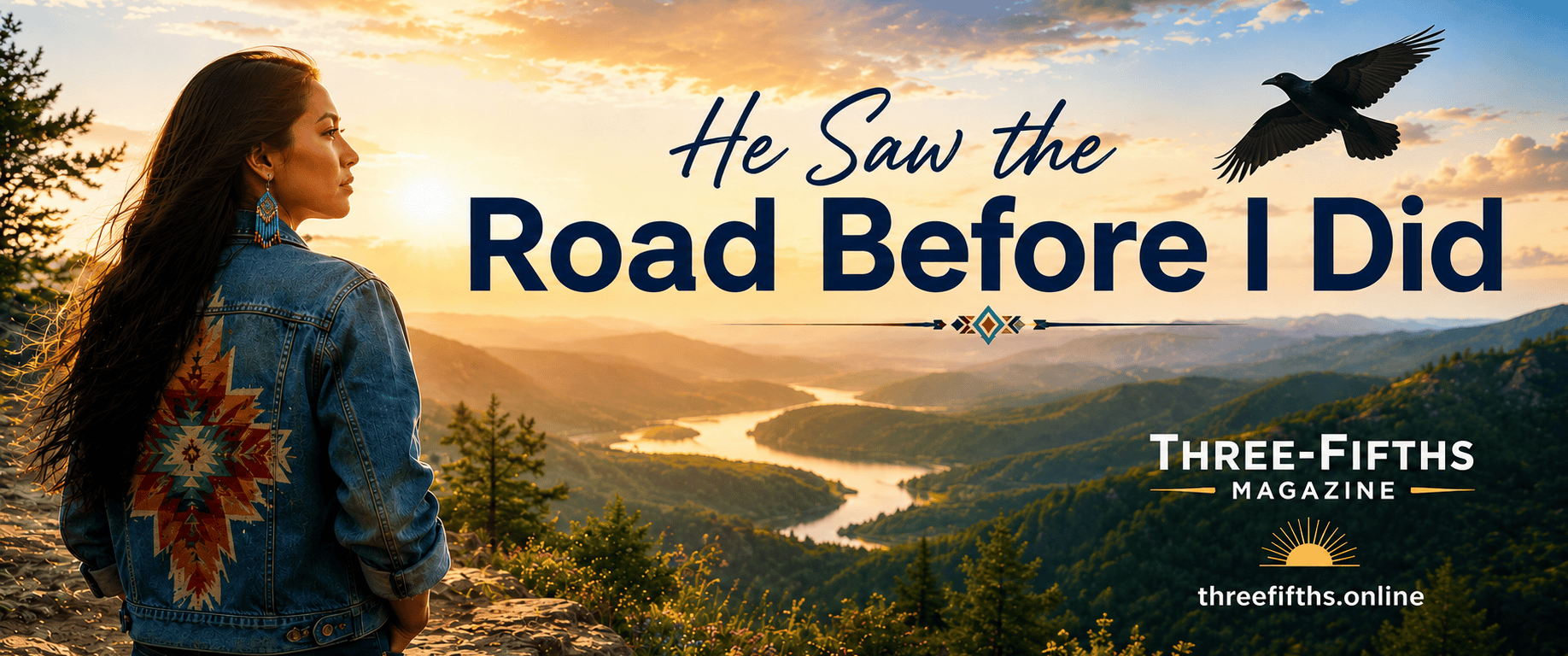
A scene from Bambi* has stayed with me since I was a child. A crow flies above the forest, calling out as Man approaches. The animals below cannot see what the crow sees. They move through the forest from the only perspective available to them, unaware of what lies ahead. The crow has a different view. It can see beyond the trees, and because it sees what those below cannot, it calls out. As a child, I simply understood it as part of the story. Looking at it now, I see something much deeper.
I have spent much of my life walking roads I did not understand. There have been seasons when I could not see why I was where I was, why certain opportunities came into my life, why certain people crossed my path, or why I was being led into places I never expected to go. I wanted God to explain the destination before I took the next step.
Instead, He gave me the next step. Then another. And another. Looking back, I can see something I could not see while I was living it. He saw the road before I did.
That realization has changed the way I understand my own journey. I have learned that there is a difference between being lost and simply being unable to see the whole road. I was looking at the road directly in front of me. God was looking at the entire landscape.
My tribal identity has also taught me to look at life through more than one generation. I come from a people whose history cannot be separated from family, community, culture, land, and the generations who came before us. My ancestors could not see the world I live in now, but they walked their roads anyway. They carried hardships and injustices that became part of the history passed down to those who followed them. They also preserved pieces of who we were so that I could still know something about where I came from.
That makes me ask a different question about my own road: What am I carrying forward, and what kind of road am I leaving for those who come after me? That question has become important in my work as well. I have spent years working alongside communities and people whose circumstances cannot be understood simply by looking at what is
visible on the surface. There are stories beneath the statistics. There are generations behind today’s circumstances. There are reasons people arrive at places we may be quick to judge. We see where someone is standing.
Faith does not require the whole map.
God sees the road that brought them there. Proverbs 4:25–27 says, “Let your eyes look straight ahead; fix your gaze directly before you. Give careful thought to the paths for your feet and be steadfast in all your ways.” I have come to
understand that Scripture does not promise that I will see everything. It reminds me to watch my path and remain steadfast. Faith does not require the whole map. It requires trust in the One who has it. That matters in a world filled with noise. Political noise. Cultural noise. Religious noise. Social media noise. Fear, anger, and division. Sometimes the loudest voice wins simply because it is the loudest. But volume is not the same thing as truth.
We tend to look at tribal nations from the outside and believe we understand them because we have seen the statistics, heard the political debates, read about the land, seen the casinos, or learned about the programs and government relationships. But a community is more than what you can see from the outside. There are stories beneath the statistics. Generations shaped today’s circumstances. Traditions survived because somebody decided they were worth carrying forward. There are families who kept going. People chose to remember. And there are people today who are still trying to build something better from what was handed
to them.
This is where I believe perspective matters when we talk about justice and reconciliation. We cannot pursue justice if we are unwilling to see what we have not seen. We cannot pursue reconciliation if we refuse to hear histories that challenge our understanding. And we cannot talk about flourishing if our definition of flourishing only includes people whose roads are already clear. My own experiences have taught me that perspective requires humility. We each see only a portion of the landscape. Another person’s story may reveal something we could not see from where we were standing. Perhaps that is why the image of the crow matters.
It is not simply that the crow can see from above. It is that what it sees creates a responsibility to
call out. I believe God does the same with us. Sometimes He calls us to speak. Sometimes He calls us to
listen. Sometimes He calls us to serve. Sometimes He calls us to change direction. And sometimes He asks us to keep walking when we cannot see where the road leads. I still do not know what every road ahead of me will look like. There are still things I do not understand, and seasons I am still learning to navigate. But I no longer believe that uncertainty means I am lost.
I have learned to trust that the One who sees beyond my view is already there. My ancestors could not see my road. I cannot see the road of the generations who will come after me. But I can choose how I walk mine. I can choose truth over noise, understanding over assumption, justice over indifference, and reconciliation over division. I can choose to listen when God calls me to see something differently. And I can choose to leave something behind that makes the road a little better for the person walking after me.
I may not see the entire landscape. But I know who does. He saw the road before I did. And sometimes faith is simply having the courage to take the next step.
Sources & Further Reading
The Holy Bible. Proverbs 4:25–27
Disney. Bambi. Walt Disney Productions, 1942.
Author’s Note: This essay is a personal reflection on faith, cultural identity, lived experience,
truth, justice, reconciliation, and the responsibility we carry toward those who come after us.
Discover more from Three-Fifths
Subscribe to get the latest posts sent to your email.


