

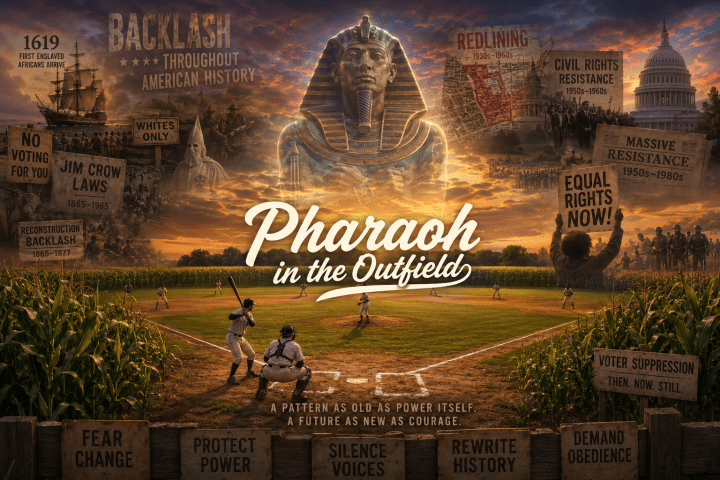
As America celebrates its 250th anniversary, many will be sitting in the stands, eating hot dogs or brats and sipping their favorite beverage. The scene will be set, and the smiles will be bright. Seventh-inning melodies of “Take Me Out to the Ball Game” will be sung. Yet for many, memories of those who could not participate and led to the existence of the Negro Leagues will take precedence. This would continue through folk tales of the heroics of many Black baseball legends, such as pitching legend Satchel Paige, who became the 7th Black player to eventually reach the Major Leagues with the world champion Cleveland Indians. Many years after the color line in baseball was breached, Hank Aaron still had to endure facing death threats in 1974 for potentially breaking the Babe Ruth home run record, which he eventually broke.
Fresh off the deeply cathartic, spiritual, and life-changing experience of being in the presence of God through the burning bush. Moses, with the eloquent communicator Aaron riding shotgun, headed for Egypt, taking the mission of emancipating the Hebrews straight to Egypt’s leader.
In the Words of Scripture, as read in the 5th chapter of the book of Exodus, se: paraphrased: “Moses and Aaron stand before the God of Mizraim (Egypt), who was none other than Pharaoh, to boldly proclaim, “Our God has ordered you to take heed to his word. Let my people go!” The response was far less than the wide-eyed one expected. Flexing behind Pharaoh’s stiff upper lip and furrowed brows with a loaded question. Mocking their God and charging all the slave population to build bricks without the key reinforcing agent of straw. With one instant rebuke, the slave population fell victim to the “Backlash.”
To bring us closer to the present, as in the 1994 movie Angels in the Outfield, strange things were happening as the Angels performed all kinds of miraculous acts in the outfield. However, if we look more closely today, we can see something sinister unfolding just beyond the 400-foot fence. You might call this phenomenon “Pharaoh in the Outfield”
Living in 2026 America as a minority means living in times of Backlash and being forced to once again build bricks without straw. Backlash means building the bricks of our education system without the straw of books needed to teach our children a proper history of America. The backlash is asking BIPOC people To Make Bricks of keeping their neighborhoods safe without the straw of common-sense gun legislation. Backlash is asking these same populations to build the bricks of voting without the straw of voting rights legislation. Backlash is challenging people of color to build the bricks of going up the corporate ladder without the straw of DEI protections, which, by the way, helped white women more than any other demographic group. Backlash asks Black populations to build the bricks of enduring gerrymandered congressional maps without the straw of proper representation through eliminated black congressional districts. Backlash is building the bricks of a liberal democracy without the straw of three independent branches of government to ensure proper checks and balances. Backlash is building bricks of economic empowerment, while still enduring the straw of the fact that “the richest 10 percent of American households now own over two-thirds of the nation’s total wealth.”
– Federal Reserve data
A Three-Fifths Magazine Perspective
Backlash is the psychological immune system of power. When societies begin moving toward greater justice, entrenched systems often react as though they are under attack. The resulting fear, resistance, and retrenchment are not necessarily signs that change is impossible. Rather, they may indicate that change has become significant enough to challenge the assumptions, identities, and structures upon which the old order depends.
Viewed through the lens of Pharaoh’s response in Exodus, one can see British reactions to colonial resistance, Reconstruction-era opposition, Jim Crow, resistance to the Civil Rights Movement, and contemporary debates over racial equity all share a common psychological thread: the fear that expanding freedom for others may diminish power, status, or certainty for oneself. That fear, whether justified or not, is often the engine that drives backlash.
England taught America well
Taxation without representation or sovereignty over their public revenues, and the lack of decision-making power within political representation, were other harsh forms of backlash. The colonists believed they were being asked to bear taxes and regulations without meaningful political representation. The famous cry of “No taxation without representation” reflected the belief that they were being held accountable without a necessary voice in decision-making. While this is in no way a fair comparison to the inhumane cruelty, degradation, or genocide involved in slavery, whether Hebrew or transatlantic, or by the hands of Columbus or Ponc-Deleon, etc., it is to the Indian Removal Act. Backlash is the American way.
While this differs from the literal labor demands imposed on the Israelites, the underlying complaint was similar: obligations were increasing while the means to influence them remained limited.
Baseball and Apple Pie are at the heart of American folklore. Wholesome and pure, clean and fundamental to the image of American exceptionalism and the American way. These ideals have been regarded as sacred, almost theological. Yet like the hypocrisy that has grown along with these nuanced, ever-shifting definitions.
American exceptionalism has been built on the ideas of equality and fairness, grounded in the belief that hard work will lead to success regardless of who you are or where you come from. At the same time, American Exceptionalism suggests that the American way of Democracy and Liberty, and the rule of the people, the right to vote, along with one man or woman, one vote, were as abstract concepts as the idealistic yet unfulfilled spiritual concepts of universal love and Beloved Community.
The American Church: The Not-so-Beloved Community
The involvement of the American church in lynching and racial terror after Reconstruction is one of the most difficult chapters in American religious history. The answer is not that all churches supported lynching—many Christians, Black churches, and some white clergy courageously opposed it—but that large portions of the American church either actively supported, theologically justified, or remained silent in the face of racial violence.
The irony is that the Church possesses one of the strongest theological foundations for unity in all of human history. Jesus prayed:
“That they may all be one… so that the world may believe that you have sent me.” (John 17:21)
Yet the American Church has often struggled to demonstrate that unity visibly and consistently. Given today’s Political divisions influencing the Church, including continuing flirtations with Christian Nationalism and extremism, the struggles continue.
Viewed in this context, it raises the question of what, if any, of American folklore can live up to high aspirations attributed to it. Baseball’s history was inundated with alcoholism, along with the racism mentioned before. American Exceptionalism never really existed. Therefore, we see that backlash is very American.
Frederick Douglass, a committed Christian believer, said, “I love the pure, peaceable, and impartial Christianity of Christ: I therefore hate the corrupt, slaveholding, women-whipping, cradle-plundering, partial and hypocritical Christianity of this land.” The hypocrisy was breathtaking. Not to take a backseat to Douglass’s times, the post-Civil War 19th and 20th centuries have been stained by the more than 4,400 racial terror lynchings of Black people. Many American churches stood by or kept complicitly silent.
Many of America’s sacred institutions have their shaded underbellies, those places no one wants to discuss openly. I am one who loves my Apple Pie, but even it has a high amount of carbs and sugar, along with those fattening calories.
We sat in our seats and hoped for more balls to go over the fence; the question must be asked. What awaits outside the park, and how will it affect my loved ones and me? What does Pharaoh have in store for us? If you have ever followed the biblical story or even watched the Charlton Heston version shown each Easter/Passover, you must be acutely aware that all of Egypt is ultimately drawn into this situation. I am in no way trying to forecast plagues on America but simply want to draw us to the realization that ultimately, we will rise together or we will fall together through our own undoing, divisions, inequity, and hypocrisies. This gives us the opportunity to go off into the night with bended knee in prayers and, more importantly, a mindset to get this thing right.
“First they came for the Socialists, and I did not speak out—
Because I was not a Socialist.
Then they came for the Trade Unionists, and I did not speak out—
Because I was not a Trade Unionist.
Then they came for the Jews, and I did not speak out—
Because I was not a Jew.
Then they came for me—and there was no one left to speak for me.”
By Martin Niemöller- Theologian

Additional Resources
John Jost (System Justification Theory), Henri Tajfel (Social Identity Theory), Daniel Kahneman (Loss Aversion), Jonathan Haidt (group identity and moral psychology), Charles Tilly (contentious politics and resistance to social change)
Federal Reserve data
Holocaust Encyclopedia
Discover more from Three-Fifths
Subscribe to get the latest posts sent to your email.


And now we see lynching’s masked as suicides and black men/boys found dead!
They no longer wear hoods (KKK), but masks covering their faces (Patriot Front) as they march through the streets of Washington, DC. July 4, 2026.
We see our contributions to this Nation being tossed in the trash cans as the books are burned.
A White House our ancestors built, known as the People’s House is now an amusement park.
That is why my library has many of the books that have been removed and my verbal sharing of times past (as our Ancestors did) is done with my grandchildren.
LikeLike