
Her Body Remembers
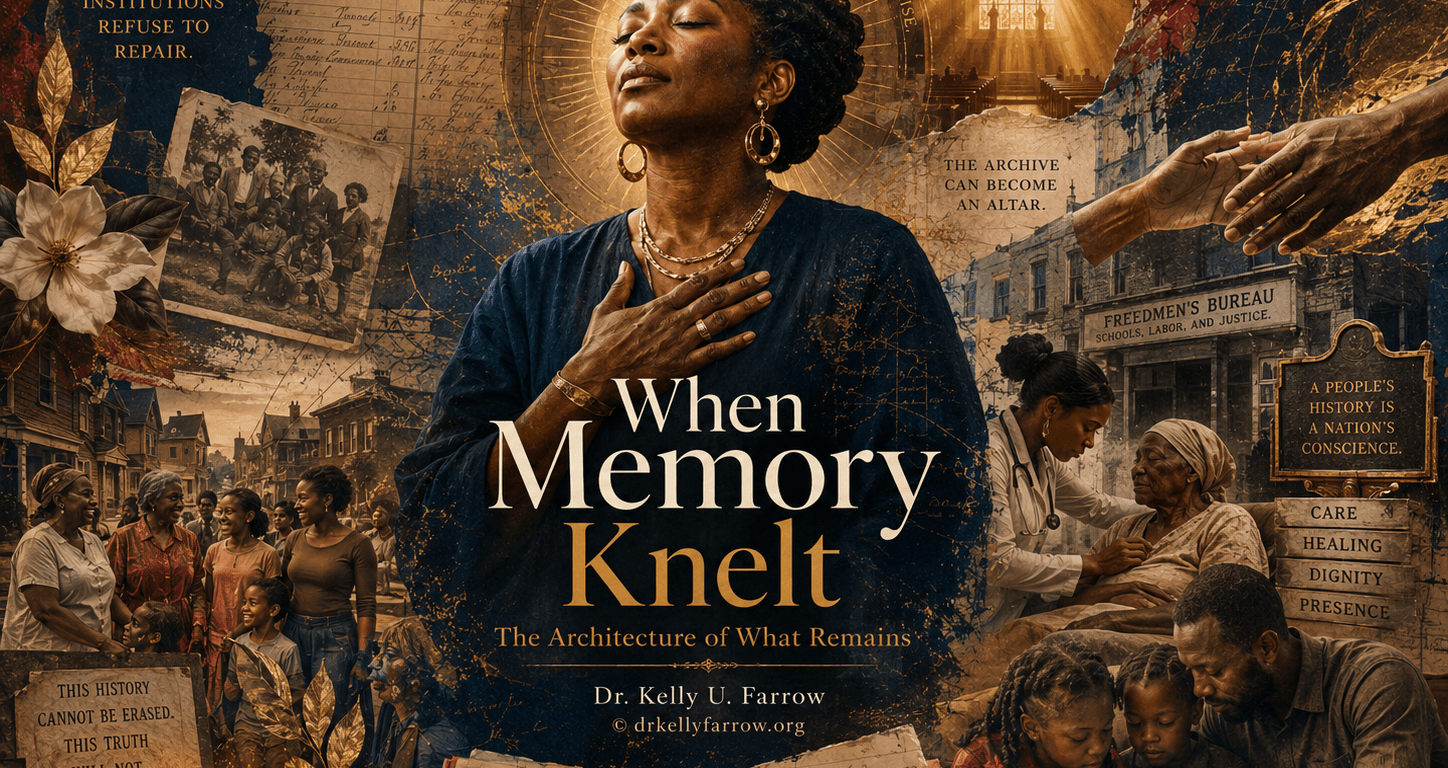
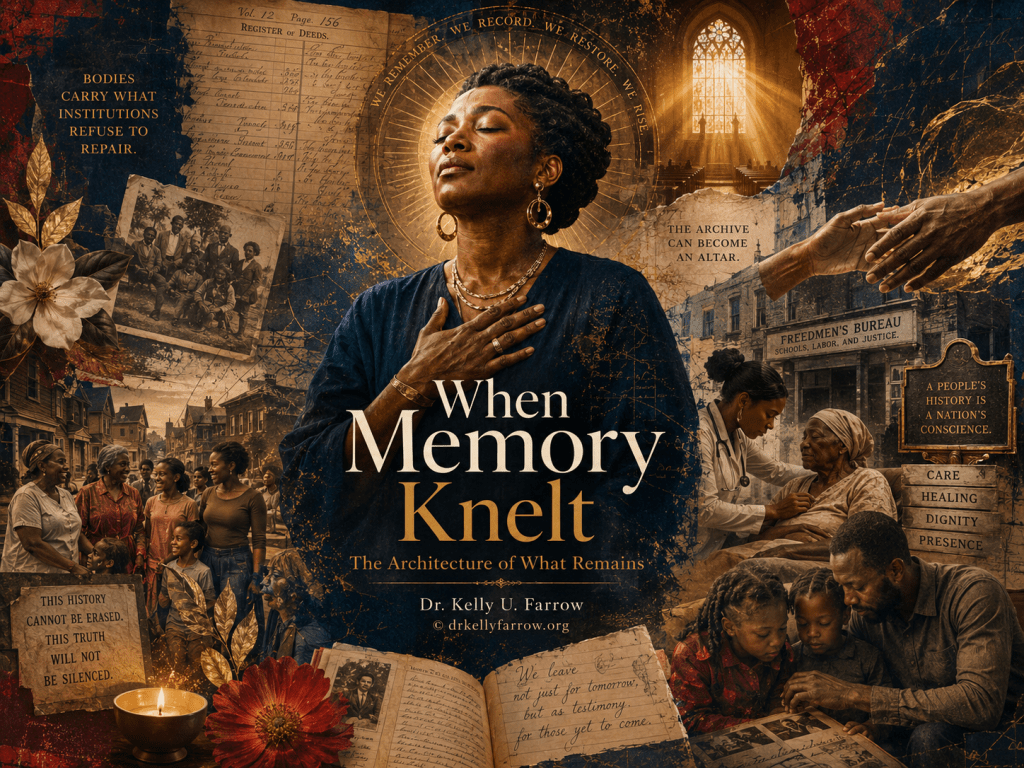
Some histories do not stay in the Smithsonian. They do not remain trapped in old dusty court records, past census lines, outdated policy language, or the brittle pages of a nation’s selective memory. History travels, descends, and settles in the body, not just in books. It enters the body to take up residence in muscle and marrow, in blood and bone, in breath and burden, until flesh itself is the witness. Museums preserve what a nation is willing to remember. Bodies preserve what a nation has refused to repair. Black bodies know something about this kind of scorekeeping.
We know that flesh can become a written ledger that runs red when America denounces accountability. Those books never get balanced, and the miscalculations are recorded on Black skin. It is recorded in ink on the prints of our innocent fingers. It is inscribed in the incision after the surgery to remove the bullets that tore open our chest for being young, Black, gifted, and human. It is tatted on our skin to cover up the scar left behind by the wound inflicted by verbal violence and insidious physical assault. We have long been made to carry what America refuses to hold with honesty: conquest disguised as progress. Neglect dressed up as policy. Shame passed down as tradition, and pain so old it no longer arrives as a new discovery, but sits as an unexhumed ancient archaeological dig.
This is the hard truth of our afterlives.
History does not only haunt institutions and neighborhoods. It teaches the body. It hides under the skin. It waits there, speaking in symptoms. It signals as nervous system deregulation, in the hypervigilance of the mind scanning for emotional safety, in silence because sometimes there are no words, and in bodily ache. Neither the biblical archive nor history is unfamiliar with bodies made to carry what the world would rather spiritualize, scandalize, or scrutinize.
In the Gospel of Mark, there is a woman whose body had been speaking for twelve years, though almost no one had learned how to hear her except as a disruption. She was suffering a condition, yes, but she was also suffering from an interpretation of who she is, and this translation of her body became the frame around her existence. It became the telephoto lens through which she was forever photographed. What afflicted her was not only blood loss, but the world that gathered around her bleeding and called it her burden alone.
How many times in this country have we “gathered” for prayers, soft words of comfort for the bleeding, but left the archive of affliction to writhe in the body of the afflicted, alone? Before she ever touched the hem of Jesus, before the crowd surged and pressed around Jesus, and before he turned and asked, “Who touched me?” her body had already become a living archive. Kronos had gathered in her flesh. Those years did not simply pass over her. They pressed into her soul and became visible evidence in her body.
The twelve years were not hovering above her life as chronology. They were living in her body as accumulation. Year after year, the bleeding did more than weaken her. It made her body carry what suffering becomes when it is forced to live in public for too long. When pain is made visible but not relieved, it gathers secondary wounds that spread across the communal body, becoming mirrored images that frame the architecture of suffering. Human culture, from modern day to antiquity, helped her to fossilize and promoted decay by forcing her and us to relive the shame as it gathered like thick smoke, smoldering across pulpits, publications, public memory, and, most importantly, her life.
This is why the woman with the issue of blood must be read as more than a biblical character in need of healing. She is one of culture’s clearest revelations of the body as archive. She stands in history as one whose flesh has become record, witness, and indictment all at once. To read her only as sick is to miss how thoroughly her body had been made to carry social meaning tethered to the social impact we see and feel in Black bodies in America today. Her story is not separate from what we experience in American culture today. In contrast, it is the beginning patch of a larger diasporic quilt.
Her Body Held It All
When I name her body as living archive, I am leaning into an intrinsic embodied womanist view of her existence. By archive, I do not mean a quiet place where memory is stored neatly on a shelf. I mean her body was a living record, and her afterlife is a site that still conjures that same symbiosis. A site where suffering is kept, where history settles in the parasympathetic nervous system within a toxic social location. A place where society refuses to reckon with what is carried in her muscle, marrow, skin, and spirit.
An archive is not just a place where memories are stored. It is where what matters is kept from disappearing, and time is the scribe recording the sacred history of all the body’s movements and settlings. Embodied, an archive is what the body remembers when the mouth has gone silent. It is a scar that has volume. The shoulders that show burden. The breath that shortens at familiar harm, and the softening that comes when safety is finally real. It is a memory made of skin and bone. Spiritually and emotionally, an archive is the record of what has been carried, survived, loved, lost, and learned. Not all of what is recorded is written down. Some of it lives in posture, some in patterns, and others in instinct. Others are found in traces of the way our bodies brace, reach, open, or refuse to let go of the memory trapped by a period of time. An archive can also be sacred. It is not just storage. It is witness, a bodily witness. It says this happened. This mattered. I was here. We were here. It is felt, seen, and transmuted into our DNA. It reveals our mood, our posture, and our memories. When I say archive, I am naming it in an embodied way of remembering and witnessing. I am naming more than a collection. I am naming a living repository of memory, meaning, and survival. Black people are living archives that tell the history of humankind, from mitochondrial Eve to Dr. Kelly Farrow.
Her body was a chamber of physical pain, but it also housed public shame, economic depletion, religious exclusion, gendered vulnerability, and the long humiliation of remaining medically untreated. She did not simply bleed. She bore what the bleeding made of her in the eyes of humankind. Her flesh became a witness to what happens when a wound is left to outlive compassion, avoid accountability, and excuse poor care of the world’s most vulnerable.
She moved through the crowd with a condition, yes, but also with the afterlife of that condition. Her body carried, as our bodies carry, the grief of what she lost and collected as she lived. Shame and isolation were collected. Scrutiny and physical depletion were her daily condition. The dismemberment and erasure of her existence journeyed with her and framed how she was held by everyone. Twelve years is not only a timeline, but the narrator that told the story of all that happened during those years of her life. Just as in our time, bodies are narrated through abandonment, medical neglect, public shaming, and the violence of being treated aggressively when we are simply telling the truth of our suffering.
What does it mean when a body keeps score like that? What does it mean when flesh becomes ledger, testimony, warning, and lament all at once? This woman’s story opens the door into afterlives because her body not only carried illness. It carried a broken social order. Her body is carrying the social logic that marked her untouchable, and the spiritual language that would be used to exile her from community and the church.
Our Bodies Still Archive
Black women know something about the difference between violent treatment and wholeness. We know that the balm is not only medicine, though medicine matters. It is being believed before proof is demanded. It is being touched without violation. It is being listened to without suspicion. It is being handled with care that does not reduce us to case study, pathology, inconvenience, or cost. Balm is what happens when the world stops making spectacles of suffering and begins the holy labor of restoration. It is what happens when a body is met not with more interpretation, but with honor. Not with delay, but with admiration. Not with soft words and no change, but with the kind of public regard that says, your suffering was real, your life matters, and you do not have to carry this alone anymore.
In that sense, her story is not far from our own. Black women’s bodies still archive what policy refuses to heal and what the apothecary has no cure for. Black and Brown bodies carry grief connected to reproductive injustice, chronic stress, racialized social neglect, somatic hypervigilance, inherited silence, shame, and the long fatigue of surviving under patriarchy and sexual bias. Some histories do not stay in the Smithsonian. They enter the bloodstream and settle beneath the pulse of melanated skin, waiting for someone to finally ask, what can I offer to make you whole and honor your existence?
Her Body becomes an Altar
By the time she reaches for the hem of Jesus, her body is now carrying decision. For twelve years her flesh has been interpreted by other people’s fear and theology. Yet somewhere beneath the exhaustion, beneath the depletion, beneath the public weight of being seen as interruption, there is still enough life in her to move toward wholeness. Her touch is not random. It is intentional. It is not reckless. It is embodied discernment. It is a woman, long denied, refusing to let her body remain a tomb of accumulated pain. It is faith moving through the storehouse.
Jesus does not let her healing remain hidden in the same place her shame had lived. He stops. He turns. He asks the question that pulls her existence from anonymity into witness. Not because he does not know her. Not because he wishes to expose her to another round of public scrutiny. He asks because balm must reach further than symptom relief. The blood stops in private, yes, but the restoration does not stay there. Rather, it comes into deep illumination. He will not allow her to leave with only a changed bloodstream and the same social exile. Jesus calls into the open what she had carried alone to restore her where she had been reduced, so her entire pulse shifts from shadow to shine.
This is the balm. Not only that her body is relieved, but that her personhood is returned. Not only that the flow of blood is arrested, but that the long hemorrhaging of dignity has been interrupted. She is not only healed, but restored rightly before a community that refused to hold her existence without dropping her. Before the witnesses, before the crowd, before all those who had learned to read her body as burden, Jesus names her beyond the wound. He does not call her an issue. He does not call her interruption. He does not call her unclean. He calls her daughter. Daughter was not random. It too is intentional. It matches her energy to press toward his hem. For it is his voice that shifts her restoration within holistic community because it shouts, “How dare you?” to those who cast her aside. In one word he invites relationship where there had been rupture. In one word he returns belonging where shame tried to build a permanent dwelling.
This is why her healing was done in public. Public shame requires public restoration. Public diminishment requires open tenderness. The woman who had been made into a cautionary tale is spoken back into kinship with one word. That should tell America it does not take a lot to restore. It only takes one word, one voice, one invitation into communal relationship. Now, the body that had become archive also becomes altar, a site where God does not merely stop the suffering, but answers it with presence, language, and honor. She leaves not only with relief from all her body held, but with dignity. Not only with a changed condition, but with a changed social location. The crowd that knew her as disruption must now reckon with her as beloved. For when memory kneels with power, strength, and intention, it rises with a new foundation and changes an entire culture’s foundational architecture on how history is stored, seen, remembered, and honored.
Discover more from Three-Fifths
Subscribe to get the latest posts sent to your email.


Powerful and on time!! Thanks, Dr. Farrow!!
LikeLike