
I’ve been spending time with Archibald MacLeish’s poem Land of the Free. Written in 1937, MacLeish describes this work as a “book of photographs illustrated by a poem”. Every phrase of verse has been isolated and anchored by MacLeish to a photograph from the Resettlement Administration (which became the Farm Security Administration). These include photos from Dorothea Lange, Russell Lee, Walker Evans and Carl Mydans. It is a stirring work whose lens focuses on a poor, mostly white America during the Great Depression and Dust Bowl years.
In the body of the poem, MacLeish meditates upon the Declaration of Independence and our ideas of liberty. His bias is evident because this is a meditation for white America. And maybe his nearly complete omission of Americans with African, Asian, Latino and Indigenous ancestry is deliberate because he is trying to influence the white legislators who’s sympathies in the 1930’s align mostly with white people.
Intentional or not, his message seems directed at an audience of white people who believe in the idea that their liberties are protected by the laws of the land; an audience who is repeatedly caught off guard when those liberties are NOT protected. White people who, generation after generation, are surprised to be left out of the American Dream – liberty, freedom, a house, a car and a chicken in the pot.
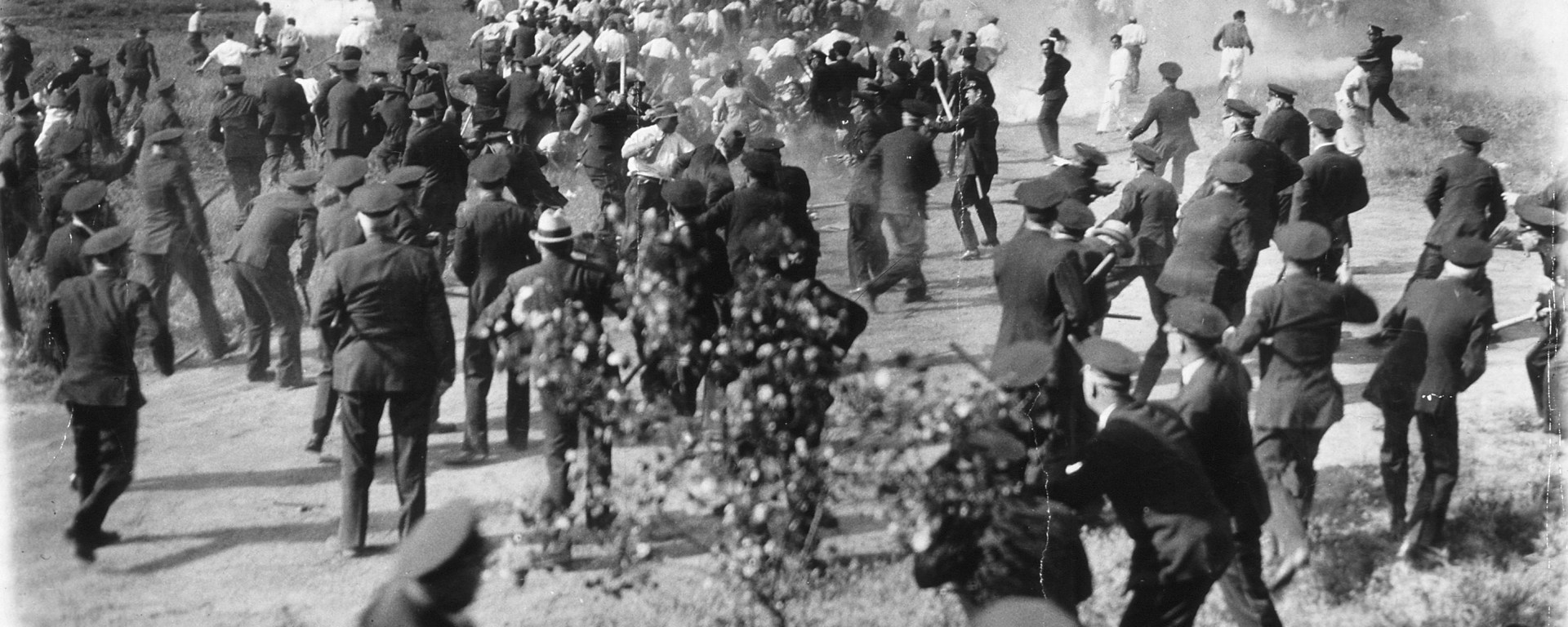
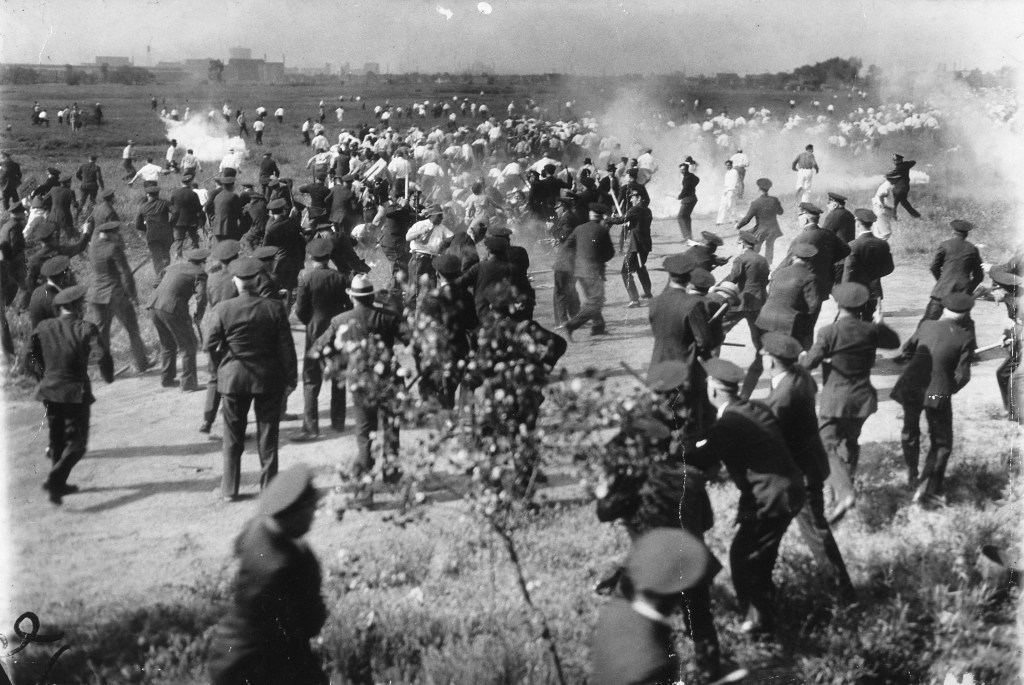
In one section of the poem, Macleish refers to the 1937 Memorial Day Massacre in Chicago’s Southside,
Maybe the proposition is self-evident.
Maybe we were endowed by our creator
With certain inalienable rights including
The right to assemble in peace and petition.
Maybe.
But try it in South Chicago Memorial Day
With the mick police on the prairie in front of the factory
Gunning you down from behind and for what? For liberty?
In the 1930’s, Senator Robert F. Wagner wrote legislation that would constitute the National Labor Relations Act (also called The Wagner Act) which protected private sector employees’ rights to organize trade unions. This legislation was opposed by Republicans in congress but passed with Democrats support to the desk of President Franklin D. Roosevelt in 1935. Twelve years later, a Republican-controlled congress would override Democrat President Truman’s veto and pass the Taft-Hartley Act which significantly reduced the protections codified in the Wagner Act.
Mollie West was a labor activist from Chicago during the 1930’s – 1960’s and she was there with striking steel workers on that Memorial Day in ’37 where Chicago police fired into a peaceful march of thousands, killing 10 and injuring a hundred. The Chicago Tribune at the time, sided with the police and delivered line after line portraying the strikers as communists, violent, and drug users. But a Federal investigation unearthed the truth that, in fact, the Little Steel company had spent months building up weapons, tear gas and alignments with Chicago police in an effort to halt unions at its Midwestern plants. But the Wagner Act of ’37 protected their rights as private employees to peacefully organize. Of the Wagner act, Mollie said, “…there was an enormous advance, of course. First of all you had the right to organize: that you weren’t being punished, you weren’t being killed for it, you weren’t being jailed. You had the right. It was the law. And that was absolutely revolutionary in our country…”
In another section of Land of the Free Macliesh writes about the 6-year-old blonde kids (cotton-tops) working in the food industry in 1930’s Texas. He goads his audience to tell the kids about liberty, closing this stanza with the bitter reality that “our liberties” won’t let us stop child labor:
Maybe the constitution assured us our liberties
But tell the six-year cotton-tops in Texas
Canning the crawfish in the ten cent cans –
heading the shrimps because the law can’t stop it:
Tell them our liberties won’t let us stop it…
…
We wonder whether the great American dream
Was the singing of locusts out of the grass to the west and the
West is behind us now:
The west wind’s away from us
*
Macleish’s Land of the Free is heavily influenced by Marxist and Socialist theory and his poem closes with the idea that instead of believing in the land as representational “liberty”, we should instead place our dreams on the freedom of “men” (universal). And he ties this freedom and liberty to our ability to organize and be in collective societies. It’s a hopeful idea. His work joined scores of progressive voices during the early 1900’s as they advocated and advanced legislation that protected American people in our labor conditions. His work is a great example of how America’s activists were able to influence elected leaders to codify protections and change; protections and change that is repeatedly eliminated by conservatives.
Whether through his own racism or his intentional pitch to white politicians in the 1930’s, Macleish’s lens is focused on white America. It exposes the disillusionment we find ourselves in when we realize that we are deceived by systems of white supremacy. If the “promise” of white-supremacy is power, safety, wealth… then how do we end up with bullets in our backs at peaceful demonstrations? If the “promise” of white supremacy is leisure, comfort, privilege… then how do we end up working 2-3 jobs just to make ends meet?
And a seductive call of “merit” – a word that pacifies millions of working poor and working middle classes – disguises a particularly cruel fate when it’s used to blind those of us in the “white” classification. We measure success on it – if you have two mansions and can take vacation, you must have worked really hard to earn it. We don’t examine our own lives and wonder why, after 30+ years of working hard, we don’t also have mansions and vacations.
America’s assignment of skin color categories masks the truth that power, in fact, is about wealth consolidation built upon exploitation and dehumanization. Wealth consolidation doesn’t care what skin color people have as long as you’re producing capital for the ones with power. Wealth consolidation in America dresses itself up in skin color categories so that working poor and working middle class whites are stuck in racism.
And there’s an invisibility in our acculturation too that deepens our vulnerability to believe in race. We are acculturated as white people not to see ourselves as having a skin color but to see ourselves as being a standard – a cultural norm – by which everyone is measured. Within white spaces, there are further hierarchies of culture, class, and geography which justifies violence against working poor and working middle class whites.
American people who identify “white” and who do not carry privileges of wealth, geography, culture and academic-supremacy must remove the glasses of an acculturation with racism in order to see that our bodies are being used as instruments for the long arm of wealth consolidation for a few people at the top of society’s economy. We’re like the crew on the slave ship (historically, these crews were kidnapped, destitute blokes and orphan boys pulled off the streets of Liverpool and London) who exist at the mercy of the captain. We do what we’re told because we want to survive. Kept busy in the machinery of exploitation, we rarely ask ourselves what on earth we’re surviving FOR.
Do we endure purely to survive as systemic victims ourselves? As Macleish implores his readers, our “liberties won’t let us stop…” the cruelty of a greedy few, the laws that protect their crime, and the amassed industrialization of modern human civilization. Is this – our existence in systemic exploitation – worth it when nobody is free?
There’s a bumper sticker phrase used lightly in conversation as intellectuals toss around their theories: nobody is free until we all are free. The phrase carries a truth which nobody can dispute and we’ve reduced it to bumper sticker fodder where the elites – in their “liberty” – have not formulated and codified protections for universal liberation.
Working poor and working middle class people know exactly what we need for liberation. We know exactly what to demand from systems of power, especially those power systems who claim an allegiance with progress. We need to know that our health will be taken care of. We need assurance that working 40-hours per week will be enough to afford our housing and food. We need freedom to explore our skills and talents through education and opportunity. We need guarantees that we can safely be ourselves in public without being controlled by racism or classism or gender discrimination. We need a promise that the systems of exploitation entrenched at all levels of society – from marriage to military, industrial to individual – will be audited and abandoned according to our commitment to authentic, realized freedom. Then, and only then, will power in all its forms assume it’s place in the rear view mirror – a warning shot for America and who we do not want to be ever again.

Discover more from Three-Fifths
Subscribe to get the latest posts sent to your email.

 Three-Fifths
So much to unpack.
LikeLike