

In the final analysis, racism is evil because its ultimate logic is genocide… If one says that I am not good enough to live next door to him; if one says that I am not good enough to eat at a lunch counter, or to have a good, decent job, or to go to school with him merely because of my race, he is saying consciously or unconsciously that I do not deserve to exist… [Racism] is the affirmation that the very being of a people is inferior.
- Martin Luther King Jr. “The Other America”
In the speech quoted above, Dr. King draws out the logical end of racism. If one believes that another race of people is made inferior, the conclusion one ultimately reaches is that they ought to be eliminated. And, though he does not name the so-called crime of “miscegenation” in his list of examples, in other places, he notes that the fear of reproduction between white and Black people is another example of racism that leads ultimately to genocide. For King, the issue wasn’t that Black people were desperate to marry white people, but the fact that so many white people found the idea of white and Black people marrying and reproducing terrifying (only 4% of Americans surveyed by Gallup in 1958 approved of interracial marriage—source). He saw beyond the policy issue to the heart of the matter, namely that many white people were unwilling to accept Black people as equally human.
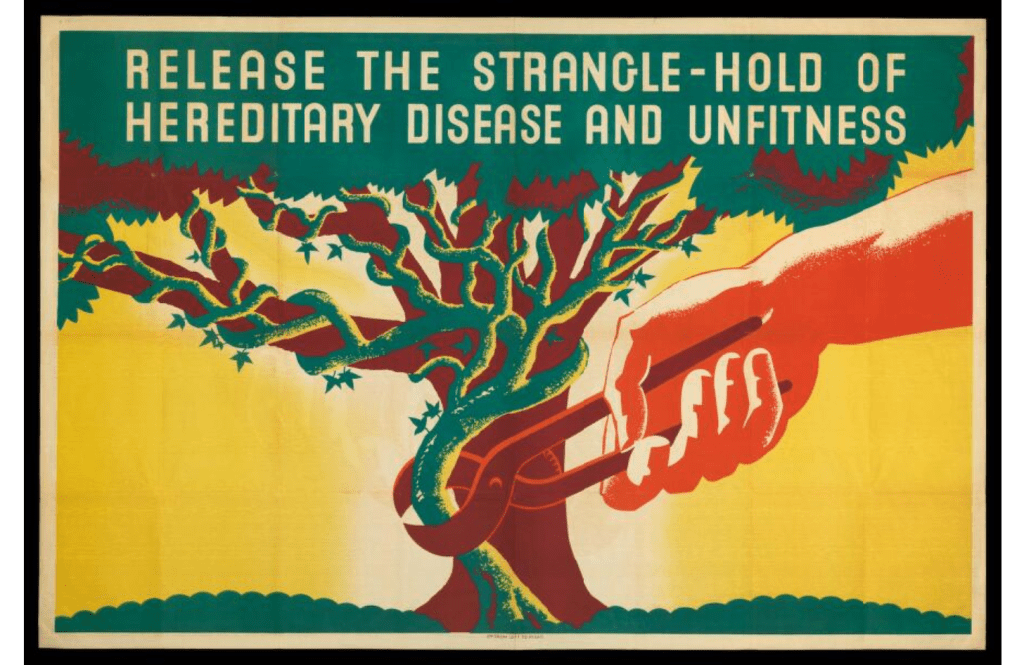
And while many people today think of King’s racist opponents as backward and unintelligent, it is important to note that their ideas came from the revered figures of the European Enlightenment. As Cornel West documents in his excellent book Prophesy Deliverance: An Afro-American Revolutionary Christianity, white supremacy and the white normative gaze were built into the European “Enlightenment,” which then was taken across the globe through colonialism. West writes, “The idea of white supremacy was accepted by [the major figures of the Enlightenment] without their having to put forward their own arguments to justify it… [they] believed that the authority for these views rested in the domain of the naturalists, anthropologists, physiognomists, and phrenologists” (p. 61). This backstory explains how the progressive, enlightened (white) minds of the 19th and 20th centuries argued using the “science” of eugenics that it is moral and kind to remove the genetically unfit (e.g. racial and religious minorities, people with disabilities, etc.) from the gene pool so that future generations can flourish.
King was right to note that the concept of white supremacy leads to the horror of genocide. The root of the problem of fears regarding miscegenation was spiritual and ontological in nature—that is to say, the problem is the spiritual poverty of the Enlightenment and its absurd denial of Black humanity. What, then, can we do to counter the great evil of white supremacy that has done so much to shape the modern world and continues to hold so much sway within it? Here, I turn to the psychiatrist and freedom fighter Frantz Fanon. Fanon is perhaps most famous for his argument that violence is sometimes necessary in order to achieve liberation. However, I argue that he and King have some important points of connection, despite their disagreement regarding the acceptability of violence, once we look below the surface.
Fanon was born in Martinique under French colonial rule. Much of his adult life was spent in support of the Algerian fight to free themselves from colonialism. In his work as a psychiatrist, he saw first-hand the damage that colonialism did to the people involved. He saw how French colonizers were encouraged to view the Algerians and other colonial subjects as less than human, and how those under colonial rule were encouraged to hate themselves and attempt to transform themselves into their colonizers. In religious terms, colonialism set up a kind of idolatry, with the colonizers set in the place of God and colonial subjects encouraged to worship the “ideal” of the colonizers. Fanon rejected the colonial order both because it was false and because it was damaging. It degraded the humanity of all involved.
Drawing on his training in psychiatry and philosophy (he was influenced by the French philosopher Jean Paul-Sartre and educated by the Martiniquais philosopher and politician Aimé Césaire) recognized that the self is a gift, and that we must receive the gift of the other in order to experience the fullness of our own humanity. Such giving and receiving is not possible within the strictures of colonialism. Reflecting on Fanon’s concept of the self as gift, decolonial philosopher Nelson Maldonado-Torres writes, “But why is it that the master resists accepting the gift or recognizing the Other as someone who can give?… it makes evident the incompleteness of the master. Lordship requires impenetrability while giving necessitates openness and receptivity.”1 Colonial masters could not recognize the gift of the colonized other because the system of colonization sets up the colonizer as an idol, as complete without the gift of the other.
Fanon sought to create a world without colonialism wherein previous colonized and colonizers would recognize and receive the gift of one another. King, in a different language, sought something quite similar in his formulation of the Beloved Community. For King, the Beloved Community is both a goal toward which we work and a reality we can experience in the present, where each person’s full humanity is recognized and respected. King stated on many occasions, and in various ways, that one cannot be whole (or even exist) without other people. Thus, King argued that even if you are primarily self-interested, you must care about the well-being of others because we cannot live well unless others are also. We are inescapably bound together. To put King’s philosophy into Fanon’s terms, our self is a gift from others, and only in a community where we receive the gift of others and give ourselves as a gift can we experience the fullness of our humanity.
So, to return to the topic at hand, what can we do about the current fears regarding miscegenation (now often called the “Great Replacement Theory”—the idea that white people are being bred out of existence through migration and “interbreeding” with non-white people)? We must learn to see the other—especially people most unlike us—as a gift. For white and Black people in America, this involves arduous and distinct challenges. As a white person, I can say that for white people, it involves, among other things, unlearning the idea of white mastery and dominance and dismantling systems and structures in our midst that create inequity, division, and isolation. This task is difficult but not impossible. We can create a better world together. As James Baldwin wrote near the end of his “Letter from a Region in My Mind”:
Everything now, we must assume, is in our hands; we have no right to assume otherwise. If we—and now I mean the relatively conscious whites and the relatively conscious blacks, who must, like lovers, insist on, or create, the consciousness of the others—do not falter in our duty now, we may be able, handful that we are, to end the racial nightmare, and achieve our country, and change the history of the world.
- Nelson Maldona*do-Torres, Against War: Views from the Underside of Modernity (Duke University Press, Durham, NC: 2008), 150.
↩︎
Discover more from Three-Fifths
Subscribe to get the latest posts sent to your email.

