

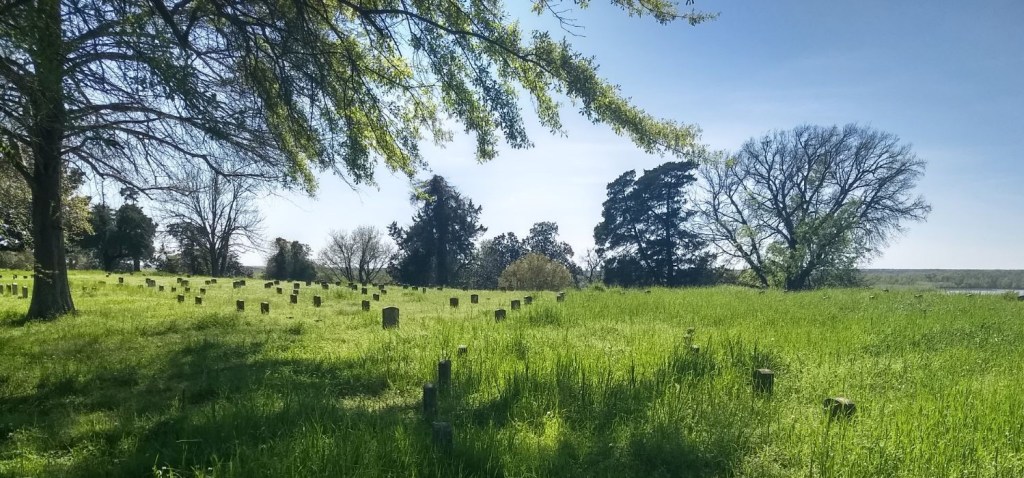
July 4, 1863. Ulysses S. Grant crowned a 47-day battle at Vicksburg, Mississippi with the surrender of tens-of-thousands of confederates. It dealt the enemy a punishing blow from which the Southern slavers and aristocracy would fail to recover. There were 110,000 forces participating in this fight: 33,000 confederate and 77,000 American troops. Grant walked away with 29,000 prisoners of war and with American (Union) losses at just over 1%.
During the siege, a little-known attack occurred on June 7 – nearly one month before the confederate surrender. The Battle of Milliken’s Bend happened a heart-beat Northwest of Vicksburg in Louisiana. It’s among the first documented battles where new recruits in America’s US Colored Troops (USCT) were on the front lines repelling a confederate assault. The USCT held their ground at Milliken’s which ultimately weakened the confederate hold on Vicksburg.
Americans with African ancestry had been actively supporting US forces since the onset of the war and multitudes were escaping plantations to take their freedom. A stream of people fleeing slavery became a diaspora of mass human migration and, combined with appeals from leaders like Frederick Douglass, Lincoln and Congress were forced to respond (Schwalm, Emancipation’s Diaspora: Race and Reconstruction in the Upper Midwest). Through legislation approved in the summer of 1862, a door opened for the formation of the US Colored Troops and Emancipation. While the advent of USCT was a welcome advancement toward equality, the restrained Republican policy kept Black soldiers tasked with rudimentary labor at Union camps. But after their fierce bravery strengthened America’s position on the front lines at Milliken’s, it was decided that African descent Americans could serve in combat. This didn’t mean that America’s soldiers classified “Black” received the same pay as soldiers classified “white”. There was a 30% difference in compensation.
Before Milliken’s Bend, there was another engagement of USCT in the Civil War. It happened on a Missouri prairie at a place known today as Island Mound. While the USCT were officially established in 1863, US military leadership in Western states were already organizing units. In 1862, a new company of USCT recruits secured a garrison in Missouri; a border state bloodied by skirmishes between confederates and abolitionists. It didn’t take long and the new USCT soldiers were under attack. On October 29, the soldiers engaged in intense fighting to defend their garrison from confederate assault… and they won. The memory of the Island Mound Battle has been preserved in recent years. Missouri erected a state park and monument at Island Mound and produced a film about the battle which includes interviews with the descendants of Americans who fought.
In 2018, I was researching Civil War battalions from Southwest Wisconsin. It took me awhile to locate histories of USCT activities during the Civil War. It was easier to find histories of white units, but it was much more difficult to uncover the movement of Wisconsin’s Black soldiers. When I was in high school during the ’80’s, USCT received only a mention and there was not a word written about the battles fought by these units or the disparities imposed by racism. The 1989 movie, “Glory”, was like a lightning bolt for many young people at the time. It felt like a “why-wasn’t-this-in-history-class” moment for those of us severed from the memory of USCT.
Thanks to the scholarship of Dr. Benjamin A. Quarles and his book The Negro in the Civil War published in 1953, histories like the battle at Milliken’s Bend have been preserved. Journalism from Earnest McBride and The Jackson Advocate shone a spotlight on Milliken’s and the racism that almost erased the USCT participation during the Vicksburg battle. McBride writes, “Most of the 7,240 Black troops buried at Vicksburg were assigned unknown grave markers and were identified by their regiments under the banner of the United States Colored Troops (USCT).”
Of the more than 17,000 American (Union) soldiers buried at Vicksburg, only around 4,000 were identified at their time of burial. This is because most of those interred here were moved from other battlefields after the war. For “unknown” soldiers in this National Cemetery, a brick-sized chunk of marble is numbered and set in the ground above the remains. Because so many at Vicksburg are “unknown” these small, numbered blocks are scattered over the entire cemetery. However, the section where our USCT are buried is mostly “unknown” markers. Very few of the standard-issue, marble headstones with names and rank emerge above the resting places of the Civil War’s Black troops here.
United States school curriculum covering the Civil War experienced a massive, generations-long, and well-documented revisionist campaign often lobbied for and funded by the organization called “The United Daughters of the Confederacy.” In general, educators offer only a sliver of United States’ history; it’s a one-dimensional and static story*’*. Conducting research in any aspect of history is troubling because it’s mostly the dominant narrative that persists; it’s the dominant narrative that is taught in school. I was heartbroken when I discovered how little I knew about the history of my home-place in rural Iowa – I didn’t even know the story of the land I’d walked on since birth. For example, I was never taught in school and didn’t encounter living memory that illuminated the fact that Americans of African descent were among the pioneer families in the Central Plains. McBride describes how historical erasure impacts residents of Vicksburg, “The Black burial ground, covering a large section of the northwest quadrant of the cemetery’s 116 acres, was for many years one of Mississippi’s – and the nation’s – best kept secrets. Nearly all Black natives of Vicksburg over 50 years of age today were never told of the cemetery’s importance.”
This is a deeply wounding erasure of American History. Not only does it perpetuate a long-standing white-supremacist harm against Americans with African ancestry, it harbors the relentless currents of racism in Americans classified as “white” today. Without a truthful accounting of American history, all of us are at a great disadvantage. We can’t even unite around our ideals for equality in this country because we don’t have access to – or we choose to ignore – truth.
*
Through this dissonance rising over the resting places of America’s fallen soldiers at Vicksburg, I walk slowly so I can look at each marker and headstone. My shoes become tangled in long, unkempt grasses and I lean down to move winter’s leaves from a name chiseled and hidden underneath lichen. This battlefield where cannonade once thundered is framed by woodlands concealing shaded scars of earthworks. It’s early in the year, 2018, and I’m looking for my family here. One headstone is overtaken by an old magnolia tree; only a part of it remains visible beneath the bark. Another headstone sinks into the earth, its name barely legible. On my left are rising terraces where white soldiers lay; on my right are slopes lined with “unknown” markers of Black soldiers. In the distance, a car glides slowly along an avenue called “Given Hill Road.” I wonder how “Given Hill” got its name; if it was “given”, who took it?
On a hillside high above the cemetery there’s a view of a grand and fractured Mississippi River, its muddy branches turn slowly beneath islands of heavy trees. My thoughts are full of stories of the men resting below me and the word “hallowed” comes to mind. I think, “Hallowed be thy name”.
In 2023, Vicksburg archeologists are starting to correct the conditions of the Black section of the cemetery. They’re using DNA and isotope testing to identify members of the US Colored Troops Civil War veterans. Today, it’s been 163 years since this cemetery was established and I am hoping to locate two of my 3rd-great grandfather’s neighbors from Wisconsin who might have been buried in the section for USCT: Charles Shepard and his son, John. Their names don’t appear on the lists of those interred in Vicksburg but considering that most of the USCT section is “unknown”, I’m hoping that the archeologists might locate them. I have the notes of Charles’ personal belongings that were stored after he succumbed to illness at Vicksburg in 1865. I even know the name of the office clerk and military staff who signed his certificate of death. But I have no clue where he was laid to rest. And I want to know where he is.
*
Ordinary American lives meet at the crossroads of America’s Civil War. Let us remember some of them here today…
Caroline Shepard left Virginia with her husband, Charles, to settle in Southwest Wisconsin in 1848. They made the journey with their slaver, William Horner, a member of a prominent Warrenton family. They built Horner’s new home for him in Wisconsin and were allowed to remain there to carve out their own lives on the frontier. Their manumission papers had been applied for at the time of their departure from Virginia and were approved in Warrenton during their first years in Wisconsin. They had seven kids, among whom was a boy named John. In 1864, John and his dad, Charles, enlist in the US Colored Troops and are sent to Vicksburg for garrison duty. John’s military records convey movements across the Southeast where he may have been on battle front lines including the Siege of Fort Blakely in Alabama. Both father and son never make it home to Caroline and the other kids in Wisconsin. While their final resting place is unknown, their names do appear on the monument commemorating Wisconsin’s Civil War veterans in Lancaster, Wisconsin.
Sarah Stockdale was the daughter of English immigrants. In 1872, she married Peter Marcy, an American who’d fled the Georgia plantation where he’d lived since he was born in 1850. He crossed paths with Captain Martin A. Moore of Company H of the Iowa 9th Infantry sometime in the Spring of 1863 and possibly near Vicksburg where Moore was deployed. Moore brought Marcy to Iowa with him that same year. Nine years later, Marcy and Sarah married and established their farm near Bluffton, Iowa where they raised their seven kids and were active in their community. Sarah passed away in 1904. Eight years later, Peter Marcy followed his wife. His obituary was recorded in Bluffton and Decorah newspapers. It was also noted in the society page that Peter’s son, Fred, returned home from North Dakota to attend his father’s funeral. Sarah and Peter have a prominent, well maintained headstone in a prairie cemetery. Family pay regular visits to their graveside and leave silk flowers as is customary for the area.
Catherine Griffin received manumission when she was a toddler living in Virginia. She traveled with her family to Iowa and when she was about 18 years old in 1848, she married Alexander G. Clark in Iowa City. Alexander Clark was born free in Pennsylvania into a family who’d already received manumission. Catherine and Alexander made their home in Muscatine where Mr. Clark had built his life as a pioneer since 1842. The Clarks were devoted to helping other Americans escape slavery. They established Muscatine’s African Methodist Episcopal Church and helped Frederick Douglass with his North Star publication. At the outbreak of the Civil War, Clark had become a prominent leader in Iowa and was chosen to organize the 1st Iowa Infantry, African Descent troops. The 1st Iowa Infantry went on to become known as the 60th Iowa Colored Troops. The Clarks also demanded that kids of African descent would receive education in Muscatine’s public schools. They sued the City of Muscatine and took their case to Iowa’s Supreme Court and won. Their son, Alexander, Jr., became the first African-descent American to receive his law degree from the University of Iowa Law School. Alexander, Sr., also received his law degree from the school and went on to represent the United States as the Ambassador to Liberia.
*
*’*Notes About Why We Need a Truthful American History in US Schools
K/12 schools teach an American history in line with a single, glorified narrative. It’s a rare teacher who is able to incorporate a comprehensive story in the face of school boards and parents who align with white supremacy. To our society’s detriment, history curriculum can be static, one dimensional and deceptive. Structural white supremacy has made it difficult to locate a whole American story.
American kids, today, live as they always have, in rich diversity, complexity, and movement. From rural communities to metropolitan centers, we are engaging with varied perspectives and experiences. Most public school teachers work hard to make sure diversity and awareness is a fundamental value in busy classrooms. Youngsters have access to materials online that broadcast the concerns of a grown-up world around them. They constantly absorb and synthesize experiences and messages from national events all the way down to what’s going on in their home.
Additionally, American kids live with great uncertainty. As safety nets like welfare, healthcare, and school lunch programs are whittled away by America’s corporate aristocracy, kids are vulnerable to the slightest turn in the economy. Many children live with housing insecurity and food insecurity. Around ¼ of American kiddos grow up in homes with only one grown-up. Most kids are in families where guardians are working several jobs just to make ends meet. Even America’s school teachers pick up second jobs to pay the bills. My point here is that American kids are sophisticated because they have to be; because they’ve ALWAYS had to be. It’s a quiet but weighty success story in what it means to be a “melting pot”. American kids are astute and resilient.
But right now, parents and leaders who tend to be classified “white” and who can afford lifestyles like what you find on “Leave it to Beaver” or better, are afraid that their kids will feel bad if they learn American History. (And I assert the use of the term American History in its comprehensive form and not to be confused with the white-washed curriculum in schools.) The preference to teach a one-dimensional history exposes a deep racism in a collective, white-acculturated psychology. On one hand, there’s the obvious racialization of American history that centers a European story. On the other hand, is a deeper revelation where people who are classified white today, aren’t able to identify with the wider, more rich narrative of a truthful American past. For example, African Americans identify with George Washington because, like all Americans do, he’s our first President. But Americans of European descent who identify white, mostly don’t identify with George Washington Carver because that’s African American history and isn’t “white”.
I’m not a psychologist but I am an observer of white people and how we interact with history. I am not surprised when white-identifying people become tongue-tied, ashamed, confused, or dismissive when encountering America’s history with slavery, Jim Crow, Japanese-descent Internment, or persecution of Indigenous people. These reactions reveal that they are only connecting with the white people in these histories. A racist will exult in the story of a glorified white history. Someone who is ashamed of this history is only identifying with the behavior of the white actor in the story. Entrenched in racialized identity, white people don’t seem to connect with the historic experiences of People of Color. They remain in a condition termed by writer Naomi Raquel Enright as the “racial” binary where “white” people center themselves in an “us vs. everyone else” equation.
But if we are all Americans, don’t the historical experiences of enslaved people or persecuted people belong to all of us as inheritors of this history? Part of the mindset of people who only want a one-dimensional, glorified teaching of history is that they think history is only aligned with the “us” side of the “racial” binary. Telling “the other side” is perceived by a white-acculturate mind as a threat to “white” identity. This would mean that when teaching the history of slavery – a system that people can only imagine today – it is assumed that we identify with the narrative that aligns with the color of our skin. But anyone today must rely on imagination to experience what America’s slavery was like; why do white people only relate with the slaver’s experience? Wouldn’t it be better if “white” people identified with and formed empathy for the enslaved rather than identifying with the slaver?
Here’s an example of what a collective, white-acculturated mindset looks like. A few years ago, I was in a meeting with a group of Democrats in Iowa. We were looking for ways to host more community events. I suggested that we hold a Juneteenth picnic and shine a light on our region’s pioneers with African ancestry. The room was dead silent. “Everyone knows what Juneteenth is, right?” I prodded. Everyone shook their heads ‘no’ (many in this group were professors or educators). So I resurrected the story of Juneteenth, and again, the room was silent. I asked, “We’re all still against slavery, right?” and that broke the ice. But then the president of the group decided they should seek advice from – or burden – a local Black person before commencing on plans. The event never got off the ground and the community missed a chance to observe American history and help the next generation remember it.
This is what’s going on for this group in Iowa: 1) they don’t know American history or the fact that Juneteenth was a big celebration in Des Moines for a generation; 2) they don’t see Juneteenth as their celebration to join; it is a celebration for “Black” people; 3) acculturation with a system of white-supremacy – which happens in all of us regardless of our skin color – has prevented this group from using common sense. They collectively hesitate because they don’t see American History as their story. And this reaction happens all the time in people propped up by a “white” identity – “I don’t watch ‘Finding Their Roots’ because isn’t that for Black people?”; “We owned slaves and nobody talks about it. The shame is so heavy.”; “When I joined the army, I was the only white kid in my unit. I didn’t know what to do.”; “The director of the burn unit had to ration pain medicine, so he told us only white burn patients could receive pain meds. It was the 60’s. I was from an Iowa farm. I didn’t know what to do.”; “The cops said they could get rid of our Mexican neighbor if they caused us trouble.”
This is painful stuff in the white-acculturated psychology of white people. This is deadly stuff for Black and Brown people in a white-supremacist society. For people classified “white”, their connection with humanity is severed. For people classified “Black” in a 1960’s Chicago burn unit, white-supremacy withholds treatment and exacerbates suffering. For Americans with Latino ancestry living in Southern California in the ’70’s, they could be “disappeared” by law enforcement. How everyone in America intersects with and interacts with white-supremacy is insane. It’s inhumane; it is insufferably backwards, traumatizing, and again… deadly.
So if we’re going to end white-supremacy once and for all, we need to equip American kids with American History so that they know that it belongs to them. It’s the single most important foundation from which we can all make educated, informed, and humane judgement in adulthood. For Americans who are classified “white”, we need to experience history as Americans and not as “white” people. We need to be a part of our inheritance; preserve and teach the whole story and not just the European version. We also need to assert that “racial” binary (Enright) thinking is no longer an option because there will always be people in the “white” category who will choose it. This does not mean revising or erasing HOW white-supremacist people and systems harm our past and present. Rather, it means that people classified “white” need to detach from white-centered thinking and shift into the understanding that we’re Americans, together. In fact, it forces Americans who identify as “white” to NOT hesitate and join the side of justice… or fold and become a confederate.

In my writing about racism, systemic racism and white supremacy, I practice using language which reduces a dependence on skin-color identifiers. This means you might find me placing the terms ‘white’ or ‘black’ in parenthesis. I do this, in part, to reinforce that skin color isn’t something that divides us; it’s referred to as a ‘social construct’ – a gentle term for something created by white-supremacist people and structures to build the lie that white people are god-like and everyone else isn’t. Instead of using skin color identifiers, I put my focus on how white-supremacy and systemic/individual racism operates to divide people. My thinking is informed by personal experience; the writings of Drs. Barbara J. Fields and Karen E. Fields and their book ‘Racecraft‘; Naomi Raquel Enright’s writing about identity, language, and systemic inequity in essays and her book ‘Strength of Soul‘.
Discover more from Three-Fifths
Subscribe to get the latest posts sent to your email.


Ms. Jo-Saebo,
I just wanted to commend you on your very fine article. This is my first exposure to Three-Fifths (why, I don’t know). I am delighted to learn that the journal is located in Central Ohio within a community that once was mostly rural which is what my work focuses upon. I found this link through a posting from Naomi Raquel Enright, a former student of mine.
Ric Sheffield
Professor Emeritus Kenyon College, https://www.ricsheffield.com/
LikeLike
I am so grateful for your support of my work and for joining the conversation on Three-Fifths! I’m also delighted to know that you are interested in rural America – I’ve been working to use my experience as a rural/small town person to amplify the impact of extractive economies and place-based discrimination for a long time. It’s wonderful knowing that there are voices like yours helping to make rural places a priority. Many thanks for being here and I look forward to following your work through your website. Best wishes 🙂 Sara June
LikeLike