
Common sense is anything and everything except common. Freedom ain’t free.
Favor isn’t fair. Aside from death and taxes, there are very few things in this life
that can be accepted as undeniable, undebatable, and irrefutable facts. Insofar as I’m
concerned, two such facts are at the front of my mind at present. One, Jesus is
Lord. And two, Nat King Cole was a musical force of nature.
Nathaniel Adams Coles – far better known by his stage name of Nat King Cole –
was a famous African American singer, a renowned Jazz pianist, a movie star, the
host of his own nationally televised variety show, as well as a benefactor of the
Civil Rights movement of the 1950s and 60s. Cole was not just an African
An American icon, he was an American icon. Cole was not just a Jazz great; he was a
musical great across various genres – as noted by the fact he topped Jazz charts,
Pop charts, Album charts, and Black music charts. He was a top-selling artist in
America, the United Kingdom, Europe, Latin America, and Asia. The man
recorded entire albums in Spanish and Japanese.
Cole was a triple threat: he could sing well, play piano well, and act well.
It is – in my not-so-humble opinion – an abomination that such a singular talent as
Cole has largely been lost in our postmodern “what-have-you-done-for-me-
lately/here-today-gone-tomorrow” sensibilities. Nat King Cole should never be
relegated to a speech or a poem or a blurb by somebody somewhere during Black
History Month in the United States of America. Contrary to what you think or what
you may have heard, Cole was most definitely him. Cole was “that dude.”
What did Nat King Cole contribute to American society historically? I’m glad you
asked. Cole was born in 1919 in Montgomery, Alabama. He and his family were
part of the Great Migration – the exodus that resulted in over six million African
Americans left the treacherous towns and cities of the Jim Crow South for the
potential promise and prosperity of America’s largest cities in the North. This
migration led directly to explosive growth in places like New York City,
Chicago and Detroit, to name a few. Cole and his family landed in Chicago, where
his father served as the Pastor of True Light Baptist Church and his mother served
as the Organist. Details about this remain murky, but Cole’s mother – Perlina – is
known to have taught him how to play piano. She began teaching her child prodigy
son the piano at the tender age of four. Only God knows when, where, and how
Cole came to be so exceptionally well-trained in classical piano. It is noteworthy
that Cole was never formally trained in terms of how to sing; that came naturally.
Cole had three brothers who were all musically talented. If Cole’s family had
remained in Montgomery, what might have become of Cole and his immense
talent? Perhaps he would have lived a normal (obscure) life. Or perhaps his life
might have come to an abrupt, unjustified end at the hands of a Klan member or a
racist police officer. That geographic move from the South to the North by Cole’s
family propelled him forward and set him on the path that would someday make
him world-famous.
What did Nat King Cole contribute to American society musically? That question
is a very easy one to answer. Simply put, Cole dominated popular music. Nat King
Cole was Frank Sinatra’s favorite musical artist. Think about that for a moment.
Whenever “Old Blue Eyes” wanted and/or needed to sit in the audience and be
moved musically by a vocalist/musician, he chose to go watch Nat King Cole. Full
disclaimer: I was introduced to Cole and his music by my parents during my
childhood. I have always loved Jazz, and I was fortunate to have parents who
lovingly indulged my love of Jazz by encouraging me to learn how to play an
instrument. I chose the trumpet (mainly because of Quincy Jones, no relation).
Shortly thereafter, my parents paid for me to be classically trained in voice and in
acting. I could be wrong about this but I do not think that I am; Nat King Cole
influenced their decisions. By undergraduate school, I, too was playing Jazz riffs
and jamming with other musicians. Whenever I felt stressed, anxious, or
misunderstood, my therapy came in the form of a Nat King Cole cassette tape
album or CD. To me, it was virtually impossible to continue feeling beaten down
or depressed while listening to that pitch-perfect, mellow, beautifully crafted
baritone voice of his. Cole’s influence is still very much felt to this very day.
Countless solo artists (Stevie Wonder, Sammy Davis Jr., Marvin Gaye, Johnny
Mathis, and Maxwell, to name a few) all have modeled their stage presence to some
extent on Nat King Cole’s. In a clear homage to the King Cole Trio – Cole’s seminal
Jazz ensemble – the standard of three Jazz musicians (one on drums, one on piano,
and one on guitar) has remained in full effect since the early 1950s. I don’t believe
for one nanosecond that America’s founding fathers – as imperfect as they
obviously were in retrospect – ever imagined that a Nat King Cole was possible or
probable. Even if they had witnessed Cole at the peak of his powers, proudly
displaying his God-given gifts, they still wouldn’t have believed what their own
eyes, ears and souls were experiencing. I suspect that the founding fathers
would have been unable to truly hear Cole because they might have been overcome
by fear.
What did Nat King Cole contribute to American society stylistically? The man
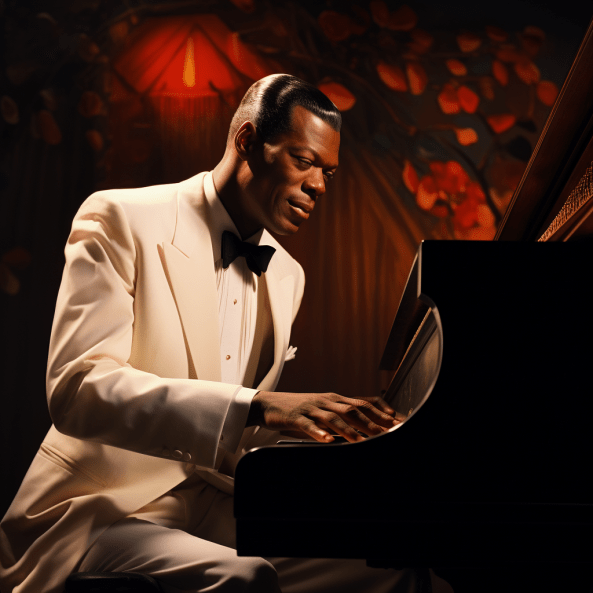
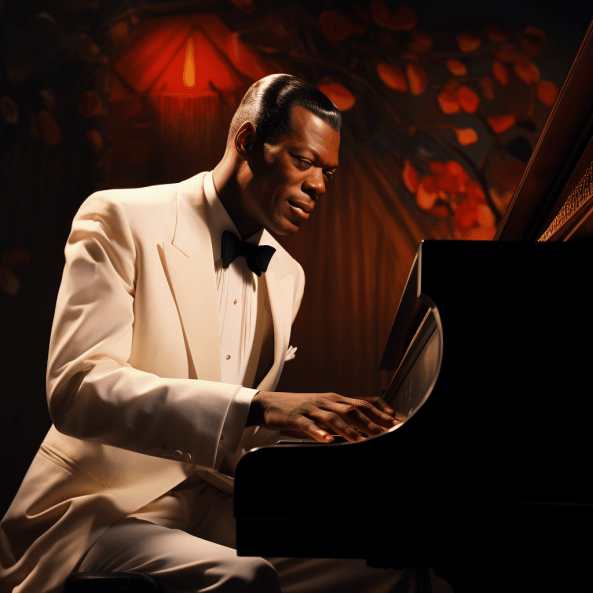
dressed immaculately. His signature look was performing in either a traditional
black tuxedo or a tuxedo with a white dinner jacket (custom-tailored, of course).
He also often wore two-piece suits (also custom-tailored). His hair was always
styled to perfection, his skin was pristine, and his smile was warm and brilliant.
Cole had a very distinctive style of playing the piano – his audience could never
tell how technically difficult his playing and singing actually were because he
made them both appear to be effortless and organic. Once Cole left his days as the
bandleader and featured performer in the King Cole Trio behind and began
performing as a solo artist, his stage mastery as a vocalist became as apparent as a
comet blazing around a pitch-black sky. Cole somehow mastered the art of
performing to an individual rather than to a crowd. This was especially the case
during his performances on “The Nat King Cole Show” on NBC. Cole’s utter
smoothness, his eye contact with the camera as he played and sang, his debonair
appearance and his undeniable talent made him the most accidental sex symbol of
the 1950s. American women – Black, White, Latina, etc. – were drawn to Cole.
Black men – at least the musically inclined and non-jealous ones – appreciated
Cole. White American men, however, were none too pleased by Cole’s magnetism.
The mere possibility that Cole might be singing about their wife or fiancée or
girlfriend or mother or sister as he crooned “Mona Lisa,” “Unforgettable,” and
“Too Young” deeply offended them individually and collectively. Typically,
adoring women fantasize about a male sex symbol – to the extent of… well, you
get the point (pun intended). The White patriarchy in America couldn’t tolerate
White American women screaming for, fainting at the mere sight of, intentionally
purchasing the music of, and flocking to the concerts so they could be in the
presence of, and (worse yet) faithfully watching a weekly TV show on a national
network bearing the name of a Negro man. Perhaps Cole was too cool. Too
handsome. Too talented. Too well-dressed. Too charming. Too intelligent. Too
articulate. Too damn stylish.
What did Nat King Cole contribute to American society financially? Cole made a
lot of money for a lot of people in the entertainment industry. Sadly, only a small
fraction of that vast wealth ended up in his own coffers. Yes, Cole had lived in a
palatial house in Bel Air (the ultra-exclusive conclave for the rich and the famous)
with his wife and five children. Yes, he owned very nice cars. Yes, he was in fact
world famous. These were all facts. Cole sold over 50 million albums; a milestone
by any definition. Although he appeared as a regular guest on the most widely
viewed network TV programs of the 1950s – including “Texaco Star Theatre,”
“The Jackie Gleason Show,” “What’s My Line,” “Ford Star Jubilee,” “The Ed
Sullivan Show,” “The Jack Benny Program,” and “The Dinah Shore Chevy Hour,”
the vast majority of Cole’s money came from his tours throughout the country and
throughout the world. Despite appearing as an actor in 43 theatrical films, TV
movies, film shorts, and documentaries, Cole wasn’t considered to be as good an
actor as his contemporary, Frank Sinatra; therefore, he was not afforded the
opportunity of a secondary career as a movie star or a Broadway star. The
phenomenon of a big musical star being invited to his or her own platform via radio
or satellite radio was decades away. Because Cole died in his 40s, he was denied
the ability to be mass-marketed to and to perform for the next generation (or two)
of people who would surely have become his fans. For all the money Cole made in
his lifetime – which was considerable – it pales in comparison to the money he
could have made and would have made had he lived.
What did Nat King Cole contribute to American society culturally? Jesus is
unquestionably the reason for the season of Christmas. After all, Christmas is the
annual celebration globally of the day our Lord and Savior was born into this
world by choice – fully divine, yet also fully human. Having said that, Nat King
Cole’s classic ode to Christmas is the perfect musical soundtrack to and for the
Christmas season. Do you know anyone, anywhere, who doesn’t adore Cole’s
performance of “The Christmas Song?” No, you don’t. Have you ever known
anyone, anywhere, who didn’t adore Cole’s “Christmas Song?” No, you haven’t.
You can agree or disagree with me on this, but the two greatest Christmas songs of
all time remain [1] Nat King Cole’s rendition of “The Christmas Song” and [2]
Donnie Hathaway’s rendition of “This Christmas.” If you agree with me, you’re
right. If you happen to disagree with me on this, you’re wrong. Period.
What did Nat King Cole contribute to American society racially? Cole was the
embodiment of Black excellence. A textbook example of the original recipe of
what was called the American dream: a person born into humble beginnings
framed by limited economic and educational resources who ultimately achieved
wealth, fame, and power through hard work and unparalleled abilities despite the
social and cultural limitations (in Cole’s case, based on his race).
What did Nat King Cole contribute to American society politically? In 1956, Cole
was asked to perform during the nationally televised birthday celebration for
President Dwight D. Eisenhower. Eisenhower was a Republican; as was the vast
majority of African Americans at that time. Cole’s song during that telecast,
“That’s All There Is to That,” was by all accounts very well received. I’m not sure
at all that you understand how momentous it was for the then President of the
United States – a White man widely recognized as the leader of the free world – to
invite somebody (anybody) Black to his birthday party. It was a huge deal. And is
still a huge deal all these decades later. In 1960, Cole was invited to perform at the
Democratic National Convention in support of Senator John F. Kennedy. In case
you are unaware, Senator Kennedy defeated his Republican opponent in the 1960
presidential election. The margin of JFK’s victory was 112,827 votes – or 0.17
percent. It’s safe to say that Cole’s enthusiastic support of Senator Kennedy was a
contributing factor for him to have secured the presidency. As a direct result, Nat
King Cole was granted the honor and the access of consulting with President
Kennedy and his successor, President Lyndon B. Johnson, on the matter of civil
rights.
It should go without saying that Nat King Cole was not a perfect human being. He
was a prolific smoker of cigarettes – and his chain-smoking habit led directly to his
death at the young age of 45 due to lung cancer on February 15th, 1965. Cole was
twice married – first to a dancer named Nadine Robinson in 1936 – and again to a
singer named Maria Hawkins Ellington in 1948. Cole was known to have briefly
had a mistress (actress and singer Gunilla Hutton) during his second marriage.
Despite the racial strife he had experienced on and off throughout his life, Cole was
slow to become an advocate for racial equality and justice. Cole’s performance on
stage at the Birmingham (Alabama) Municipal Auditorium on the evening of April
10th, 1956, would permanently change his mind about that stance. According to
Cole’s good friend and biographer, Daniel Mark Epstein, “He went down to the
South to perform with an interracial band, which was pretty bold and offensive to a
lot of whites. But then he agreed to play for segregated audiences, which offended
his black audience. The White Citizens Council of Alabama had this plot to kidnap
Cole from the theater. The plot failed, but the hoodlums did storm the stage, (and)
break up the performance. They knocked Nat Cole off the piano bench and injured
his back.” Cole was quoted in the press immediately following the incident as
having said, “I can’t understand it. I have not taken part in any protests. Nor have I
joined an organization fighting segregation. Why should they attack me?” Cole
received a terse telegram from Roy Wilkins – the Executive Secretary of the
NAACP’s national office. That telegram said: “You have not been a crusader or
engaged in an effort to change the customs or laws of the South. That
responsibility, newspapers quote you as saying, you leave to the other guys. That
attack upon you clearly indicates that organized bigotry makes no distinction
between those who do not actively challenge racial discrimination and those who
do. This is a fight that none of us can escape. We invite you to join us in a
crusade against racism.” Cole did indeed join the crusade. He spent the rest of his
life challenging racial discrimination, financially contributing to civil rights groups
and causes, and joining the boycotts against racially segregated venues. Cole even
became a lifetime member of the Detroit branch of the NAACP.
Like so many of the greatest Black singers, Cole first sang and played piano in the
Church. And what greater legacy could Nat King Cole have had aside from his
own contributions to this country and this world than his namesake – his daughter,
Natalie – reaching fame and fortune on her own terms musically?
Black History Month – contrary to what American society is convinced to be true –
isn’t for White people; it’s actually for us. Black History Month is a mechanism for
African American mothers and fathers and grandmothers and grandfathers to teach
their children and their grandchildren that there was, there is, and there will not be
American history without African American history. We use our own heroes (such
as Cole) to teach our own young people that Black excellence is achievable,
believable, and conceivable. In that regard, every month is Black History Month.
Every week is Black History Week. Every day is Black History Day. Our ability to
embrace these truths in our minds, our hearts, our spirits, and our souls can fertile
the seed that can bear forth the next Nat King Cole.
As Cole himself famously sang, “Straighten Up and Fly Right.” Well played,
Brother Cole. Well played.
As I close, do yourself a favor sometime soon. Hop on Apple Music or Spotify or
Tidal Sirius XM or YouTube. Use Google if necessary. Pull up any one of Nat
King Cole’s singles or albums. Listen to the power, the beauty, the swagger of that
man’s music, and try telling me you weren’t transfixed by such a transcendent
voice.
Mr. Cole, I humbly dedicate this piece to you, your music, and the positivity
you’ve brought to my life. You were far ahead of your time. Actually, your music
was timely – and is timeless. I appreciate you, Sir. Thank you. Happy Black
History, my brothers and sisters.

Discover more from Three-Fifths
Subscribe to get the latest posts sent to your email.

 Three-Fifths
I like this article. Dr. Michelle Ned, Doctor of Behavioral Health
LikeLike
Thanks for helping me to learn a lot more about such a gifted artist. Knowing Cole’s back story makes his success but lack of being able to truly enjoy or benefit from it, all the more tragically unjust. I would very much like to share this on my Facebook feed but am not sure if that’s allowed. Thank you again for a terrific and deeply affecting piece of writing.
Cyndi.
LikeLike
of course you can share this!
LikeLike
Thanks for helping me to learn a lot more about such a gifted artist. Knowing Cole’s back story makes his success but lack of being able to truly enjoy or benefit from it, all the more tragically unjust.
I would very much like to share this on my Facebook feed but am not sure if that’s allowed.
Thank you again for a terrific and deeply affecting piece of writing.
Cyndi.
LikeLike