
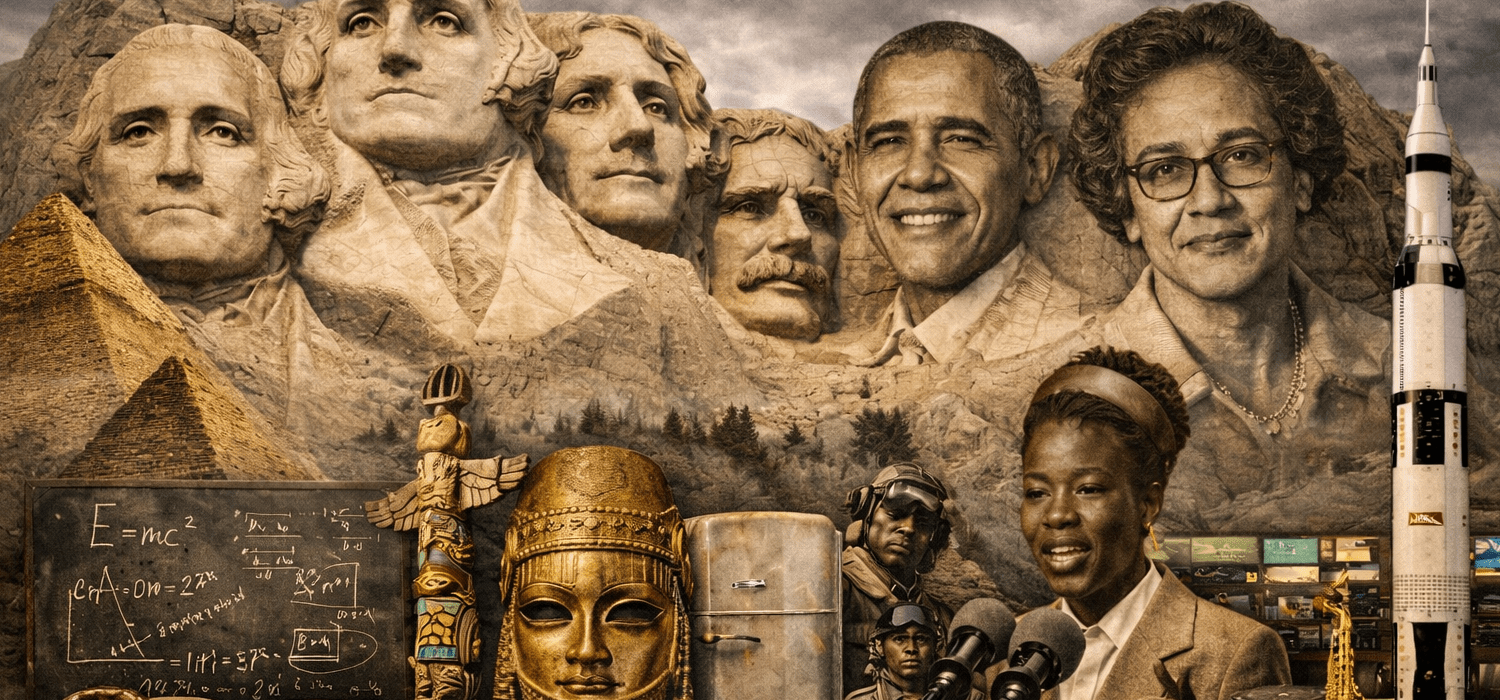
Living at the intersection of Blackness and femaleness, I learned early where society expected me to stand. I am often at the lower end of the totem pole. There is one, you know.
Luckily, I was raised in a multigenerational household full of women who had very different expectations for themselves and for me. They were women who achieved things beyond what women of their time were expected to do, becoming nurses, travelers, award winning songwriters, business owners in a time when separate was not even close to equal. They rose above. Their presence did not erase the world outside, but it did give me a counterweight, a sense that there were other ways to exist beyond what was prescribed.
Because growing up as a first generation, post Jim Crow kid helping to integrate schools in a barely no longer segregated Houston, even without the formal language, the ceiling of Black femaleness was already clear. It was the low hum beneath everything. It was in the television shows I watched, where beauty had already been decided. Blonde hair, blue eyes. It was in the textbooks where entire peoples and their contributions were missing. It was in the spaces that seemed to close before I ever entered them.
That was the totem pole.
It was not loud. It was constant.
You do not need the vocabulary for a thing to understand its shape. Your body learns the limits long before your mind can name them.
So I grew up inside that knowing. Through the small, uncountable slights of childhood. Through what was present and what was missing. Through what was celebrated and what was ignored.
And then, later, it was named.
Back in Comms 101, my first semester away from home and in college, I got to learn that officially. White man, white woman, Black man, Black woman. Clean. Ordered. Uncomplicated.
Yup. Welcome to adulthood.
But it did not feel like new information. It felt like confirmation. Like someone had finally drawn the outline of something I had been living inside my whole life.
So when I began to learn and unlearn history, I saw, with pain, my oppression on full display.
There were composers, politicians, historians, empire leaders, philosophers, scientists, inventors whose contributions had been kept from me. Power and renown had been intentionally placed as crowns on the heads of a small percentage of society, and across the globe, that pattern caught on.
That is a bitter pill for me and hard to see for those who have been centered by that narrative. Even when intentionality is debated, the idea that so many could move through the world without noticing they were not the only brilliance in the room is its own kind of revelation. To not look around and share the shine makes me wonder what kind of story we have been taught about worth and belonging.
So yes, there are moments when all of that makes my heart feel heavy.
When I see light skinned Nigerians dominating Nollywood and light skinned Mexicans filling the lead roles in telenovelas, I cannot help but see a loss of acknowledgment of beauty in all shades. Even when I, as a lighter skinned Black woman, am approached by someone who believes calling me redbone is a compliment, I feel the sadness of how deeply color hierarchies have shaped our sense of self and desirability.
And I have had to unlearn something else, too.
I have had to unlearn the belief that people in power do not feel pain and loss.
There are days when my anger and pain are crushing, when the stupidity that greed, power mongering, and colonization have unleashed on the world shows up in every news headline, in every conversation, in every social feed someone wants to send me to. Something better than that, because honestly, I watch puppy videos.
But even in that, I have had to let go of the idea that oppressors do not themselves experience loss.
Like a big toddler welcoming a new sibling, people who feel like they are being pushed out do not always recognize the beauty of what is actually being offered, the expansion of love, the possibility of wholeness, the invitation into something more connected.
How many adults, if they are honest, would wish their siblings away?
And still, let me be clear.
This is not the fodder of giving people a pass because it was another time, or because their pain is the same as mine. It is not.
Pain combined with power, from where I sit, does not begin to touch pain combined with struggle.
I stand in power, the dreams of my ancestors embodied, and yet I bear the ancestral wounds, wounds that meet the cold, rainy weather of today’s nouveau racism, producing deep aches that always know the weather.
The work I have done to help people understand others, other religions, genders, sexualities, cultures, is always a bit lopsided.
Not because it does not deserve to be.
I mean, you triage the injured first.
But the people in the waiting room, perhaps even the medical staff themselves, they too may be working under duress, stress, injury.
And unlike those people, who have the privilege of our sympathy, people in power experiencing loss are often left out of the work.
They, even without knowing it, are the silent losers.
Loss of identity and heritage, because whiteness, as it is practiced, is not an ancestral identity in the same way. Loss of identity as the majority, because most of the world exists in shades of brown. Loss of identity as the gold standard, the status quo.
As people begin to reclaim older ways of knowing through spirituality, science, and history, as cultures begin to recognize that the roots of civilization trace back far beyond the narrow story we were told, as we begin to see histories instead of a single polished, prepackaged version that has been sold to the world, it is shifting.
And that shift feels like loss to some.
And that is where I have had to sit.
Not in agreement. Not in equivalence.
But in understanding what I am actually witnessing.
I can see it now.
Not to excuse it. Not to soften it. Not to pretend that understanding makes it equal. It does not.
But to understand what I am being asked to hold.
Because I stand in power, the dreams of my ancestors embodied, and still I carry what they carried. The knowing. The ache. The memory that lives in the body whether we name it or not.
And I can see, too, what others are losing. Not in the same way. Not with the same cost. But I can see the disorientation. The unraveling of a story that told them they were the center of everything.
I do not have to agree to recognize it. I do not have to diminish myself to make space for it. I do not have to forget to move forward.
But I also do not have to harden.
So I choose something else.
I choose to stay open without collapsing my truth. I choose to see clearly without losing myself. I choose to carry both the wound and the power without confusing them.
And I choose to unlearn.
I choose to unlearn what I was taught about where I belong. I choose to unlearn what the world told me was missing in me. I choose to unlearn what it means to be at the bottom of a structure I did not build, a totem pole that is more specter than structure, losing meaning every day.
I choose to reclaim what was always mine. The fullness. The brilliance. The knowing that was never absent, only obscured.
I choose to unlearn this for myself. For my children. For their children.
For the kind of wholeness we deserve to feel, even here, inside a world still clinging to an old story, losing meaning to the truths unfolding like the dawn of a new day.
Discover more from Three-Fifths
Subscribe to get the latest posts sent to your email.
 Three-Fifths