
I arrived at Three-Fifths Magazine in year five, not at the beginning. I did not walk with this platform through every turn of the last half decade. My byline is new. My eyes are not.
What I stepped into was not simply a publication, but a witness. A living codex. A record with a pulse. A place that does not let America slip into amnesia. Three-Fifths is not a neutral title, nor is it a clever one. It reaches back to the arithmetic of betrayal, to that constitutional lie that measured Black humanity for the comfort of white power and the convenience of the state. The name tells the truth before a single sentence is read. This country has always known how to draft beautiful promises and withhold them from the very people whose labor, blood, prayer, and brilliance helped build the house.
Here is the singular truth I cannot unsee.
America keeps revisiting old battles because it has mastered the performance of justice while protecting the systems that profit from division.
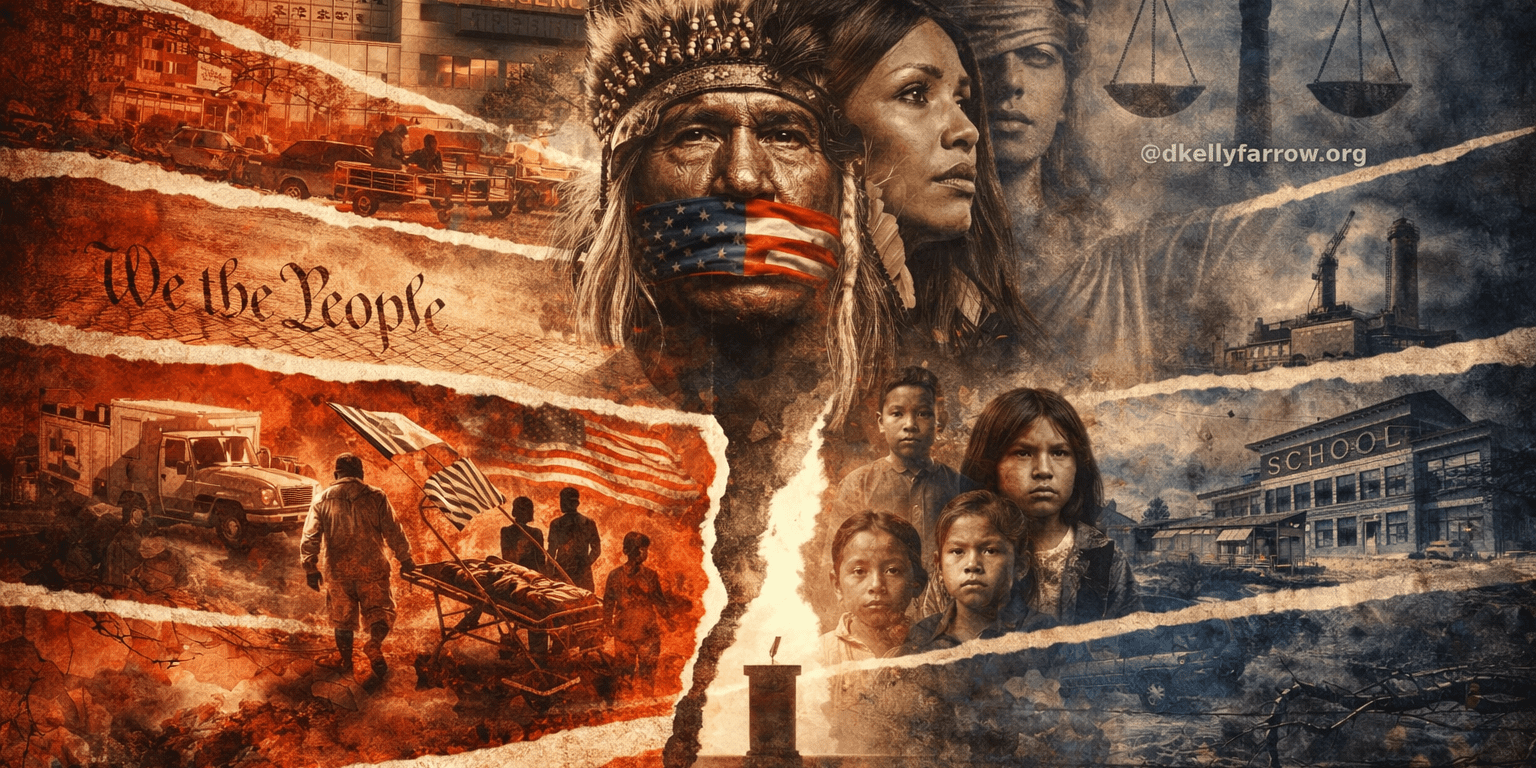
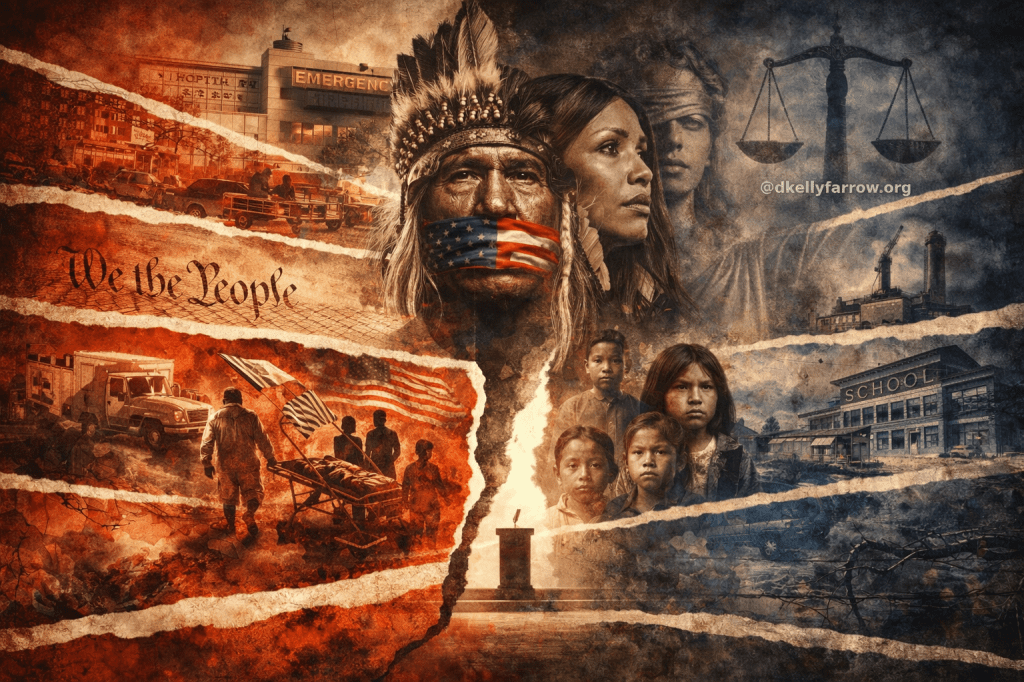
That performance is polished. It wears a navy suit and red tie at the podium, a flag pin on the lapel, sorrow in the voice, and strategy in the pocket. It appears beneath the soft lights of the press room. It steps to the microphones after the funeral of children killed by AK-47s, offering hollow prayers and thinner condolences. It posts the black square, hosts the town hall panel, forms the commission, lowers the flag, then slips right back into the same old mechanical gears by morning. It knows how to look burdened without being altered. Performance knows, with polished sophistication, how to borrow the language of grief while keeping the engine of harm running hot. In America, moral crisis is often handed a press secretary, a logo, and a deadline, but rarely what it needs for wholeness.
That is what I mean by performance. It is the theater of concern. Sorrow with a media team to control the optics. But it never houses repentance, nor redistribution. Justice in America is a dress rehearsal. He has mastered the art of sounding transformed while refusing to surrender power.
The performers are not hard to find. Just watch the White House when it drapes exclusion in the language of merit, while having a double standard of discipline for the poor and indulgence for the powerful. Sit with legislatures when they call the stripping of protections “common sense,” while turning dispossession into policy and calling the wound wisdom. Watch universities when they celebrate Black visibility while gutting the very structures meant to widen access. Watch corporations when they feature Black faces in glossy campaigns, then retreat from equity commitments the moment the market or the political wind shifts. Watch cultural institutions when they grow nervous around the full truth of slavery, conquest, segregation, and theft, and start editing the national story into something easier to swallow. That is not transformation. That is costume.
But none of this began yesterday.
This is a country that declared all people created equal while Indigenous nations were dispossessed, Black bodies were bought and sold, and the Constitution itself was made to accommodate bondage. This is a nation that promised liberty, then gave us Reconstruction’s collapse, Jim Crow’s iron hand, and the incineration of Greenwood in Tulsa. This nation birthed redlining, voter suppression, segregated schools, and a long habit of calling theft “order” to maintain its proximity to power. Isabel Wilkerson helps us see it plainly in Caste when she writes, “Caste is the bones, race the skin.” Michelle Alexander names one of its modern afterlives in The New Jim Crow when she writes, “We have not ended racial caste in America; we have merely redesigned it.” The costume changes. The acting and actors remain the same. America has a long habit of changing the costume while keeping the blade sharpened and trading old uniforms for new language while preserving the same appetite for domination.
The phrase old battles does not go far enough for me.
These are not dusty disagreements left over from another century. These are recurring betrayals and rehearsed evasions. This is the aftermath of conquest, captivity, and caste still moving through policy, moving through neighborhoods, and moving through bodies. Eradicating Black Wall Street was not an accident. Jim Crow was not misfortune. Redlining was not oversight. The betrayal was structured, etched in law and stone, then engrafted into the heart of this nation and bled through the skin of its pigmented people. Let’s remember, the forgetting is structured too.
Somebody is always eating from this division.
Power eats from it. Campaigns grow fat on it, while news cycles starve for truth even as heart disease ravages the network. The prison economy, over the last century, has put on its weight from the same poisonous meal. Ava DuVernay’s 13th laid that bare with chilling precision, showing how America’s gut-deep decay of slavery moved through the loophole of the Thirteenth Amendment, through criminalization, through convict leasing, and into the swollen belly of mass incarceration. Division is a dish served warm and juicy, and fear merchants swallow it slowly until anxiety becomes appetite.
The politics of resentment, scarcity, and suspicion keep a lot of people paid. Meanwhile, whole communities are left to make a miracle out of almost nothing. Schools strain under neglect. Hospitals close. Neighborhoods flood with surveillance and starve for care while public housing crumbles. Groceries cost too much. Oil is high as hell! Rent costs even more. Still. The prophet Tupac said, “they got money for war but can’t feed the poor.” Dang, he ain’t never lied.
Tupac’s line has kept circling back across the decades since it first dropped because it still exposes the lie. This nation can always find money for punishment. There is always money for jails, drones, raids, riot gear, walls, patrols, and military pageantry. There is always money for spectacle. There is always money for control. Yet let the conversation turn toward housing, healthcare, food security, maternal care, public schools, clean water, mental health, living wages, and the ordinary conditions that let people breathe, and suddenly the pockets turn inside out and the sermon becomes austerity. Our poor are told to be patient. Our hungry are shamed into “be disciplined, get a job.” The wounded are told not to make everything about race, yet historically we are continually erased and told to prove, again and again, that exclusion doesn’t exist.
History, then, is not behind us like an old photograph curling at the edges.
It lives in the body.
It settles in the jaw of a mother as she teaches her son how to survive a traffic stop and her daughter how to claim the agency of her own body: “Keep your hands where they can see them. Do not reach too fast. Come home alive. You do not owe access for love, silence for peace, or surrender for approval.”
It rides the shoulders of fathers and grandmothers who know one emergency, one hospital bill, one police encounter, one school decision can rearrange an entire life. It lodges in the spine of Black women who enter rooms already reading tone, threat, access, temperature, and danger before they ever sit down. It hums in children who learn early which neighborhoods welcome them, which stores watch them, which teachers misread them, which sidewalks they can stroll and which ones they must cross with caution. Our nervous systems have become archives. Our flesh remembers what official language tries to smooth over.
Policy breathes it into our bones and etches it on our skin. You can read it in district lines that sort children before they ever open a book. We see it cleanly in zoning maps and mortgage approvals. The eyes of Lady Justice are not truly blind. We know she peeks under the blindfold in sentencing hearings because our eyes are opened to the disparities. Maternal mortality rates among Black mothers unfold it in the birthing room. Dr. Eboni Marshall Turman states, “Racism starts in utero” and it does. Black communities on the edge of Lake Pontchartrain recall it in the denial of flood protection and stolen home equity. We hear it in the difference between how protest is named in Black streets and how violence is explained away when it arrives wearing white patriotism. We feel it when public memory gets edited and book access grows timid. We smell the salt and sweat off Black skin when slavery becomes unfortunate labor, when conquest is rewritten as expansion, and when history is trimmed until innocence can fit back into the frame that whiteness wants to hang in its hallowed halls.
We are often told that America is divided because we disagree.
No.
America is divided because this country keeps trying to negotiate with what God has already judged. America is divided because too many invested in the infection want the music of justice without the proper rhythm of a waltz. They want the anthem, but not the Ole’ Negro spirituals. They want the language of protection and change, but not the disciplined turning that could set a country right side up. What America really needs is a proper dance instructor to show him how to lead the dance and do justice, not merely memorize the mechanics of the steps. This refusal to dance in step with all his partners has scarred families, thinned communities, stained the soul of the nation, and left us all without syncopation.
That is why Micah still rises from the page with force.
He has shown you what is good.
Not hidden it behind a degree.
Not buried it beneath performance.
Not reserved it for the powerful.
Shown YOU.
“And what does the Lord require of you but to do justly, and to love mercy, and to walk humbly with thy God?”
The requirement is practice, and the prerequisite is a death to the lie.
To do justly means telling the truth about who is being crushed and who is being cushioned by the arrangement. It means refusing the narcotic of vague progress talk. It means looking straight at segregated schools, racialized wealth gaps, dispossessed neighborhoods, and public systems that still ration dignity unevenly, then calling those realities by name. It means rejecting the seduction of symbolic victories that leave material realities untouched. It means understanding that commemoration is not consequence. A public statement is not structure. A holiday is not healing. Visibility is not vindication. Diversity language, by itself, does not put resources where they have long been withheld.
To love mercy does not mean becoming soft about human evil. It means staying human while naming it. Mercy keeps the struggle from curdling into cruelty. Mercy keeps the heart from becoming the very thing it resists. Mercy tells the truth without surrendering tenderness. Mercy leaves room for transformation, but it does not lie about the wound, dilute the damage, or confuse delay with redemption.
To walk humbly with God means remembering that none of this work belongs to our vanity. Humility keeps witness from becoming another stage and righteous vocabulary from turning into ego dressed for Resurrection Sunday. It keeps the writer, the creative, the preacher, the activist, and the scholar under holy governance. In a bloodthirsty country, humility is one way to keep your hands from reaching for applause when they should be reaching for surrender and easing affliction.
I arrived at year five, and I arrived clear.
My resolve is not to be dazzled by eloquent evasions.
My resolve is to watch where the money goes.
My resolve is to keep writing toward the actual and telling truth even in discomfort.
To watch who gets protected. To watch what gets dismantled and what gets dressed back up in gentler language.
To watch whose history is being maligned, whose grief is being welcomed, and whose pain is still being asked to wait its turn.
I am the watcher on the wall, called to guard the realms of humankind.
To keep naming the difference between staged concern and lived experience.
To keep giving my family and my community language sturdy enough to spot the trick when it shows up wrapped in a flag, tucked inside a policy memo, standing in a pulpit, smiling in a campaign ad, or glowing from a university brochure.
Across five Aprils, America is still trying to convert moral obligation into spectacle. Still trying to call delay discernment. Still trying to make theater look like transformation.
Three-Fifths Magazine matters because some of us are still unwilling to let the nation hide behind its costumes. Words, when they are honest, can become witness. Witness can sharpen memory. Memory can call a people to movement. Movement can alter policy. Policy can widen breath.
That is the long road.
That is the hard road.
That is still the road.
So, I will keep writing.
I will keep naming the pattern.
I will keep refusing the costume.
I will keep reaching for language that does not merely sound righteous. Instead, I will help us live nearer to what righteousness surely requires.
God has shown us what is GOOD. Now we must let IT cut us open and build us clean.

Dr. Kelly U. Farrow
Discover more from Three-Fifths
Subscribe to get the latest posts sent to your email.
 Three-Fifths