
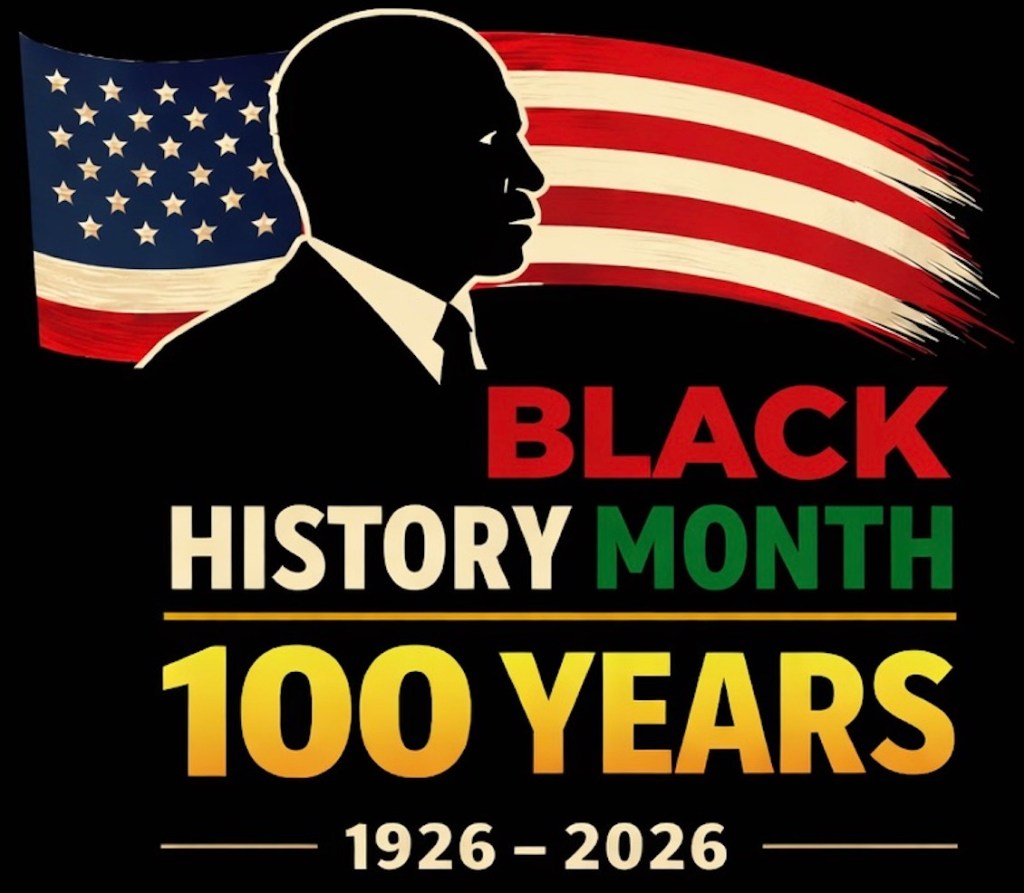
What if Dr. Carter G. Woodson’s vision had fully come to pass? When he established Negro History Week in 1926, he did not intend to create a permanent observance. His aim was far more ambitious and far more American. Woodson believed that the study of Black history would eventually become so normalized, so deeply embedded in the nation’s understanding of itself, that a separate celebration would no longer be necessary. Negro History Week was meant to be corrective, not permanent, a bridge toward a fuller and more honest telling of the American story. Nearly one hundred years later, as Black History Month reaches its centennial and the United States approaches its 250th anniversary, that unfinished vision comes sharply into focus. This convergence is not coincidental. It is a measure of progress made and of progress long delayed.
Woodson’s life story is inseparable from the contradictions of the nation he sought to improve. Born in 1875 in Virginia to parents who had been enslaved, he came of age during the collapse of Reconstruction, when the promise of freedom was steadily withdrawn from formerly enslaved people. Poverty defined his early years. Education was sporadic and inaccessible. Like many Black Americans of his generation, Woodson worked manual labor jobs, including time spent in coal mines, while educating himself through independent study. He did not complete high school until his early twenties. Yet his determination carried him forward, first to Berea College, then to the University of Chicago, and ultimately to Harvard University, where he became only the second Black American to earn a doctorate in history. His academic ascent stood in stark contrast to the lives his parents were allowed to live, and it sharpened his understanding of how deeply the denial of education shaped inequality in America.
Woodson recognized that the exclusion of Black history from American education was neither accidental nor benign. It was systemic, and it had consequences that reached far beyond one community. In The Mis-Education of the Negro, he issued a warning that still resonates today:
“Those who have no record of what their forebears have accomplished lose the inspiration which comes from the teaching of biography and history” (Woodson, 1933).
This insight was not limited to Black Americans. It was a critique of the nation itself. A democracy that withholds truth from its people undermines its own future. When young people inherit a distorted version of history, they inherit a distorted understanding of citizenship, responsibility, and possibility. Woodson understood, much like the nation’s founders before him, that self-government depends upon an informed populace. While the founding generation failed to extend this ideal equitably, the principle remains clear. Education is not ancillary to democracy; it is foundational.
Over time, Negro History Week evolved into Black History Month, not because Woodson’s vision had been fulfilled, but because it had not. The expansion of the observance reflected the nation’s continued refusal to integrate Black history fully into its educational, cultural, and civic life. This reality does not diminish the importance of Black History Month. The celebration remains necessary, meaningful, and powerful. It has preserved stories that might otherwise have been erased and has provided generations with language, pride, and historical grounding. But necessity is not the same as fulfillment. Woodson did not seek separation. He sought normalization. His work through the Association for the Study of Negro Life and History was intended to weave Black scholarship into the fabric of American intellectual life, not to confine it to a designated space.
Today, the nation finds itself confronting a familiar pattern. Black history exhibits are being removed. Diversity, equity, and inclusion initiatives are being dismantled or framed as threats rather than investments. Educational efforts that challenge power are increasingly politicized. These moments echo earlier chapters in American history, when progress was met with backlash and comfort for some was preserved at the expense of justice for others. Two hundred and fifty years ago, liberty was proclaimed while millions remained enslaved. Today, historical truth is often celebrated rhetorically while suppressed in practice. Woodson encountered similar resistance in his own lifetime, barred from mainstream academic institutions and forced to build parallel structures to preserve truth. The persistence of this pattern underscores why his work remains unfinished.
A stronger America is not one that avoids its history. It is one that confronts it honestly. Education does not weaken a nation; it fortifies it. Economically, socially, and politically, democracies thrive when citizens understand where they come from and how their systems were built. Woodson understood that Black history is central to understanding American labor, American democracy, American resistance, and American possibility. To know Black history is to better understand the nation itself. If the ideals of “We the People” are to mean more than aspiration, then Woodson was not challenging America. He was completing it.
Carter G. Woodson deserves to be remembered as a great American hero and a principled patriot. Not because he ignored the nation’s failures, but because he believed deeply in its potential. His life’s work was an act of faith in the American experiment, rooted in the belief that truth strengthens democracy and education sustains freedom. He cared profoundly about the longevity of Black Americans, but also about the longevity of the republic itself. As the nation reflects on both a century of Black History Month and 250 years of independence, the question Woodson posed remains unanswered: Will America finally tell its full story, or will it continue to rely on a month to compensate for its reluctance to do so?

Educator & Future Public Servant
(Inspired by those who led with truth)
Sources (for reference or publication)
Woodson, Carter G. “The Origins of Negro History Week.” Journal of Negro History 11, no. 2 (1926).
Woodson, Carter G. The Mis-Education of the Negro. Washington, DC: Associated Publishers, 1933.
National Park Service. “Carter G. Woodson.” U.S. Department of the Interior.
Encyclopedia Virginia. “Carter G. Woodson (1875–1950).” Virginia Humanities.
Library of Congress. “Black History Month.”
Association for the Study of African American Life and History (ASALH). Founding mission and historical records.
Jefferson, Thomas. Notes on the State of Virginia.
Madison, James. The Federalist Papers.
Adams, John. Selected writings on education and civic virtue.
Discover more from Three-Fifths
Subscribe to get the latest posts sent to your email.
 Three-Fifths