
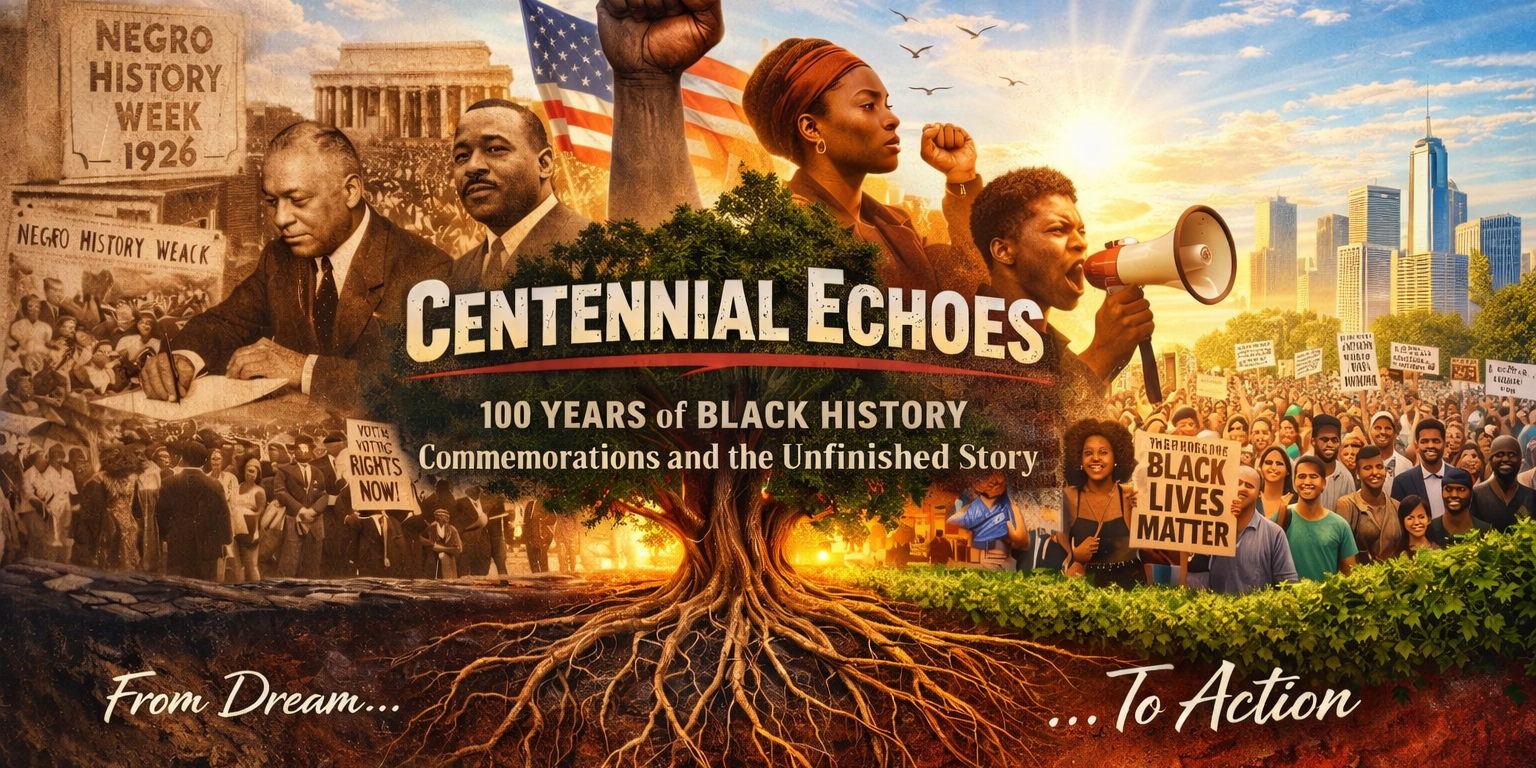
This February, we observe the 100th anniversary of Black History Month. What an enduring dynamic of sustenance, and against all odds, no matter how steep those odds were, this cultural legacy has survived so long. Surviving many liberation-quenching moments and piercingly strong and sustained periods of backlash. All the whiles draw us out and take us back to the wise words of scripture. Rehearsed through multiple generations, combined into a single course of yearning survival in a clear voice. “How can we sing the Lord’s song in a strange land?” Psalm 137:4
Who was Negro History week’s architect and founding progenitor. It was none other than Carter G. Woodson who gave all melanated castaways of the triangular trade reason to celebrate survival by singing that song in spirit and in silent resistance to the status quo, in whatever way it manifested, in spite of. Though the two had nothing to do with each other, their parallel paths clearly resonate with the denial. That song would first be realized during the first Negro History Week. But who was this Carter G. Woodson? His name always sounded familiar. From where, I did not know. Until, like a phantom, a memory flashed before me and was gone just as quickly as it came. After some time reflecting on a menagerie of tiny thoughts desperately searching for an osmosis-like connection able to stand up on its own as a thought that through the silence of patience, matriculated into an idea. He was in my family tree. Now, that really sparked my interest, so I had to know more. A distant cousin from the central part of Virginia, while most of my closer relatives navigated the lower extended regions along the North Carolina border.
The question posed in scripture by the population in captivity was how to bring joy and some sense of normalcy into this space where we were certainly not celebrated or even welcomed. Determined to turn this dirge into something to be bravely celebrated and boldly transferred to the Generations that followed.
NAAP.org notes that “Carter G. Woodson was a scholar whose dedication to celebrating the historic contributions of Black people led to the establishment of Black History Month, marked every February since 1926. Woodson fervently believed that Black people should be proud of their heritage, and all Americans should understand the largely overlooked achievements of Black Americans.”
He placed it in February because it was the month that shared the space with the birthdays of Abraham Lincoln and Frederick Douglas’ birthdays. These two important Historical figures were forever connected by their at times contentious, relationship, in which they had differing views of what a slavery-free post-Civil War America would look like. Despite their differences, the two moved forward to see its end.
To Keep It 100 would be to keep this month sanctified and set apart as a national month for the African American community to feel the perennial pride and sense of achievement, because this community has navigated the ebbs and flow of how to sing the Lord’s Song in a Strange land with the rhythm of survival that has stemmed from ancestors to the present day.
An article, “The American Spirit: What Does It Mean?” from the National WWII Museum, New Orleans, beautifully paints the imagination. Gordon H. “Nick” Mueller, PhD, brings to light the Spirit of America.
“We don’t have to look back too far—to 9/11, 2001, when America was subject to a sneak kamikaze attack on the Twin Towers. We all remember the shock, the fear, the anger—and then the overwhelming sense of national unity.
A common sense of the American Spirit brought us together against a new enemy that attacked us with the intent of undermining our system of beliefs, our economic and democratic way of life.
We were severely tested in that moment…
Later on the same article goes on to say, “A full century after Lincoln’s “Gettysburg Address,” in 1963, Martin Luther King Jr. delivered his famous “I Have a Dream” speech in Washington D.C., saying that America had yet to fully deliver on its promise of freedom and opportunity, that African-Americans still found themselves in many ways to be exiles in their own land.
“I have a dream,” he said, “that my four little children will one day live in a nation where they will not be judged by the color of their skin but by the content of their character. While it did not come easily, change did come, as Americans moved closer to the ideals of the Founding Fathers.” The American Spirit encompasses the complete story of America getting it right and many times, getting it wrong included in this we must never forget the ongoing plight of First Americans.
May we get this right by honoring part two of Woodson’s quest: ‘all Americans should acknowledge the overlooked achievements of African Americans.’ Now, more than ever before, Black History Month can take on the Teflon veneer of an educational resource system, conduit, and distributor of books, teaching series, documentaries, and films to effectively combat systemic erasure that has found a foothold in today’s culture. African American History can become a 365-day, 24/7 educational conglomerate of many archives to carry us through the next hundred years, serving as an intellectual engine to drive facts over narratives. Future months of February could turn into celebrations that assess the progress of the past year and establish new goals for the next.
Take a moment to imagine how it would look for those 100 years to majestically and organically take on something greater, literally being received by the totality of its inhabitants as American History featuring the African American Story. Something big enough and bold enough to be seen as a national month of liberty, justice, discovery, and achievement. Not just for some but for all. It alone stands as a most endearing expression of the proud American Spirit of overcoming adversity with an eye toward that More Perfect Union America Strives to be. Come on, America, we don’t have to keep it only 100; let’s take this thing all the way.

Discover more from Three-Fifths
Subscribe to get the latest posts sent to your email.

 Three-Fifths