
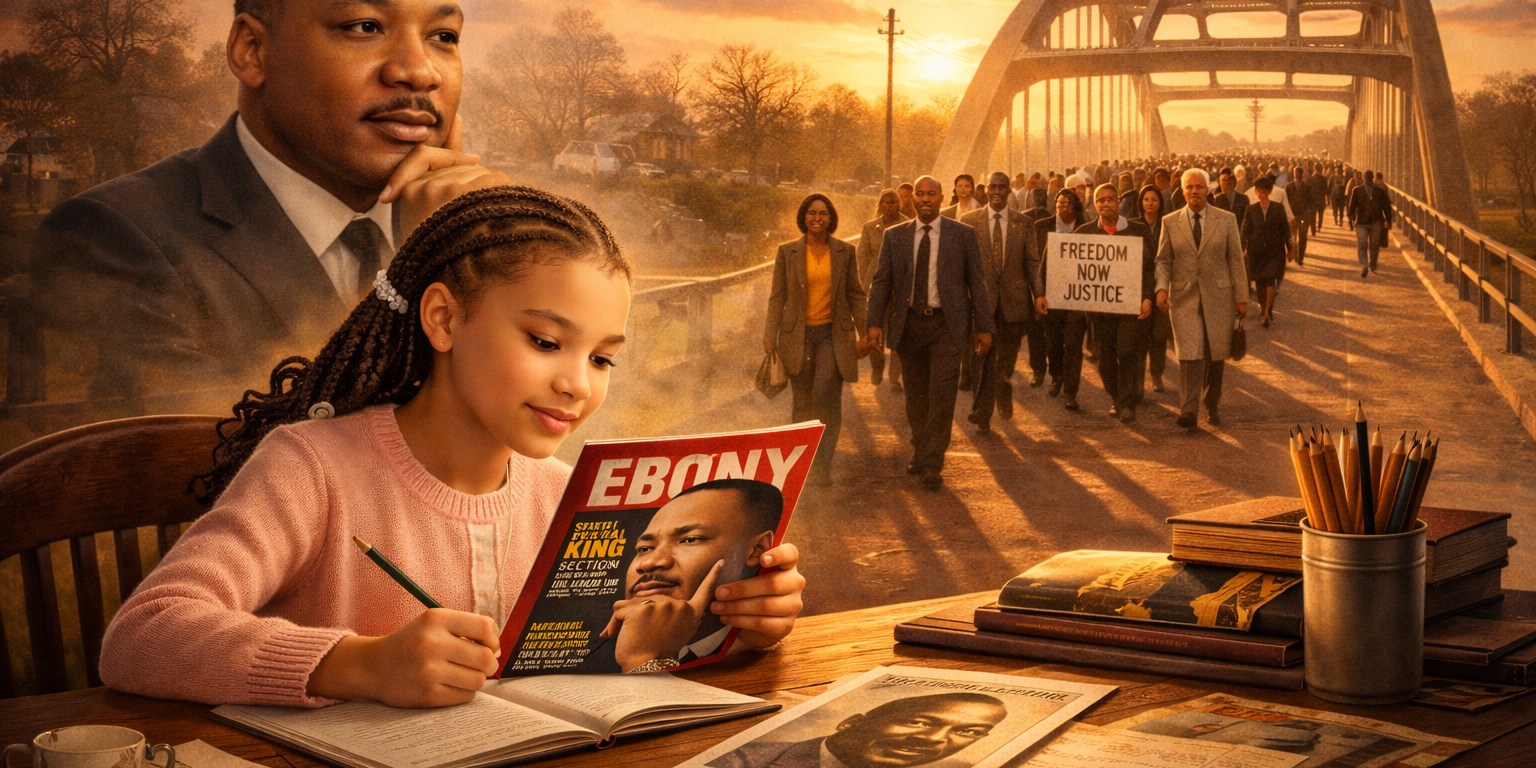
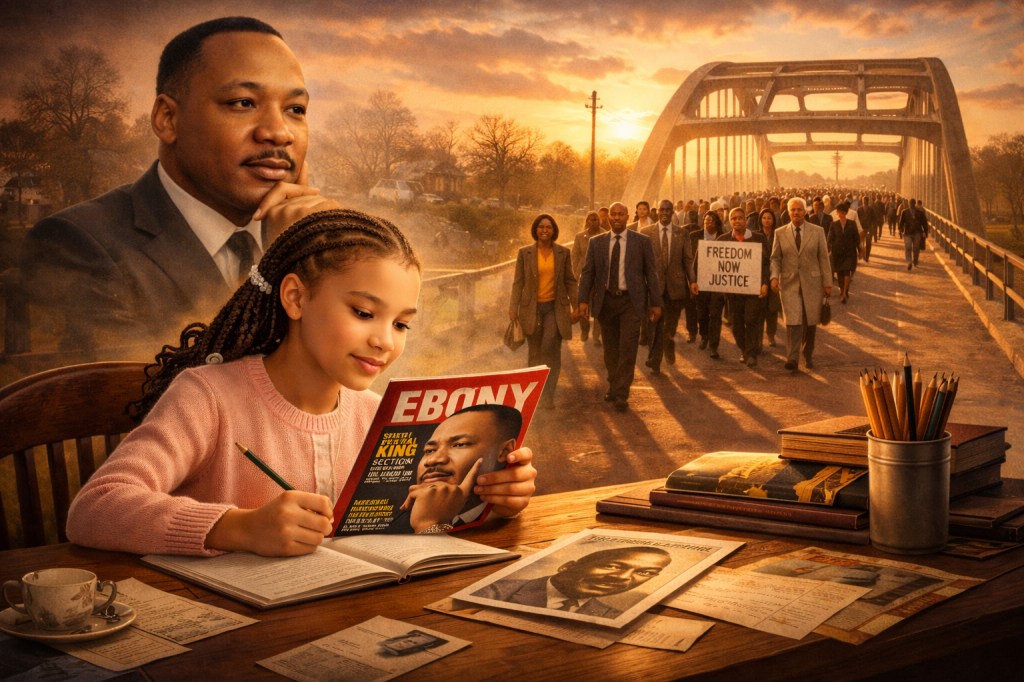
I met Martin Luther King Jr. in the fifth grade.
He met me on the January 1986 cover of Ebony magazine. “The Living King.”
The assignment was simple. Write about someone who inspires you.
I chose him, not because I understood the breadth of his sacrifice, but because something in his gaze held me. His stillness. His gravity. His refusal to perform comfort for approval. I remember the weight of that magazine resting in my small hands. I remember the kitchen table, the scrape of a pencil, the seriousness settling into my body before I had words for it. Even then, I knew this was not just an essay. It was a naming.
I got an A on that paper.
My grandmother still has the magazine. She still has the essay. Somewhere in her careful keeping lives the first written evidence of a calling I could not yet articulate. In that paper, I wrote that I wanted to be a Reverend Doctor like Martin Luther King Jr. I did not know what those titles would cost. I did not know the long obedience, the lonely stretches, the way truth presses on the body. I only knew that his life made me want to stand upright in the world.
King did not simply inspire me. He tuned me.
Through him, I learned that justice has a body. It breathes. It aches. It walks deliberately into danger without surrendering its soul. His life taught me that faith is not an escape hatch. It is a summons. That prayer without action collapses under its own weight. That love without discipline dissolves. That nonviolence is not softness, but rigor. A strength that requires command of breath, voice, nerve, and resolve.
Later, when I learned that King studied Gandhi, something settled deeper still. I recognized a lineage of embodied resistance. Men who offered their entire selves as instruments against injustice. Their posture became protest. Their breath became witness. Their willingness to absorb harm without yielding dignity rewrote my understanding of power. Moral authority, I learned, is not seized. It is carried.
King changed how I see the world by shattering the myth that progress is inevitable. It is not. Progress is chosen. Again and again. Often at great cost. His life revealed that movements are sustained not by slogans, but by stamina. Not by spectacle, but by people willing to be misunderstood for the sake of a future they may never fully touch.
What I understand now is that King’s legacy was never meant to be rehearsed. It was meant to be practiced.
We do not honor him by reciting his words once a year. We honor him by telling the truth about the present moment. By naming economic violence, voter suppression, state harm, and the quiet normalization of despair. By refusing the comfortable fiction that racism has disappeared simply because it has changed its clothes.
What we must do now is recover the courage to be precise.
We must reject unity that avoids accountability. We must practice a love that is active, disruptive, and rooted in justice. We must organize where we live, protect those most exposed, and speak when silence would be easier. We must remember that King’s work was pastoral as much as public, grounded in community care rather than performance.
For me, continuing his work means living into the vocation I named as a child. It means preaching, teaching, organizing, and healing with integrity. It means allowing my body, my scholarship, and my faith to tell the same story. It means choosing presence over performance, truth over comfort, and love over fear.
The King and I are separated by generations, but bound by the same question that still presses the soul of this nation.
What will you do with the life you have been given?
I am still answering.

Discover more from Three-Fifths
Subscribe to get the latest posts sent to your email.
 Three-Fifths