
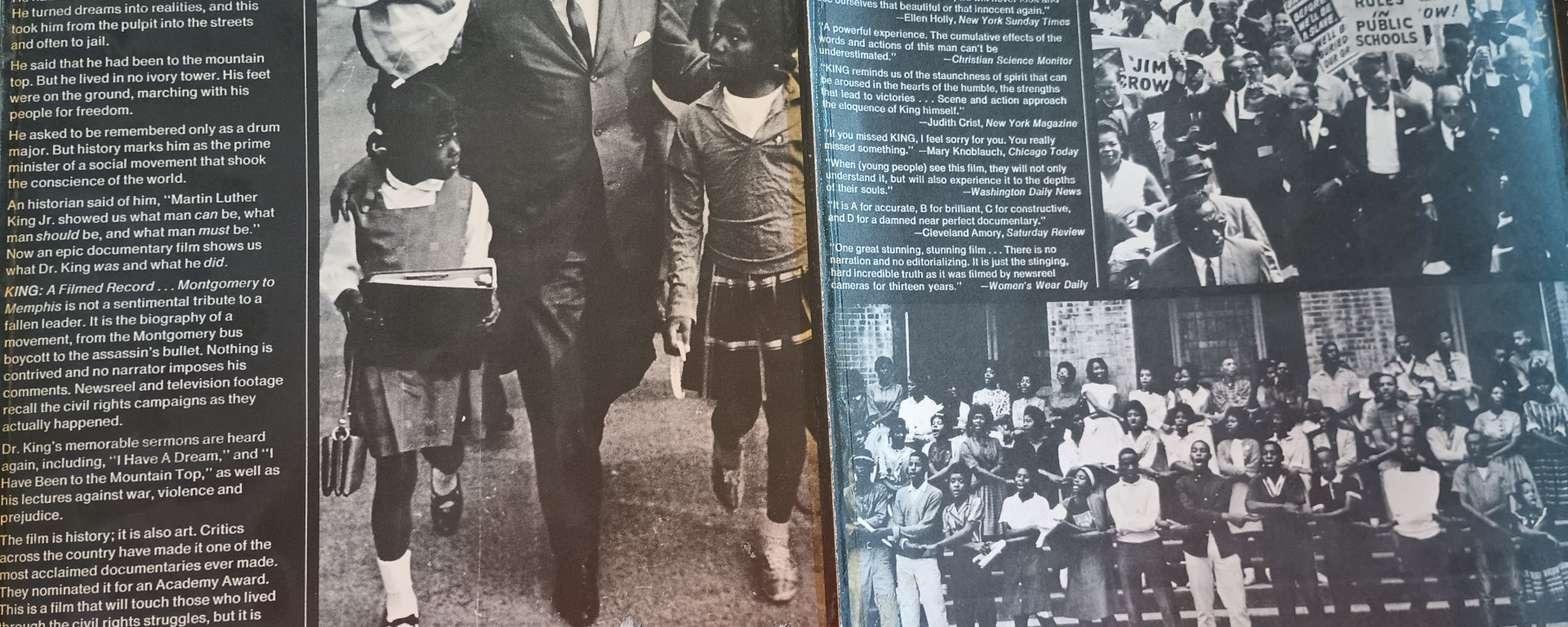
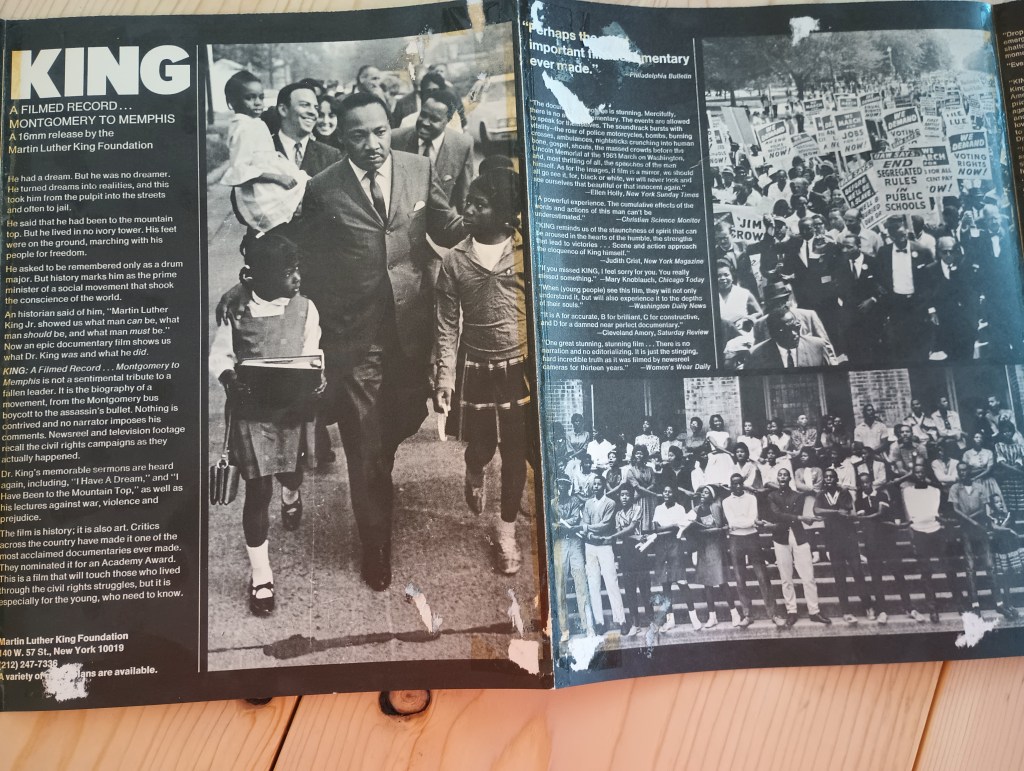
When I was a youngster growing up in rural Minnesota and Iowa, the daughter of a Lutheran minister, Martin Luther King Jr. played a compelling role in my father’s ministry and social justice sensibility. But as a child, I didn’t connect the dots that MLK was a member of the clergy. My father had a poster by his desk of MLK speaking on the Mall in Washington and I thought he was a political figure. Not a spiritual one.
As a preacher’s daughter, church was central to my upbringing. In fact, the role of church was more important in raising me than what I was getting at home. While many today point to abuses and harm caused within church communities, my experience was completely opposite. Church, for me, was a place of love, acceptance, curiosity, and fun.
Until recently, I liked to believe my version that King was a political leader first and clergyman second. But I’ve come to a new-to-me perspective that centers King’s ministry within the context of his social justice activism. Maybe this is because I’m white and my activism has usually been attached to white spaces.
A closer look at King’s roots shows that without Christian faith, there is no Martin Luther King, Jr. He assembles a movement for liberation, equality, and justice from Christian gospel. His activism is built on faith.
How did I accept that MLK was a political leader and not a religious one?
After his assassination, King’s vision continued to be delivered through his Christian lens in African American communities. Reverends Al Sharpton and Jesse Jackson spent lifetimes adding to King’s Christian-based Civil Rights. African American churches advocated for Americans’ human rights and provided sanctuary for people harmed by racism.
But European Americans who identify white seemed to let go the faith piece of Civil Rights altogether. After MLK, white activists steered their participation away from MLK’s Christian sensibility and into an intellectual and academic context instead. By the 1980’s, social justice activity coming out of white spaces was siloed between white churches focused on foreign aid, intellectuals coming from hippie culture, and academics. To this crowd, MLK was OK if you separated him from his faith.
Concurrently, church attendance within white communities shifted away from older traditions by either leaving faith behind altogether or aligning with Reagan’s Moral Majority. The “Moral Majority” movement – combined with a rise in white Christian Nationalism – used the “cause” for religious freedom to erode Civil Rights. Put another way, Reagan’s right-wing Christians wanted protections for white Christians under the decoy of “religious freedom” because Civil Rights, offering human rights for everyone, threatened white supremacy.
This religio-political engineering was nothing new in white churches. The same thing happened in the early 1910’s & 20’s when corporations paired with white Christian thought leaders to undermine white church-goers’ growing interest in union organizing and socialism.
White church life in America has always held space for two conflicting ideas: 1) Gospel-driven liberation and 2) Corporatist white-supremacy. As the numbers of white church-goers left their older gospel-driven churches in the 1980’s & 90’s, the dominant white church left standing in America today is Christian Nationalism.
Do people who identify white and who left church traditions remember that values of abolition and liberation come from our Christian roots?
Origins for Civil Rights begin in 17th Century* Colonial America with church. Throughout the 1600’s & 1700’s are examples of suffrage for women, laborers, and colonists with African ancestry. Churches are meeting places for these Colonial organizers who are claiming liberation for the political body as witnessed in the Bible. In the 1800’s America delivers the 13th Constitutional Amendment. With this amendment, it is widely accepted that Abraham Lincoln ‘freed the slaves’. A more accurate understanding of this amendment would be to recognize that Lincoln delivers emancipation because enslaved people were already freeing themselves; walking away from plantations in one of the largest mass migrations ever seen on this continent.
These enslaved people were taking their liberty because they were listening in church: Let My People Go. They were taking their liberty because abolition is Biblical; freedom is a God-given right. It is an act of faith to join small resistance; it is an act of faith to walk away from systemic oppression. Church, as it is intended, is a weekly intersection where we are liberated.
In Arkansas, in the 1930’s, tenant farmers – Black and White – were being evicted off land they’d farmed for generations. For a few seasons in the early 30’s, there were back-to-back floods and droughts erasing crop yields. Property owners lost their income and responded with evictions.
The evicted tenant farmers – Black and White – gathered together in country churches to learn more about organizing and forming unions. For this community, it made sense that their meetings should follow the church’s order for worship. A speaker welcomed the crowds and read a passage from the Bible. Hymns were sung and prayers were said. Another speaker would talk about what a union was and how it brought people together to fight for their collective human rights. Everyone, including women, could stand and speak about these new ideas. Everyone voted to form consensus on actions – it was a democracy with church roots.
The Southern Tenant Farmers Union of the 1930’s comes from America’s abolition movements in the 1700’s & 1800’s. And this farmer’s union wasn’t alone in labor organizing. Coal mine workers – laborers of all ethnicities across Appalachia – had been organizing for decades and using scripture to connect the dots between human rights and worker protections. To this day, each coal union chapter still has their own clergy.
Also in the 1930’s, Black communities across the South were organizing through their churches to fight lynchings and Jim Crow. Into this climate, MLK, christened “Michael”, was born in Georgia in 1929 to parents with sharecropper and rural-church backgrounds. MLK’s parents were, themselves, activists for equal rights in their Atlanta community and MLK’s dad was a Baptist minister.
The Southern Tenant Farmers Union was officially organized on July 18, 1934. That very same summer, when MLK was 5-years-old, MLK Jr’s dad traveled with the Baptist World Alliance (BWA) to observe the injustice of rising Nazi-ism in Germany. Observing how Nazi’s used America’s Jim Crow playbook to disenfranchize and harass Jews, the BWA issued a resolution stating, “This Congress deplores and condemns as a violation of the law of God the Heavenly Father, all racial animosity, and every form of oppression or unfair discrimination toward the Jews, toward colored people, or toward subject races in any part of the world.”
On his visit with the BWA to Germany in ’34, King Sr was inspired by Martin Luther’s** 16th Century radical activism. When he returned home in August, King Sr decided to change his name and his son’s to honor the Lutheran.
White Americans who’ve left off their connections to faith traditions can intellectualize Civil Rights all they want. But to truncate MLK from his Christian faith misses the entire story of our liberties won in 1964. MLK Jr’s speeches are sermons. His activism is compatible with Torah and he places liberation within the gospel of Christ.
Looking at the landscape of churches in America today, it’s easy to reject all of it. American Christianity has become commercialized and nationalist; money-grubbing egoists profiting off the story of a radical homeless person crucified by power. But Martin Luther King Jr’s Christian legacy reminds us of an American inheritance with Christianity that attacks today’s perversion.
MLK’s ministry is abolition, liberation, equality, and justice. His political activism is a side effect of his faith and Civil Rights, the result.

**Martin Luther has been credited for spurring a division in Christianity away from Catholicism. A man of his time in the Holy Roman Empire of continental Europe, Luther was anti-semitic and anti-pagan. While he made his mark on theories of pluralism, he also advocated for violence against Jews and Pagans.
Discover more from Three-Fifths
Subscribe to get the latest posts sent to your email.

 Three-Fifths