
As we prepare to celebrate the life and legacy of Dr. Martin Luther King Jr., I find myself reflecting on the countless ways his teachings have shaped my life. For as long as I can remember, Dr. King’s values, words, and moral clarity were woven into my upbringing. His message was shared with me by pastors from the pulpit, teachers in the classroom, and most consistently by my mother, a steady, guiding presence. I cannot pinpoint the exact moment I first learned about him, because in many ways, Dr. King’s influence has simply always been there. He has existed in my consciousness as a fact, not an introduction.
As an adult, and now a parent, I’ve often considered how Dr. King’s teachings show up in my daily life and in the lives of my children. Just as I was raised with deep reverence for his work, my kids grew up celebrating his legacy, attending community events, learning his speeches, debating his politics, and visiting the places where he lived, spoke, and ultimately sacrificed his life. We have walked through museums in Atlanta and Memphis, stood before artifacts that hold the weight of history, and allowed the experience to settle into us in ways that words alone cannot.
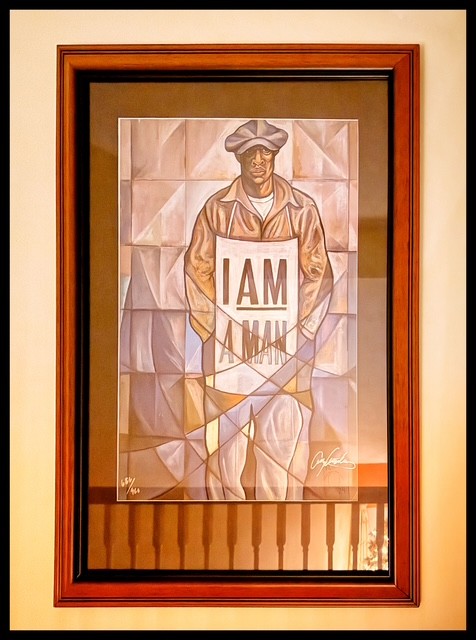
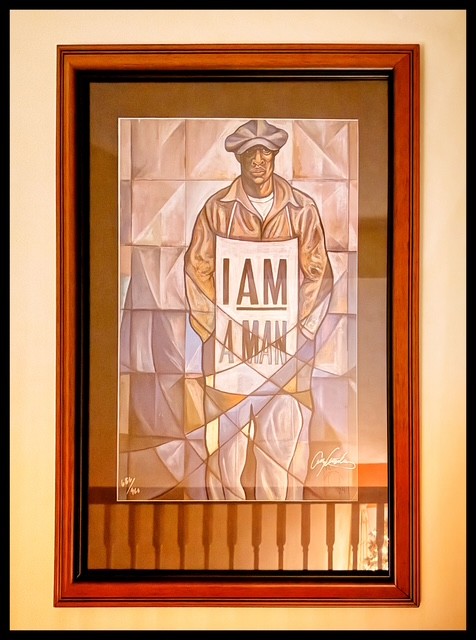
A painting in my home captures one of the most powerful declarations of human dignity to emerge from the Civil Rights Movement: “I Am a Man.” Though not a phrase Dr. King originally coined, he understood its force and elevated it to national consciousness. The statement was born from the 1968 Memphis sanitation workers’ strike, where Black men demanded fair wages, safe working conditions, and basic respect. “I Am a Man” was both a protest and a proclamation, a refusal to be diminished or disregarded.
Dr. King joined the strike as part of his Poor People’s Campaign, which sought to expose economic injustice across race and class. He recognized that the fight for racial equity could not be separated from the struggle for economic dignity. In what became his final speech, “I’ve Been to the Mountaintop,” King called on the nation to stand with these workers, not only to affirm their humanity, but to transform the systems that denied it. His message was clear: dignity is not a privilege to be granted, but a birthright to be honored.
Instilling these values in my children has been one of the most meaningful parts of parenthood. My oldest son, a Morehouse Man like Dr. King, has found deep personal connection to the “I Am a Man” statement. It resonates with him not just as a historical phrase, but as a grounding reminder of identity and legacy. He carries it—literally—tattooed on his arm. And when people ask what it means, he offers them a lesson in history, humanity, and the ongoing pursuit of justice. Sometimes he explains it to people who look nothing like him; sometimes, to people who look exactly like him. That, too, is part of the work.
Dr. King’s teachings are not meant to be admired from a distance. They are not relics to be revisited once a year, nor quotations to be recited without reflection. His work calls us to action, to examine our own contribution to justice, to equity, and to the dignity of others. Honoring his life requires more than remembrance; it requires continuation.
As we move into another year, may we commit ourselves not only to celebrating Dr. King’s legacy, but to living it, through our choices, our advocacy, our courage, and our unwavering insistence on the humanity of every person.

Discover more from Three-Fifths
Subscribe to get the latest posts sent to your email.
 Three-Fifths