
Abstract
This essay explores how women writers across generations have reclaimed the symbol of the circle as a metaphor for continuity, collective memory, and resistance. From the ancient archetype of the womb to the modern woman’s consciousness, the circle becomes a literary space of rebirth, dialogue, and rebellion against patriarchal linearity. Drawing on voices such as Audre Lorde, Clarissa Pinkola Estés, Toni Morrison, and Bell Hooks, the piece examines how feminist literature transforms pain into wholeness — and silence into ritual speech.
The Shape of Wholeness
There is something ancient about a circle drawn in the sand. The line returns to itself, unbroken, neither beginning nor end — a quiet defiance against the straight lines of conquest and certainty. Each time the sea erases it, the circle invites us to begin again.
In the language of women’s writing, the circle is never just geometry. It is a memory, a womb, a ritual, and a rebellion — a shape of wholeness reclaimed. For centuries, the feminine voice in literature has spoken through spirals and returns, finding power not in the rush toward resolution but in the act of revisiting. Women’s narratives, unlike the linear march of empire, rarely end in victory; they end in recognition — of self, of others, of the sacred continuity between them.
As Ada R. Habershon once wrote, “Will the circle be unbroken?” The question lingers in every story where women dare to speak, write, and reimagine their world. In the circular rhythm of their words, the feminine principle of creation — inclusive, relational, regenerative — quietly challenges a culture built on separation. The circle becomes not only a symbol of equality, as the Indigenous tradition teaches, but also a literary archetype of return: the movement from silence to speech, from fragmentation to healing.
The Patriarchal Line vs. the Feminine Circle
Western literature has long been obsessed with the straight line — progress, ascension, conquest. Its heroes move forward, leaving home to conquer chaos and return transformed, often alone. It is the geometry of patriarchy: one direction, one climax, one voice. The line cuts, divides, advances. It names this movement “development,” “civilization,” “plot.”
But women have always written in circles. Their stories bend time back upon itself, refusing the illusion of control. In Virginia Woolf’s To the Lighthouse, the passage of years collapses in the rhythm of thought and tide — the inner lives of women stretching beyond the logic of clock and chronology. The novel’s center, the lighthouse itself, is unreachable for most of its pages — not because of distance, but because of perception. Woolf turns narrative into current, not staircase.
Similarly, in Clarissa Pinkola Estés’s Women Who Run with the Wolves, the feminine psyche is portrayed as a wild, circular force — an ecosystem rather than a system. Her retellings of myths and folktales trace the instinctive returns of women to their own voices after exile, silence, or domestication. For Estés, healing begins not when the story ends, but when it returns to the beginning differently — wiser, wilder, whole.
To write in a circle is to refuse the hierarchy of beginning and end. It is to affirm what patriarchal storytelling fears most: that transformation is not a single triumph but a continual becoming. Women’s literature, in this sense, is both spiritual and insurgent — it dares to imagine a time that spirals, breathes, and forgives.
The Circle as Womb, World, and Word
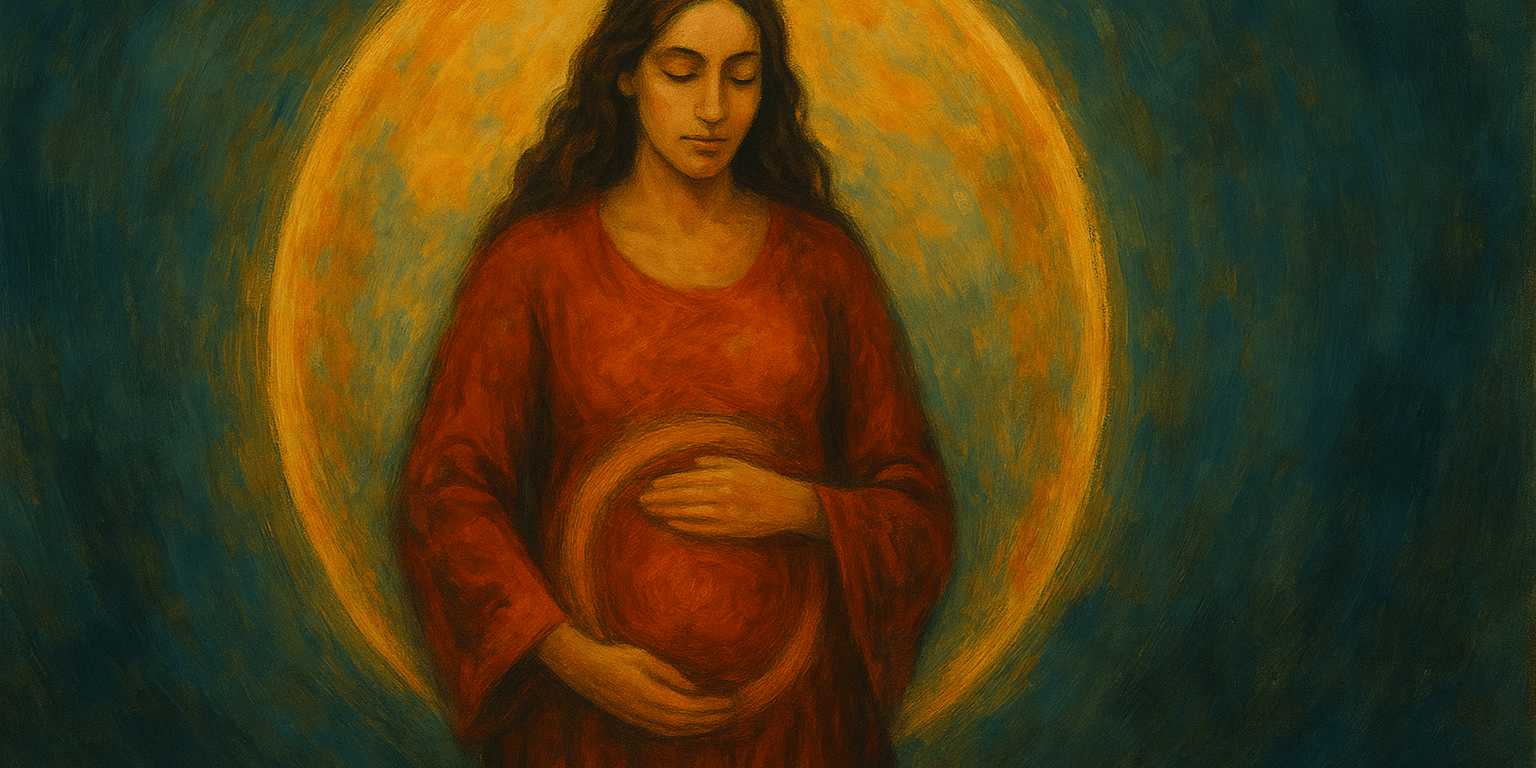
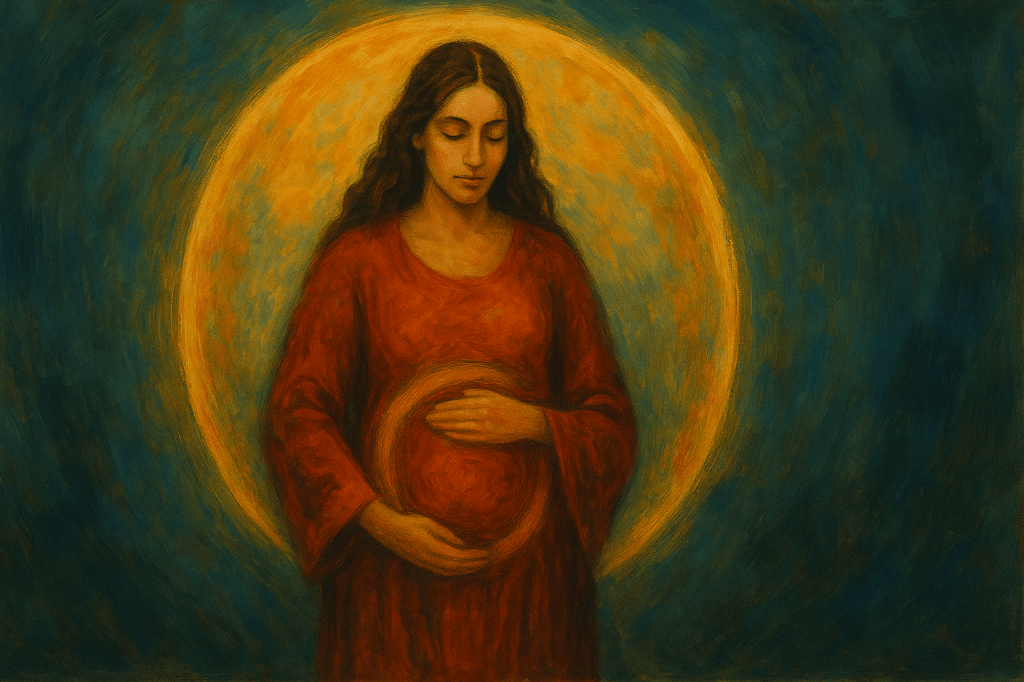
Before there was writing, there was rhythm — the pulse of breath, the tide, the heartbeat echoing through the body. The first circle we ever know is the womb: the sound of blood and water surrounding us before we have a name. In this primal geometry, women’s writing finds its oldest metaphor — creation that contains rather than conquers, nurtures rather than divides.
Audre Lorde called the erotic “a measure between the beginnings of our sense of self and the chaos of our strongest feelings.” For her, creation — whether poetic, political, or maternal — was circular energy: it moves outward, returns inward, and sustains the whole. The circle of creativity is not a performance of power but an exchange of presence. When Lorde wrote that “the master’s tools will never dismantle the master’s house,” she was also speaking of form — warning that linear, patriarchal storytelling cannot birth liberation. Only circular creation, born of connection and embodiment, can.
bell hooks extended this understanding into love as praxis — not sentiment but structure. To love, she wrote, is to build community, to return again and again to the circle of care despite rupture. Her language — tender and revolutionary — reminds us that the circle’s strength lies not in its symmetry, but in its capacity for renewal.
And in Toni Morrison’s worlds, the body and word are inseparable. The circle becomes both scar and sanctuary — the place where language reclaims what history dismembered. In Beloved, trauma repeats until it is spoken; in Sula, friendship loops back across time, love, and loss. Morrison’s women inhabit the circular truth that healing is not a destination but an act of remembering — again and again — until the self becomes whole.
To write as a woman, then, is to trace this eternal round: the body as text, the earth as language, the word as rebirth.
Circles of Healing and Rebellion
To heal is to return — not backward, but inward. Women’s stories understand this instinctively: that the wound must be re-entered before it can close. In patriarchal myth, the hero conquers; in women’s literature, the heroine remembers. Her courage lies not in departure, but in facing what the world taught her to bury.
In Toni Morrison’s Beloved, the haunting refuses linear time. Sethe cannot move forward until she circles back to the memory that binds her — the unspeakable violence of slavery turned inward as guilt. The ghost-child who returns is not only trauma personified, but the past demanding to be witnessed. The novel itself becomes a ritual — a communal act of exorcism through storytelling. Each repetition of pain, each voice reclaiming another’s silence, completes another loop of healing. Morrison teaches us that healing is not forgetting, but re-membering — piecing the dismembered back into being.
Alice Walker’s The Color Purple offers another kind of circle: the correspondence between Celie and Nettie forms a spiritual circuit that transcends geography, patriarchy, and time. Their letters become a call and response — an echo of ancestral dialogue — restoring the balance between voice and silence, self and sisterhood. Through this exchange, Celie moves from submission to sovereignty, her “I am” rippling outward into community. The circle, here, is the architecture of liberation.
These writers refuse the straight line of history — the notion that suffering is something to outgrow or escape. Instead, they write healing as rebellion: a cycle of return where love, language, and memory become instruments of resistance. The circle is both sanctuary and uprising, both ritual and revolt.
The Reader’s Circle: We Who Sit Together
Every story that survives does so because someone has kept the circle intact. A reader listens, receives, and passes the story on. In this way, literature itself becomes a living sharing circle — a communion of breath and thought across centuries, across silences.
To read a woman’s story is to join her ritual. When we open Morrison, Walker, or Woolf, we sit beside them, not below them. There is no hierarchy in this kind of reading — only reciprocity. The writer offers what she has gathered from pain and memory; the reader carries it forward, reshaping it into her own understanding. It is an exchange older than print, older even than language — a return to the fireside, where wisdom is not owned but shared.
Historically, women have turned to one another in literal circles — sewing rooms, consciousness-raising meetings, reading groups, writing collectives — spaces where dialogue replaced decree. The Harlem Renaissance salons, the feminist gatherings of the 1970s, the digital book clubs of today: all echo the same truth that the circle has no leader, only keepers. Within it, everyone speaks; everyone listens.
To read collectively — to bear witness together — is a radical act in a culture that prizes individual enlightenment over communal growth. The circle resists isolation. It teaches us that language is not a ladder toward transcendence but a thread that binds us. In that gathering, even across pages, we remember what the hymn asked long ago: Will the circle be unbroken? The answer depends on whether we keep showing up — eyes open, hands extended, stories shared.
Closing Reflection: Returning Whole
The tide has come and gone, but the circle remains — faint, imperfect, re-drawn by countless hands. Its survival is not in its symmetry, but in its persistence. Like the women who have written, loved, and healed before us, it endures because someone keeps tracing it again.
Perhaps that is the essence of the feminine circle: not closure, but return. A movement that gathers what was scattered, that forgives what history has tried to divide. Every story told by a woman — whispered, written, sung, remembered—widens that circle just enough for another to enter. In that widening, healing becomes inheritance.
When Ada R. Habershon asked if the circle would be unbroken, she could not have imagined how many forms that question would take — how it would echo through blues and gospel, through Black and Indigenous traditions, through the pages of women’s books that refuse to end neatly.
The circle keeps turning because we keep turning toward one another.
And so, as I close this reflection, I return to the shore — to the same gesture that began it. I draw the circle once more. It may not be perfect, but it is alive. The sea will rise, and I will trace it again.
In every wave, every word, the circle remains — unbroken, unfinished, whole.

References
ESTÉS, Clarissa Pinkola. Mulheres que correm com os lobos: mitos e histórias do arquétipo da mulher selvagem. Rio de Janeiro: Rocco, 1994.
HOOKS, bell. All about love: new visions. New York: William Morrow, 2000.
LORDE, Audre. “Uses of the Erotic: The Erotic as Power.” In: LORDE, Audre. Sister Outsider: Essays and Speeches. Freedom, CA: Crossing Press, 1984.
MORRISON, Toni. Amada. São Paulo: Companhia das Letras, 2007. (Título original: Beloved, 1987).
MORRISON, Toni. Sula. São Paulo: Companhia das Letras, 2019. (Título original: Sula, 1973).
WALKER, Alice. A cor púrpura. Rio de Janeiro: José Olympio, 1985. (Título original: The Color Purple, 1982).
WOOLF, Virginia. Ao farol. São Paulo: Companhia das Letras, 2015. (Título original: To the Lighthouse, 1927).
HABERSHON, Ada R. “Will the Circle Be Unbroken?”. Hino, 1907.
PASS THE FEATHER. Sharing Circle Teachings. Disponível em: https://passthefeather.ca. Acesso em: out. 2025.
Discover more from Three-Fifths
Subscribe to get the latest posts sent to your email.

 Three-Fifths