
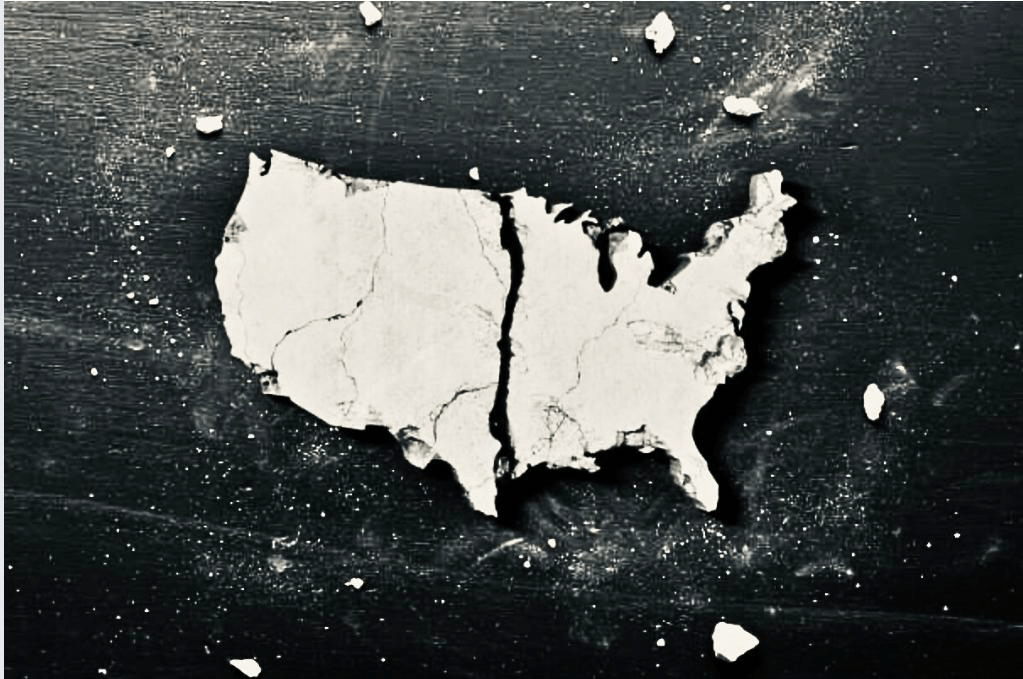

We must return and claim our past to move toward our future.
— Dr. Joy DeGruy
For all the history of grief, an empty doorway and a maple leaf.
— Archibald MacLeish
The landscape of America is rapidly changing. This landscape is no longer made up only of natural landforms, ecosystems, and aquatic features, but has the proclivity now to transform us physically, mentally, emotionally, psychically, and spiritually. This landscape has evolved entangling humankind in our man-made landscapes, exacting geographical shifts into urbanity-displacement, cultural shifts in demography-climate refugees, digital shifts in cyberspace-cyber attacks, and further shifts into hybridity. Even our soundscapes, financial landscapes, and political frameworks are all environments that have changed and taken up residency. All of these nested interconnected systems are undergoing a profound technological metamorphosis. These landscapes that we live within are continually being created and recreated around us as we speak.
Meanwhile, as one transformation is fueled by a push for inclusivity and diversity driven by the collective efforts, at the same time counter-transformations come as a strong backlash from those resistant to liberatory ideas. The core question emerges: How can America embrace and transform while navigating this constant backlash from those resistant to the kind of transformation that is meant to usher in greater freedom and civility for all?
As we take up this question and contemplate the complexities of this journey within the American experiment, we are called to engage with and challenge the narrative landscape that has shifted from paper into digital space, moulding our world as viewed from our phones. Yet, drawing from the influence of the written word, we are reminded that the act of speaking—the very act of language—is a form of resistance.
Language as Agency and Resistance
“Language is power,” writes Voloshinov, describing his concept of “multi-accentuality,” and indeed, language is a powerful tool wielded by both the oppressor and the oppressed. The very arbitrariness of patriarchal supremacy lies within its claims over language as the exclusive vessel of meaning. Deconstruction reveals that language is a living being, continuously transformed through its speakers and listeners, deteriorating and rebuilding in every exchange. But what happens when language becomes a weapon? When the rhetoric of exclusion masquerades as conversation, and anti-immigrant narratives blanket the discourse on human dignity? As we navigate through the current tensions of civil rights movements, the dynamic forces of liberation are constantly undermined by the simultaneous injustices faced elsewhere—genocidal wars raging in Gaza; families in flight in Ukraine; and the systemic dismantling of due process with American immigration raids. All leaving us with a sense of complicity and urgency as we seek to find our path through this confusion. How do we reconcile these contradictions? How do we hold out for the narrative of a just world? A world that stops the madness and rolls back the red tides coming in. The tides evoking an ocean-sized symphony of grief across the world?
Power, Identity, and Resistance
Through the lens of history, literature, and modern jurisprudence, we witness deep-rooted complexes in our tandem relationships. A deeply woven interplay between power, identity, and resistance—in this narrative, the body is a site of contestation—not only the bodies of people but also the body of our land, rivers, and forests. All that humankind still deems conquerable rather than seen as sacred and worthy of restoration and preservation.
Sadly, this old necrophilic, colonial attitude, conjuring violence against our bodies, is mirrored and reproduced in our willing exploitation of nature—also rendered voiceless by structures that uphold value extraction and superiority over survival and domination, or death and destruction over life and flourishing. The language of suppression, like music, intones a violent dissonant melody, but within the larger circling of voices forms a symphony of dissent; these voices at the margins harmonize perfectly, building a counterpoint to suppression that refuses to be silenced.
Accounting for History
The period following the 2008 election, marking our first Black president, saw a significant rise in political representation among marginalized communities. This surge fostering visibility and advocacy at local, state, and federal levels, leading to more inclusive policymaking, has since been met with a formidable backlash. The rhetoric of white supremacy has intensified, cultivating a hostile atmosphere for marginalized groups and triggering a rise in hate crimes.
Advancements in racial justice movements, such as Black Lives Matter, Idle No More, The Me Too Movement, and Climate Marches, have brought national attention to systemic inequities, prompting advocacy to overcome police violence, create indigenous sovereignty, stop abuses of women, and fight for the planet. Yet, we witness these efforts in the face of strong resistance. Legislative measures have emerged to suppress voting access, and the Court has overturned Roe v. Wade, illustrating a new and concerted effort to roll back women’s rights.
The backlash continues to manifest with the increased militarization of police, anti-immigrant policies, and legislative attacks on LGBTQ+ rights. With educational and healthcare policies aimed at more equity facing budget cuts and environmental justice efforts hindered by gentrification, the struggle for inclusivity remains fraught with a plethora of wicked challenges.
As we navigate this turbulent landscape, the continuous interplay of progress and resistance defines our journey. The key question persists: how do we move forward amid all of this growing opposition?
Nature, Identity, Doubt: Interwoven Struggles
In the voices of James Baldwin, Audre Lorde, Rigoberta Menchú, and Indy Johar we find the threads of resistance—tangled yet resilient. Stories unfurl with poetic fury, challenging normative constructs and demanding recognition for every line, every strophe that crafts the identity of a people long attributed with silence.
With the reclamation of voice, there is an intrinsic bond between Black, Brown, Indigenous, and Women’s identities and the land. Nature is not merely an entity to be conquered; it is a living, breathing history—an archive of cultural identity, resilience, and sacredness. The connection to the Earth runs deeper than mere occupation; it embodies heritage and belonging. To redress injustices, the nature of language must shift from the oppressive narratives of ownership back to indigenous wisdom of guardianship and kinship.
The storm of environmental justice beckons us to reconsider the labels we impose upon the Earth and one another, demanding—in a chorus of diverse tones—that its voices are heard, valued, and represented. This reclamation of language touches the very essence of who we are, colliding with the simplistic dichotomies often set forth by dominance. The language of human rights and environmental stewardship converges; echoing Duwamish Leader, Chief Seattle, who told us long ago, that what is done to the land is inherently tied to what is done to those who inhabit it—an inseparable narrative of liberation.
In a compelling article entitled “Logical Architecture: Truth, Doubt, and Conversation,” architect, Indy Johar wrote: ” … as societies we must deliberately create the preconditions of truthing: reducing precarity, expanding agency, and designing infrastructures that make uncertainty livable. Only then can truth remain unfurling rather than collapse into objecthood.” His text emphasizes the importance of doubt as a foundational element of truth and civic engagement, advocating for a concept termed “civic fallibilism.” It argues that truth should not be viewed as an absolute or singular entity but as an evolving process shaped by collective inquiry, communication, and institutional frameworks.
The pursuit of a singular truth often leads to dogma and violence, while fostering doubt enables creativity, agency, and adaptability within societies. To sustain this doubt, societies must cultivate supportive infrastructures that promote resilience, reduce precarity, and encourage open dialogue. In this context, conversation becomes a vital protocol for navigating complexities, allowing diverse perspectives to contribute to a broader understanding of truth. Ultimately, the ability to embrace doubt and engage in truthful dialogue is positioned as essential for the survival and flourishing of democratic societies in challenging times.
The Poetic Interlude: Bridging Experience and Activism
So let us suspend the linearity of traditional narrative, allowing space for the associative—a tapestry of words woven with the threads of doubt, struggle, resilience, joy, and sorrow. Every stanza a heartbeat, every verse a pulse of the collective longing for justice: Here Black, Brown, Indigenous, and Women’s voices swirl like fallen leaves—whispers of ancestors echoing in the rustling, “Remember us.” The soil enriched with stories, histories intertwining beneath the surface, carving paths for hope and existence. “We were here; we are here.” Amidst the march of civil rights, where voices rise against the night, the fervor shakes the foundations, each shouting an invocation, demanding to be seen: “Listen to our Earth; she speaks through us.” Can we hold these contradictions? Can we confront the dissonance without losing our hearts in the struggle? The voices, the resistance, the reclamation of narrative—all sail forward, navigating the tumultuous sea of change. For in every ebb and flow of resistance, there lies the promise of transformation; in every act of solidarity, the potential for healing.
The Call for Continuous Re-Creation
From the sweat of enslaved hands that built Manhattan to the cries of families torn apart today by immigration policies, our histories intertwine, entangled like roots beneath the American canopy of denial. As we contemplate the complexities of Black, Brown, Indigenous, and Women’s experiences, we are called to continuously engage with the narratives that shape our world. In this era of transformation, let us remain vigilant to the voices that have long been silenced and actively participate in the re-creation of language that honors these stories.
The winds of change are indeed upon us, vibrant and iridescent—beckoning us to embrace the beauty, the struggle, and the resilience of those who refuse to be constrained by the arbitrary claims of superiority. Together, we can weave a new tapestry, one where every thread, every word, contributes to a collective narrative of justice, inclusivity, and acknowledgment of our shared humanity.
Let this be our autumn, rich in color and complexity, as we continue to rise as orchestrators to meet and guide these winds of change. Let us prepare… because when the walls of our modern-day Jericho fall down, we will be prepared to lead with agility and sophistication and build in its place the architecture of a more just world.
References:
Anthony, Carl C. (2018). The Earth, the City, and the Hidden Narrative of Race. New York, NY: New Village Press, 2017 . The book includes bibliographical references and an index .
Baldwin, James. (1963). Notes of a Native Son. New York: Dial Press, originally published in 1955 . A later edition was published by Beacon Press in 2012 .
DeGruy, J. (2018). Post Traumatic Slave Syndrome: America’s Legacy of Enduring Injury and Healing. Joy DeGruy Publications Inc . A newly revised and updated edition by Leary, J. D. was published in 2017 by Joy DeGruy Publications
Foucault, M. (1978). The History of Sexuality, Volume 1: An Introduction. Pantheon Books, New York, NY . The work was originally published in Paris by Gallimard in 1976 as *La volonté de savoir* and translated into English by Robert Hurley . New York, NY: Pantheon Books, 1978 .
The Guardian coverage on Black Lives Matter Movement
Nwanevu.O, Moraes, F., Elliott-Cooper, A. Et al.(Sun 25 May 2025) “How did 2020’s Black Lives Matter movement change the world? Our panel responds” The Guardian Magazine. Retrieved: 03.00 EDT https://www.theguardian.com/commentisfree/2025/may/25/how-did-2020s-black-lives-matter-movement-change-the-world-panel
The Guardian Coverage of the Idol No More Movement
Charleyboy, Lisa (Fri 11 Jan 2013).“Idle No More: Canada’s indigenous people are demanding a better deal” The Guardian Magazine. Retrieved 08.03 EST. https://www.theguardian.com/commentisfree/2013/jan/11/canada-indigenous-people-demand-better-deal
The Guardian Coverage of the #MeToo Movement
Khomami, N. (Fri 20 Oct 2017) “#MeToo: how a hashtag became a rallying cry against sexual harassment”The Guardian Magazine. Retrieved:13.13 EDT
The Guardian coverage on The Climate Marches
Jessica Glenza, J. Evans,A. Ellis-Petersen, H. Zhou, N. (Fri 15 Mar 2019). “Climate strikes held around the world – as it happened” The Guardian Magazine. Retrieved: 17.43 EDT
The Guardian coverage on Russian invasion and Ukraine conflict
The Guardian archives contain a series titled “Russia-Ukraine war at a glance,” which provides summaries of significant developments . The conflict, which began with the Russian incursion in 2014, is a recurring topic . Editorials from The Guardian have focused on the Russia-Ukraine war . On November 19, 2024, The Guardian reported on Ukraine marking 1,000 days since the full-scale Russian invasion . The newspaper has also covered the visual framing of the Ukraine conflict, including perspectives on it as a national power struggle, Russian intervention, and geopolitical conflict .
The Guardian Coverage of the Conflict in Gaza
The Guardian has published numerous articles on the Gaza conflict, including reporting on Israeli airstrikes and the impact on civilians . An article published on August 21, 2025, revealed Israeli military data indicating a civilian death rate of 83% in the Gaza war, with 8,900 named fighters listed as dead or probably dead by May, and an overall death toll reaching 53,000 . Another article from January 15, 2025, highlighted the devastating impact of 15 months of war on Gaza, stating that over 46,000 Palestinians had been killed since October 2023 . As of September 12, 2025, the official toll was 64,718 Palestinians killed and 163,859 injured since the war began on October 7, 2023 . The Guardian also documented an Israeli ex-commander confirming over 200,000 Gaza casualties on September 12, 2025
The Guardian articles on U.S. immigration enforcement and raids.
The Guardian has extensively covered U.S. immigration enforcement and raids . Articles describe how the Supreme Court lifted restrictions on LA immigration raids on September 8, 2025 . Exclusive reports from August 5, 2025, featured US citizens jailed in LA ICE raids . Immigration officers ramped up sweeps in LA after a temporary restraining order was reversed on September 9, 2025 . Protests and clashes with federal agents occurred during immigration raids at a California farm on July 11, 2025 . A Guardian investigation on September 10, 2025, revealed details about Trump’s deportation program, involving 44,000 immigrants, 1,700 flights, and 100 days .
The Guardian coverage of 2008 Election.
Harwood, M. ( Mon 28 Jan 2008 ) “Post-racial politics and my generation” The Guardian Magazine. Retrieved: 15.00 EST https://amp.theguardian.com/world/deadlineusa/2008/jan/28/postracialpoliticsandmygen
Johar, I. (Sept. 13, 2025). “Logical Architecture: Truth, Doubt, and Conversation” SanFrancisco, CA. Published by Indy Johar of Dark Matter Labs
King James Bible (KJV).(1833) The Holy Bible, an Exact Reprint Page for Page of the Authorized Version Published in the Year MDCXI. Oxford, ENG: Oxford University Press .
Lorde, Audre. (1984). Sister Outsider: Essays and Speeches. Trumansburg, NY: Crossing Press.
Lorde, Audre. (1997) The Cancer Journals. San Francisco, CA : Aunt Lute Books .
MacLeish, Archibald. Collected Poems, 1917-1982. Boston: Houghton Mifflin, 1985. Another edition was published by Ecco on December 9, 1985, with 544 pages .
Menchú, Rigoberta.(1983) I, Rigoberta Menchú: An Indian Woman in Guatemala. Edited and introduced by Elisabeth Burgos-Debray; translated by Ann Wright. London: Verso, 1983 . The original work was published in 1983 .
Voloshinov, V. N. (1973) Marxism and the Philosophy of Language. New York: Seminar Press . This work was also published by Harvard University Press .
Discover more from Three-Fifths
Subscribe to get the latest posts sent to your email.

 Three-Fifths