


“Curiosity killed the cat.”
That’s what they say to keep us from asking too many questions. But let’s be real—curiosity never killed the cat. Oppression did. Silence did. Submission did.
And for Black, AfroLatine, and Indigenous peoples in this country—curiosity was never optional. It was survival. It was liberation.
From the very beginning of this nation’s construction, two systems have upheld its foundation: racism and capitalism. Slavery wasn’t just about labor—it was about profit, and it was enforced through a brutal infrastructure designed to crush our minds just as much as our bodies. White supremacy didn’t simply shackle our wrists. It tried to shackle our curiosity.
They passed laws to keep us from learning to read. From gathering. From questioning. From dreaming. And yet—we found a way. Our people got curious anyway. We taught each other in hush harbors. We hid books under floorboards. We carved questions into the bark of trees and the folds of song. Curiosity was never a luxury for us. It was resistance. It was legacy.
And that legacy must continue.
Curiosity is our birthright. But in a world built on our silence, it is also our rebellion.
Today, every system in this country—healthcare, education, policing, housing, immigration—is structured to keep us quiet. To reward compliance and punish curiosity. If we stop asking questions, they win.
We are not meant to inquire why our schools are underfunded.
We are not meant to question why AfroLatine students go uncounted in federal data.
We are not meant to push back when Latinidad is coded white and Blackness is erased from the story.
We are not meant to see the throughline from colonialism to incarceration.
But we do. And we must.
As an AfroNuyorican—born in Brooklyn, raised in The Bronx, and shaped by the love and legacy of two Puerto Rican parents—I begin by turning inward, to nuestra gente. To those who identify with the U.S. social constructs of Latinx, Latine, or Hispanic, I ask: ¿Dónde está nuestra curiosidad about Blackness? Daché et al. (2019) remind us through the lens of Blackquimiento that we must actively dismantle the myth of whiteness as neutral, aspirational, or default. We must reclaim curiosity about our African and Indigenous lineages—not as a sidebar to Latinidad, but as its very foundation. This isn’t simply an ethnic journey; it’s a political reckoning. And I start here, with us, because healing and transformation begin at home.
Curiosity is not a soft skill—it’s a decolonial weapon.
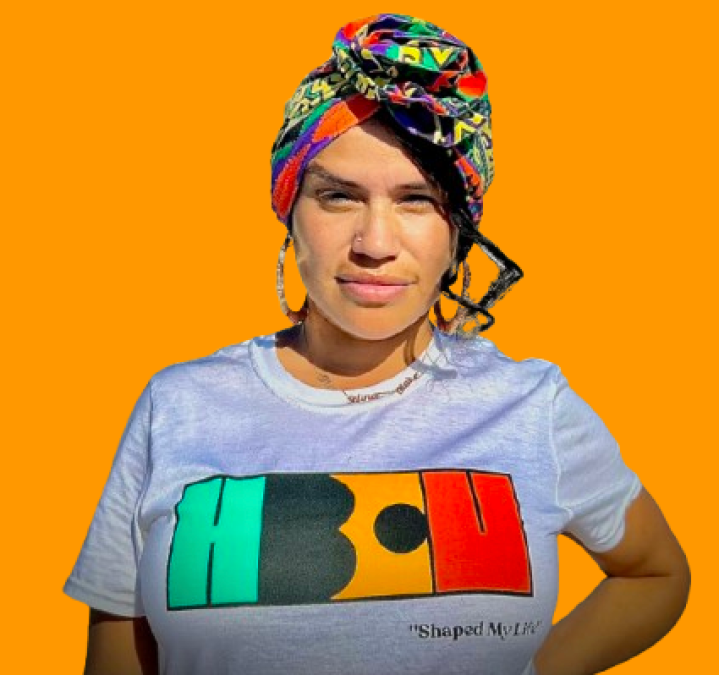
At HBCUorgullo, we activate curiosity as praxis:
- Curiosity about why HBCUs are categorically excluded from Title V Hispanic-Serving Institution (HSI) funding—even when they meet the federal enrollment threshold of 25% or more Latine students. What does it say about equity when mission-driven Black institutions are punished for serving Latinidad?
- Curiosity about why so many AfroLatine youth have never heard of HBCUs as a viable college option—despite the fact that they would not only be welcomed, but deeply affirmed there. What systems keep them from seeing themselves in these spaces?
- Curiosity about why our communities have been told they are either Black or Latine, but never both.
Let’s be clear: this either/or binary was not made by us.
It was imported through colonial logics—through Spanish, French, and Portuguese conquest that stripped our people of their native tongues, severed them from their lands, and replaced Indigenous spirituality with European dogma.
So we ask:
Why do we cling to categories created to divide us?
Why do our data systems deny our complexity?
Why do we still view education as neutral, when it has always been a colonial tool?
HBCUs must get curious too.
The same curiosity that birthed Cheyney University in 1837—in defiance of a nation that said Black people couldn’t learn—must be the same curiosity that guides HBCU strategic planning today.
HBCUs can’t afford to assume that Blackness stops at the U.S. border. That is colonized thinking. If Blackness is global, then HBCU curiosity must be diasporic. We must ask:
- Who are we not seeing in our classrooms, and why?
- What languages are spoken in our cafeterias?
- What cultural narratives are missing from our syllabi?
- How do we stretch our definitions of Black identity to include our siblings from Haiti, Brazil, Honduras, Puerto Rico, and beyond?
Because diaspora demands curiosity. It refuses simplicity. And it’s time our institutions followed suit.
The Charge:
To Latinidad:
Be so damn curious that you trace your last name past the plantation and into the legacy of warriors, healers, and maroons. That you unlearn blanqueamiento and reclaim the parts of you that colonization told you to hate. That you, like Dache and friends (2019), embrace Blackquimiento—a radical turning toward the African in you.
To Blackness:
Be curious about our cousins whose colonizers spoke Spanish instead of English. Be curious about what it means to be both/and in a world that taught us to be either/or. Curiosity doesn’t dilute the Black experience—it expands it.
To my people in power—educators, policy-makers, presidents of colleges:
Get curious about what your data isn’t telling you.
About what your “diversity” reports erase.
About how your definitions of “service” flatten real lives.
Curiosity might just be the most powerful Key Performance Indicator (KPI) you’ll ever have.
Let curiosity become our refusal.
Our refusal to accept monoracial categories.
Our refusal to reproduce the systems that killed our ancestors’ questions.
Our refusal to be anything less than fully seen.
Curiosity didn’t kill the cat.
Curiosity killed the myth.
And may our questions build the kind of world our ancestors dreamed of—and our descendants deserve.
Discover more from Three-Fifths
Subscribe to get the latest posts sent to your email.
 Three-Fifths