

Rivalries can shift to the point of vanishing “In A Moment Of Serendipity” (unexpected positive outcome).
“Unforeseen Collaboration: Two rivals might find themselves working together on a project due to a chance meeting or shared interest, potentially transforming their relationship and the rivalry.”
Serendipitous Innovation Advantage for Hybrid and Remote Teams Wise Decision Maker Guide, LinkedIn Dr. Gleb Tsipursky. Named “office Whisperer” by The New York Times for helping leaders overcome Frustrations with hybrid work and Generative…
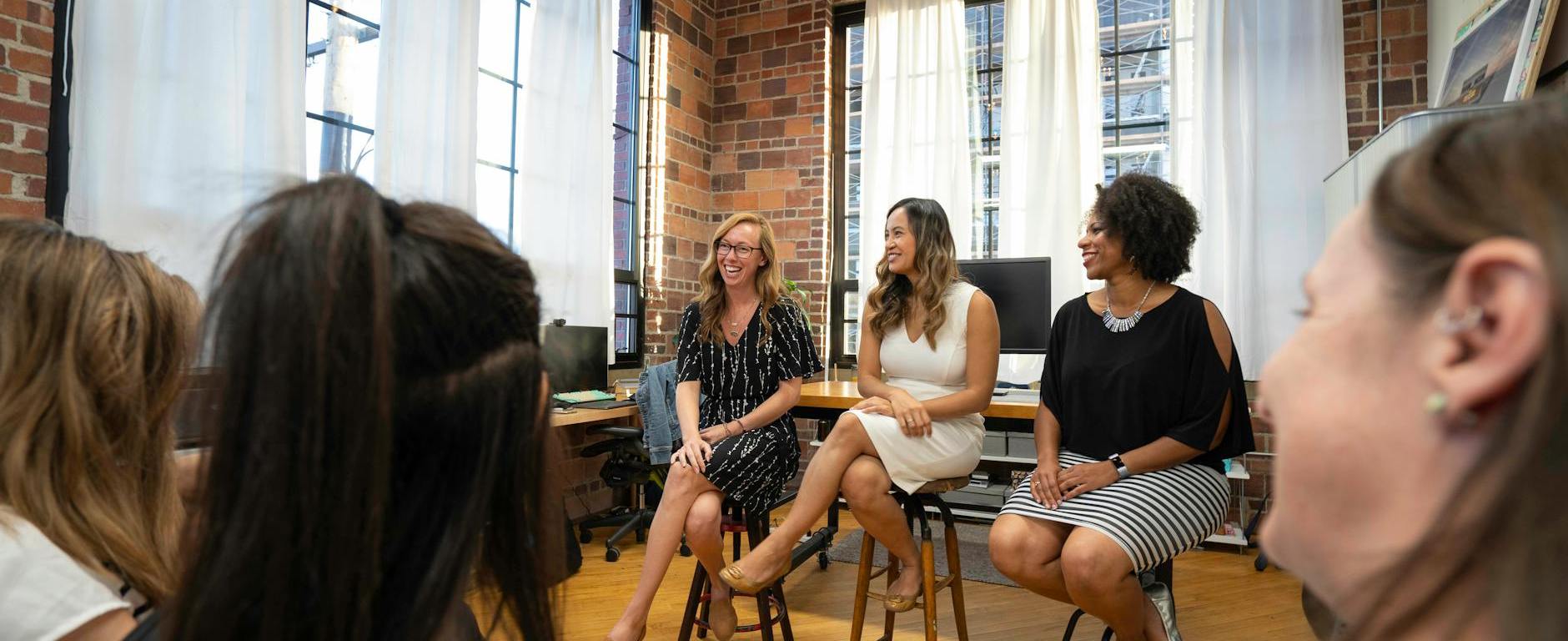
A focus group convenes. The best demographers, anthropologists, and sociologists carefully organized the group. This brought together women from diverse geographical regions, ethnicities, and socioeconomic backgrounds. Some in the group were from urban centers, including suburbs, to exurbs. Others were from rural areas. All these 20 or so women had varied levels of skepticism about this focus group and their fellow group members. The variety of facial expressions was the most revealing thing, including steely-eyed stares, intentional intimidation, and eye contact to no eye contact at all. From smiles to scowls.
What was the topic of discussion? Was it the economy, food prices, news coverage, truth vs fake news? Climate, tariffs, Elon Musk, the future of Social Security, to the state of Education? Go ahead, pick one. Regardless of the topic, there will be no shortage of opinions.
Suddenly, a sulking, impassioned inner groan could be heard, like a distracting electronic hum echoing out of speakers during an intense TED talk. The eyes of many in the group, most notably the African American women, drew immediate conclusions: “Here we go again.” The buffering of thoughts, past colloquialisms, sayings, and so much history rose from the collective memories. To the point that you can almost hear them verbally. When the “White Woman Cries,” White women’s tears.”
Danielle Slaughter states that, “The most dangerous person in America is the white woman.” Slaughter reminds us that 63 years after Emmett Till’s death, white women still have the power to “lie and get black people arrested or killed.”
In her book, White Tears, Brown Scars, Ruby Hamad discusses how evoking “the damsel in distress ensured white women to be at least considered human (although subordinate) but it did so by ruthlessly excluding non white women from the construction of womanhood.” She reminds us that today, “when white women invoke the damsel, we resurrect the bloody history that goes with it.”
Eyes roll and heads turn. But something unexpected manifested. These tears were from a black woman, which debunked the thick-skinned, angry black woman narrative. Hearts began to melt, and like the dove that descended upon Christ in scripture after his baptism from John the Baptist, a sorrowful but hopeful peace fell upon the entirety of the group. The topic had meandered to Diversity, Equity, Inclusion, and Belonging, and so the sulking soliloquy began after one of the women in the discussion shared her story of losing her job as a result of the DEI cuts and the financial and health perils that ensued. The moment proved to be an inflection point of unity for this diverse group, a transformative space, “In A Moment Of Serendipity.”
Moving beyond the fictional focus group, having Women’s History Month in the rear view mirror, White women and women of color, especially African American women, have been put in the position to assume the role of rivals. White women have been free to exploit all the base emotions in the men that protect them by executing the “damsel in distress strategy. Black women have been positioned to take a different tack. Education and empowerment have been the way to self-determination for this demographic.
In a ThoughtCo. Article entitled Black Women Are the Most Educated Demographic in America.
“The claim that Black women are the most educated demographic in America comes from a 2014 study that cites the percentage of Black women enrolled in college in relation to their other race-gender groups.4 Considering enrollment alone gives an incomplete picture. Black women are also starting to outpace other groups in earning degrees. For example, although Black women only make up 12.7% of the female population in the country, they consistently make up over 50% of the number of Black people who receive postsecondary degrees.5 Percentage-wise, Black women outpace white women, Latinas, Asian/Pacific Islanders, and Native Americans in this arena as well.”
Yet despite the fact that Black women are enrolled in and graduating from school at the highest percentages across racial and gender lines, negative depictions of Black women abound in popular media and even in science. In 2013, Essence magazine reported that negative imagery of Black women appears twice as often as positive depictions. Images of the “welfare queen,” “baby mama,” and “angry Black woman,” among other images, shame working-class Black women’s struggles and reduce Black women’s complex humanity. These depictions are not just hurtful; they have an impact on Black women’s lives and opportunities.”
Katz, Nikki. “Black Women Are the Most Educated Demographic in America.” ThoughtCo, Sep. 21, 2024, thoughtco.com/black-women-most-educated-group-us-4048763.
History reveals the Women’s Suffrage movement, which ultimately led to the passage of the 19th Amendment. One in which an African American Woman named Sojourner Truth spoke with the power and oratory acumen of a skilled politician. Her breathtaking “Ain’t I a Woman” speech in 1851 not only curled toes but delivered poignant truths to the powerful as well as the desperate. Education and the right to vote were key pillars in her battle for liberation and freedom.
Sojourner Truth shared a duality with Susan B. Anthony. However, when the 19th Amendment was passed, Black women were left out as another in the many chapters that forced black and white women into a relationship of rivalry.
“When Elizabeth Cady Stanton and Susan B. Anthony wrote the History of Woman Suffrage in the 1880s, they featured white suffragists while largely ignoring the contributions of African American suffragists. Though Black women are less well remembered, they played an important role in getting the Fifteenth and Nineteenth Amendments passed.”
Article • Suffrage in America: The 15th and 19th Amendments
Between Two Worlds: Black Women and the Fight for Voting Rights
This series was written by Dr. Megan Bailey, intern with the Cultural Resources Office of Interpretation and Education.
Serendipity has placed these historic rivals in a position to rewrite the narrative on DEI together.
“In her article “Why White Women Won DEI” By Aparna R. August 4, 2023, LinkedIn, she states the following.”
“According to a comprehensive study conducted by McKinsey & Company in 2022, an overwhelming 63% of diversity and inclusion leadership roles were occupied by White women…”
“While the presence of White women in DEI leadership may be seen by some as a testament to the progress we’ve made in addressing gender inequality, it also inadvertently casts a shadow on the very principles of DEI.”
“Companies with Diverse Teams Win Despite the Rhetoric:”
Candace McDuffie of The Root says, “McKinsey also published a separate report proving that companies with more diverse teams are 35% more likely to have financial returns above their industry average.”
-Experts Reveal Who’s The Real Face of DEI. Hint: The Answer May surprise You or Maybe Not By Candace McDuffie Published February 21, 2025,
Here is a way to make right the missed opportunity of Elizabeth Cady Stanton and Susan B. Anthony. Consider Eleanor Roosevelt and Pauli Murray’s collaboration. The two had a relationship that went beyond the limitations of commonalities and delved into the realm of possibilities for a society in need of solidarity and action to change the social fabric of America and the world. Born in 1910, Pauli Murray who later became the first female episcopal priest in 1977.
The Firebrand and the First Lady – Portrait of a Friendship
The novel by Patricia Bell Scott examines this multiethnic friendship. “1938, the twenty-eight-year-old Pauli Murray wrote a letter to the President and First Lady, Franklin and Eleanor Roosevelt, protesting racial segregation in the South. Eleanor wrote back. So began a friendship that would last for a quarter of a century, as Pauli became a lawyer, principal strategist in the fight to protect Title VII of the 1964 Civil Rights Act and a co-founder of the National Organization of Women, and Eleanor became a diplomat and first chair of the United Nations Commission on Human Rights.”
Due to this latest backlash, the biggest winners stand to be the primary losers. In A Moment Of Serendipity, two powerful demographics (Black and White Women) might have found their way back to one another as a collaborative force for recapturing the narrative of Diversity, Equity, Inclusion, and Racial Justice.

Discover more from Three-Fifths
Subscribe to get the latest posts sent to your email.

 Three-Fifths