
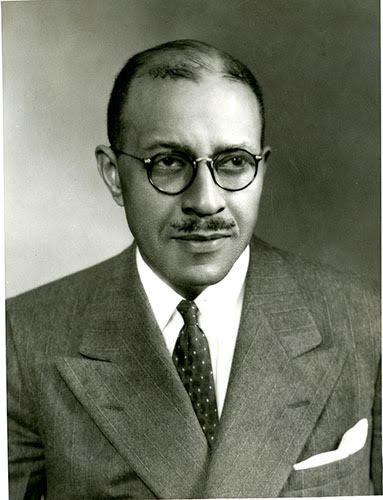
Charles Spurgeon Johnson was a visionary who championed Black talent, intellect, and artistic excellence. As a sociologist, editor, and later president of historically Black Fisk University, Johnson understood the power of art and education in reshaping the social landscape of the U.S. With an unwavering belief in Black artistic and intellectual potential, he was one of the most influential figures of the Harlem Renaissance and a pioneer in encouraging and supporting Black excellence.
Johnson began his journey into the world of Black artistry and intellectualism in the 1920s when he worked as a researcher for the National Urban League. Upon arrival in New York in 1921, he became the editor of the League’s primary publication, Opportunity, which he transformed into a platform for showcasing Black literary and artistic talent. Under his editorship, Opportunity featured the works of luminaries such as Langston Hughes, Countee Cullen, James Weldon Johnson, Zora Neale Hurston, Aaron Douglas, and Richmond Barthé. His influence was so profound that Pulitzer Prize-winning historian and W.E.B. Du Bois biographer David Levering Lewis named him one of “The Six” key facilitators of the Harlem Renaissance. Moreover, many renowned figures, including Hughes, Hurston, Douglas, and Arna Bontemps, credited Johnson as central in elevating Black artistic expression.
One of Johnson’s most significant contributions to the Harlem Renaissance was organizing a groundbreaking dinner at the Civic Club in New York on March 21, 1924. This event brought together over 300 Black and White intellectuals and artists in a racially integrated setting—an extraordinary feat in the segregated 1920s. Attendees included influential figures such as Alain Locke, James Weldon Johnson, W.E.B. Du Bois, and Zora Neale Hurston. The evening’s success secured the interest of major publishers interested in Black literary works, which allowed many Black writers and poets to gain recognition without having to rely on unscrupulous agents.
Johnson used a strategic and thoughtful approach to fostering Black excellence. He employed the arts to alter perceptions and promote racial uplift. According to historian Ralph Pearson, Johnson believed in achieving progress through “ideas and programs achievable within the racial atmosphere of the 1920s.” Although controversial among some of her peers, Johnson’s way of operating proved effective, with the Harlem Renaissance fundamentally changing the perception of Black Americans in mainstream society.
In addition to his work promoting Black artists, Johnson was deeply influenced by the ideas of philosopher John Dewey, particularly regarding his views on the integration of art and everyday life. Dewey argued that art could break down barriers and expand human understanding. He believed exposure to diverse artistic traditions—such as those of African cultures—could eradicate prejudices and encourage empathy. Johnson applied Dewey’s ideas to his work, advocating that the arts could promote racial solidarity and cultural renewal. In his 1943 article “Education and the Cultural Process,” published in The American Journal of Sociology, Johnson discussed how education could help forge a new sense of moral solidarity in a diverse society. He recognized that cultural integration was an ongoing struggle but maintained that exposure to different artistic and intellectual traditions was key to creating a more cohesive and just society.
In 1928, as the Harlem Renaissance began to wane, Johnson moved to Nashville, Tennessee, to chair Fisk University’s newly established social science department. Under his leadership, the department earned an international reputation, attracting top scholars and intellectuals. Johnson also established the Race Relations Institute at Fisk, an initiative that brought together leaders from various sectors—academia, government, labor organizations, and community activism—to discuss pressing race, poverty, and social justice issues.
In 1946, Johnson became the first Black president of Fisk University. Despite some opposition from alumni who questioned his close ties to White philanthropy, Johnson quickly transformed the university. His goal was to elevate Fisk to the same prominence he had achieved for its social science department. He focused on recruiting top faculty, expanding the curriculum, and creating an intellectually stimulating environment for students.
One of Johnson’s most remarkable achievements at Fisk was his emphasis on the visual arts. He convinced his friend Aaron Douglas, a leading Harlem Renaissance artist, to join Fisk as art department chair. Douglas, who was known for his murals and magazine illustrations celebrating Black history and culture, played an important role in shaping Fisk’s artistic strengths. Johnson also spearheaded the acquisition of the Alfred Stieglitz Collection for the university, a significant milestone made possible through the efforts of Harlem Renaissance facilitator Carl Van Vechten and painter Georgia O’Keeffe. The collection strengthened Fisk’s cultural offerings and solidified Johnson’s commitment to providing students access to world-class artistic resources.
One of the lasting symbols of Johnson’s impact at Fisk is Aaron Douglas’ mural Building More Stately Mansions, which the Julius Rosenwald Fund funded. This mural connected African heritage to a vision of an industrial future and embodied Johnson’s philosophy of linking past achievements to future progress. Douglas, reflecting on Johnson’s influence: “Johnson was invaluable to me. I don’t know what I would have done without him… His contribution to preparing young Black people to take their place is great. He led the way.”
Johnson’s work is a reminder that cultural and intellectual contributions are not just acts of expression but can be used as powerful tools for social change. At a time when the Trump administration is contesting racial equity efforts, rewriting history to exclude Black achievements, and threatening funding for the arts and humanities, Johnson’s approach offers a roadmap. He showed that advocacy, coalition-building, and an unshakable belief in Black excellence have the power to dismantle barriers and open new pathways for opportunity. His ability to bridge divides—between races, intellectual and artistic movements, and between education and activism—can serve as a lesson for today’s leaders, educators, and artists.
As we encounter and confront new efforts to suppress knowledge and limit access, I wonder how we can apply Johnson’s strategies to preserve and expand opportunities for future generations. How can his strategic use of the arts and education guide today’s fight for racial equity? What lessons can be learned from his ability to navigate racial divides? And how do we ensure that Black scholars, artists, and visionaries can continue to shape the future?

_____
The ideas for this essay are drawn from my newest book – Why Historically Black Colleges and Universities Matter: 25 Years of Research for Justice (Teachers College Press, 2025).
Discover more from Three-Fifths
Subscribe to get the latest posts sent to your email.

 Three-Fifths