
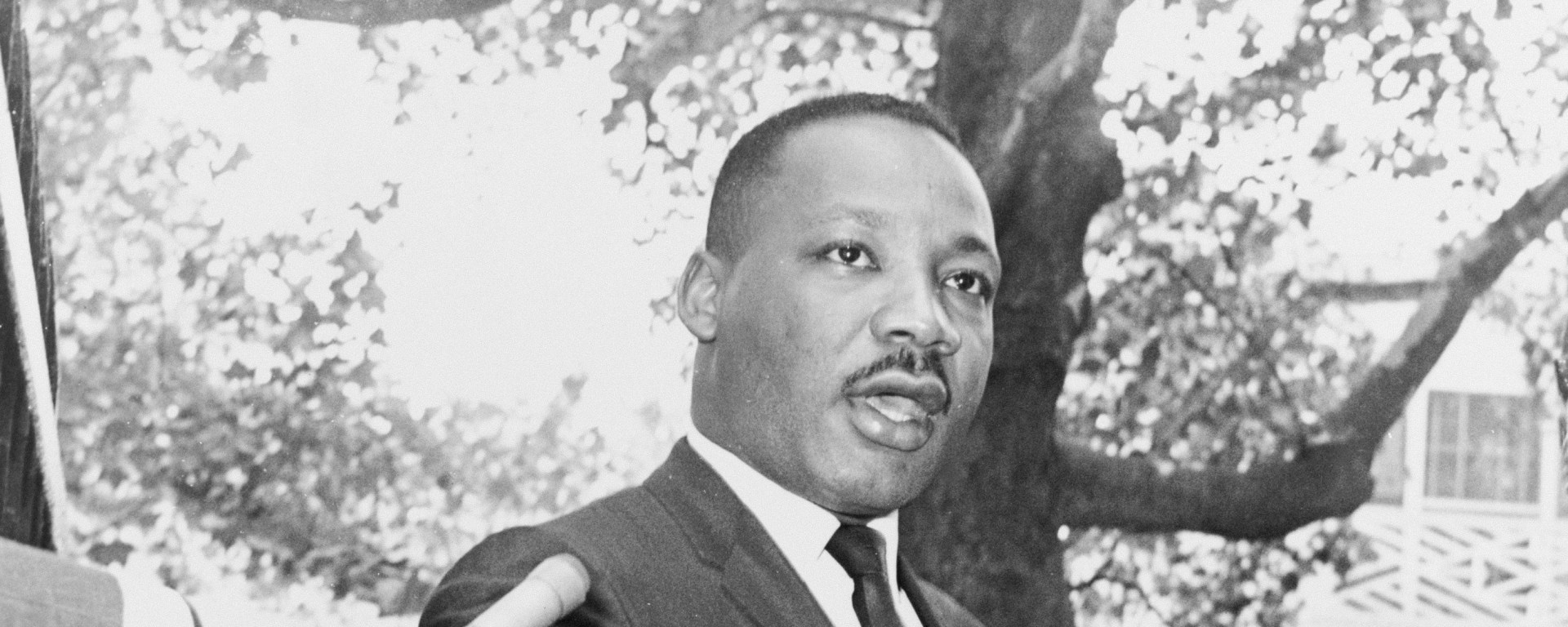

Despite the great amount of evil in the world, which seems to be on the rise at present, I believe we still have reason to hope for God’s redemption of the world. However, the hope I speak of is not a passive hope that God will come down from heaven and defeat the forces of evil. Rather, the hope I describe involves us fighting for justice and relying upon God to empower us. The person I have found most helpful in thinking about how we might move forward is Martin Luther King Jr., who I argue is the greatest American theologian. What makes King such a remarkable theologian is not primarily his theoretical insights, though he had those and they are important. Rather, King modeled what it looks like for theologians to live out the mission of the church—the body of Christ on earth—thoughtfully and powerfully.
In this essay, I first reflect on how Dr. King dealt with what he called the “white backlash” during the last few years of his life. Then, I extrapolate from King and add my own thoughts to give some suggestions for how we might move forward. Overall, while I admit that many things are alarming at present, I think we have good reason to continue to hope that King is right and we will ultimately achieve the Beloved Community in our midst.
When King faced the white backlash against his life’s work as a preacher and civil rights leader, he was disappointed but not surprised. King, as a student of history and devotee of Frederick Douglass and W.E.B. Du Bois, knew, for example, that after chattel slavery was brought to an end, there were several years of reconstruction during which the future looked rather bright for African Americans. Then, shortly afterward, the country abandoned reconstruction and many Black people were re-enslaved by other means and subjected to brutal acts of terrorism.
The civil rights era of the fifties and sixties, which can be thought of as a second reconstruction, underwent a similar shift. In particular, this shift occurred when King transitioned from fighting for civil rights to human rights. In his final book, Where Do We Go From Here: Chaos or Community?, King acknowledged that the struggle to end Jim Crow segregation, while exhausting and brutal, was relatively easy when compared to the fight for human rights that would bring an end to the triple, interconnected evils of racism, militarism, and poverty. In the pursuit of civil rights, King believed he had our country’s founding documents firmly on his side. However, the fight for human rights that sought to eliminate poverty, end war, and abolish racism was not so clearly supported by existing American values. Rather, a radical revolution of values was necessary to bring about a commitment to human rights in America.
During his fight for human rights, it became clear that many of those who previously supported King’s efforts to end Jim Crow, in particular white Northerners, were not committed to the full dignity of their fellow humans. They were repelled by the violence against nonviolent protestors, but once those spectacles were gone their willingness to support the fight for justice evaporated as well. Such people were disquieted when forced to witness violent oppression but were too comfortable with the status quo to support real change.
This shift in national sentiment caused King to lean more heavily upon militant nonviolent resistance’s active and coercive nature. While King did seek to dramatize the plight of the poor and oppressed and thereby rouse the conscience of the nation, such attempts at moral suasion were not his only or even primary tactic. Rather, King sought to wield power such that those who opposed his revolution of values would be compelled to acquiesce. In his first speech as a civil rights leader in Montgomery, King stated, “Not only are we using the tools of persuasion, but we’ve come to see that we’ve got to use the tools of coercion.”1 Throughout his career as a protest leader, King insisted that his campaigns be “militant,” which meant that they were organized to apply the maximum amount of nonviolent force in order to gain victory. For example, though he was assassinated before it came to fruition, King intended the Poor People’s Campaign of 1968 to be “as dramatic, as dislocative, as disruptive, as attention-getting as the riots” of the previous summers.2 His goal was to shut down Washington, D.C. until the needs of poor people in America were addressed. With the Poor People’s Campaign in mind, King argued that love and power must work together if we are to achieve justice. In his final address to the Southern Christian Leadership Conference, he stated, “Power without love is reckless and abusive” and “love without power is sentimental and anemic.”3 As historian and civil rights scholar David Chappell writes in his essay “Martin Luther King: Strategist of Force,” King’s philosophy was one of action and playing offense to disrupt society and reorder it towards justice.4 Thus, the first thing we can learn from King is, that if we wish to adapt his strategies to a new era, we must organize to apply the maximum amount of nonviolent force to achieve victories.
Moving forward, what else can we learn from King? One fairly straightforward conclusion is that we should prepare to be uncomfortable. If we are comfortable in a world mangled by injustice, we are very likely not loving our neighbors as ourselves. And, if we are middle-class or even working-class Americans, we likely have some measure of comfort that we should be willing to give up to support the fight for justice. No one can tell what each individual is called to do. However, everyone must do something. On this topic, King said that not everyone’s protest would look the same, but that all must protest.
In addition to the expectation of discomfort, I believe extrapolating from King’s past example gives us some concrete principles that can be applied in the present. One value that motivated King throughout his life was democracy. Initially, this value primarily showed up in King’s activism as winning the right to vote for Black people in the South. Over time, though, King increasingly sought to refashion our political and economic structures such that a fuller expression of democracy would become possible. He recognized that the mere ability to vote was not terribly important if there was no candidate to vote for that represented the voters’ interests.
I believe that a focus on democracy in the present would be effective because it is a value that is shared across the political spectrum. Though some far-right groups have begun to move in the direction of totalitarianism, support for democracy is high among the American public. For example, the Polarization Research Lab has found that support for democracy remains strong in the wake of this year’s election and that anti-democratic actions such as political violence are supported by only a small number of Americans—approximately 3% of both Democrats and Republicans (Polarization Research Lab). Additionally, my own experience being trained by Interfaith America and working on projects funded by them at Baylor University (Bridging the Gap) has indicated that democracy is a value that can unite progressives and conservatives. It is already clear that Trump cares little, if at all, for democracy. Additionally, the billionaires in power around him seem intent on circumventing democracy in order to try and achieve their goals. Therefore, if we wish to resist, democracy will likely be an effective rallying cry.
Another value that is broadly shared is the need for economic reform. The wealth disparity between rich and poor in our nation is growing, which is increasingly apparent to the general public. For example, the Public Religion Research Institute found in 2022 that 80% of Americans agreed that “the growing gap between rich and poor is a critical issue or one among many important issues” (PRRI). Additionally, while there is little reason to think that Trump’s policies will actually bring positive economic change (BBC, Trump Tariffs), polling done this September by the Pew Research Center found that the top reason that people supported him was due to economic concerns (Pew Research).
Why is this good news? I believe King shows us how to frame an economic message that also addresses issues like white supremacy. King, echoing Du Bois and others before him, argued that the rationale for racism was to divide the working class and allow rich, primarily white, capitalists to control the vast majority of resources. For example, in his address at the conclusion of the Selma to Montgomery march in 1965, King argued that Jim Crow segregation was a psychological ploy used by white aristocrats to deceive the white working class and divide labor power (Our God is Marching On). Towards the end of his life, King increasingly spoke about the need for economic justice. It is important to realize, though, that this focus on economics did not replace King’s care for racial justice. In her book King and the Other America, Sylvie Laurent writes, “King’s interracial Poor People’s Campaign offered an alternative to the facile dichotomy between social and economic justice… It was race- and ethnic-conscious as well as class-conscious.”5 In other words, King theorized how to address both economic and racial justice as interconnected, interdependent issues.
If we approach these injustices together, I believe we have a much greater chance of success at addressing both. Regardless of the fact that it is real, working class white families are generally not receptive to hearing about their white privilege. From their perspective, they are struggling to get by and do not feel especially privileged. However, if instead we argue that the people in power are working to divide the labor force using means like racism in order to keep wages and benefits low, they are much more likely to listen. I don’t have hard data to back up my conclusions here, but it certainly has been my experience among friends, family, and students that people across the political spectrum are much more likely to oppose systems like racism if they recognize that such systems negatively affect them as well. From this perspective, we should not frame our argument as convincing white people to give up privilege but rather to unite the working and middle class to build a more just world that will economically benefit everyone except those at the top of the hierarchy.
Lastly, I believe that we must adhere to one of King’s bedrock principles, namely that moral ends must be accomplished via moral means. While this principle may appear unrealistic to some, I argue it is necessary if we wish to resist injustice. In Chappell’s previously mentioned essay on King as a strategist of force, he writes, “Close attention to means is a discipline, a way to come down to earth from utopian ideals-which are as likely to inspire and justify mass murder, enslavement, and colonization as they are to drive civil rights workers to collect contributions, pass out leaflets, and plan marches. To insist on nonviolent means takes so much training and planning, so much habituation, that it can be considered like a classical virtue. Nonviolent discipline seeks to shape everyday political behavior. If it works, it builds habits of individual thought and collective action.”6 In other words, a focus on moral means makes it possible to continue to pursue moral ends. Otherwise, if the ends justify the means, our morality and humanity will be chipped away before we can accomplish anything resembling a better world.
So, in summary, I think we still have reason to believe that the moral arc of the universe bends towards justice, despite the current state of the world. And, I believe that King’s legacy teaches us important lessons on how we can move forward. To summarize, these are that nonviolent force is a means of conversion, but perhaps more importantly, it is also a way of wielding power that can create change in the world. Additionally, Americans broadly value democracy and see the need for economic reform. Both values can be used to disrupt white supremacy and move us towards a more just nation and world. Fourth, King teaches us that if we wish to achieve justice, we must do so via just means. The fight for justice will not be easy. And we ought not try to copy exactly what King and others in the past did in the present. However, we can learn from the past to more effectively build a better future for all.

- Martin Luther King, “MIA Mass Meeting at Holt Street Baptist Church,” Stanford MLK Institute, https://kinginstitute.stanford.edu/king-papers/documents/mia-mass-meeting-holt-street-baptist-church. ↩︎
- Sylvie Laurent, King and the Other America: The Poor People’s Campaign and the Quest for Economic Equality (Oakland, CA: University of California Press, 2018), 143. ↩︎
- Martin Luther King Jr. “Where Do We Go From Here?,” Civil Rights Movement Archive, https://www.crmvet.org/info/67mlkchs.htm. ↩︎
- David L. Chappell, “Martin Luther King: Strategist of Force.” In African America Political Thought: A Collected History, edited by Melvin L. Rogers and Jack Turner (Chicago: The University of Chicago Press, 2021). ↩︎
- Laurent, King and the Other America, 278. ↩︎
- Chappell, “Martin Luther King: Strategist of Force,” 539. ↩︎
Discover more from Three-Fifths
Subscribe to get the latest posts sent to your email.
 Three-Fifths