

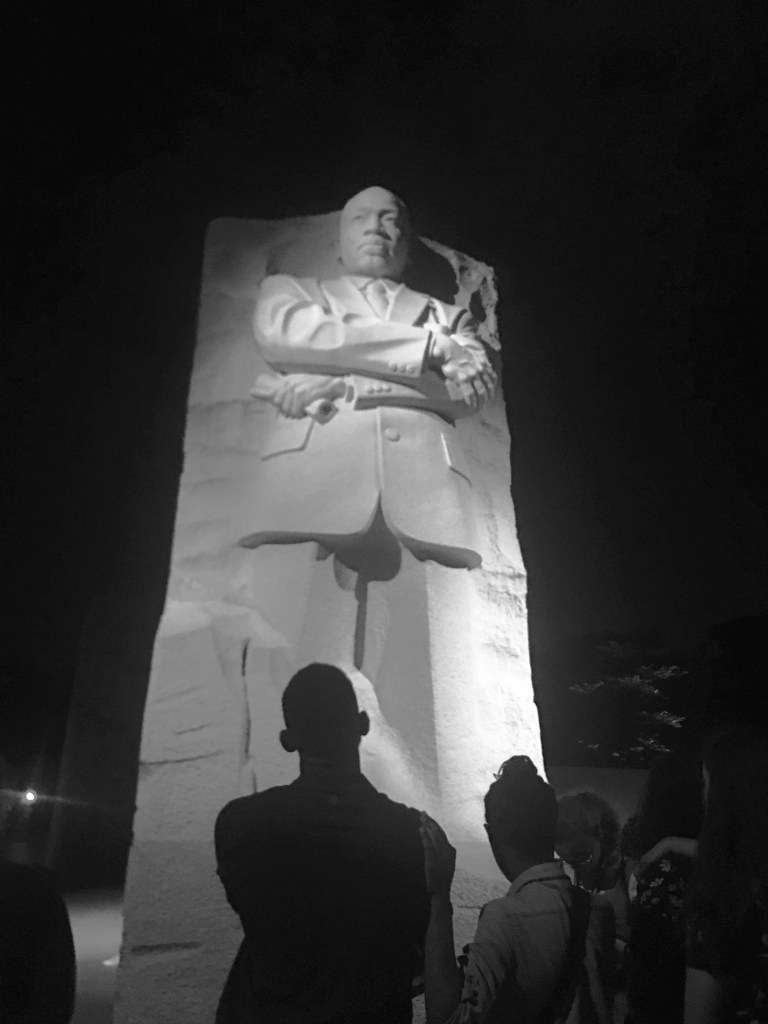
“All we say to America is, ‘Be true to what you said on paper!’” January 20, 2025, a day of American irony that awaits us.
As the United States prepares to inaugurate its 47th President, the event will fall on a date of profound historical resonance: Martin Luther King Jr. Day. This federal holiday, still debated and resisted in some quarters, honors the legacy of Reverend Dr. Martin Luther King Jr., a man whose life and work embodied the ideals of liberty and justice enshrined in America’s founding documents. Yet, as we commemorate his legacy, we must also grapple with the nation’s ongoing struggle to fully embrace the dream he articulated in 1963, and the vision of equality and unity he described from the mountaintop in his final speech. Complicating this observance is the fact that some southern states continue to honor Robert E. Lee on this same day—a Confederate general who led the charge in preserving the institution of slavery. This dual recognition starkly contrasts the ideals Dr. King championed, highlighting the enduring tension between the promise of liberty and justice for all and the persistent glorification of those who fought to deny it. Such juxtaposition underscores the antithesis of Dr. King’s dream, reminding us of the work still required to reconcile America’s past with its aspirations for the future.
Dr. King dedicated his life to a truth he believed America had written but failed to enact: that all men are created equal. This was the promise of the Declaration of Independence and the Constitution, which, though revolutionary in their time, excluded many from their guarantees. It was not until the passage of the Voting Rights Act of 1965, less than 60 years ago, that America began to approach the reality of a multiracial democracy. Many Americans alive today were born into a nation where systemic barriers to voting based on race were still enshrined in law. Even now, these hard-won gains are under threat.
As a high school junior in Dayton Public Schools, I first heard these words in the Mountaintop Speech, introduced by one of my greatest teachers, Mr. Michael Unger. Mr. Unger’s lessons connected current events to history, illuminating how King’s storytelling and moral clarity offered a roadmap for justice. King’s ability to interweave personal narratives, historical struggles, and universal ideals taught Americans of all backgrounds that the fight for civil rights was, and remains, a fight for the soul of the nation.
On the sacred day that honors Dr. King’s life and legacy, we must remember that his fight for civil rights was not limited to African Americans but extended to all marginalized communities. His Poor People’s Campaign, for instance, highlighted the shared struggles of the impoverished across racial and geographic divides. King understood that unity, decency, and moral courage were essential to achieving the promise of the Constitution for all people, especially those excluded from its initial drafting.
We must acknowledge the duality of January 20th and champion unity rather than separation. As we celebrate his legacy, we must also confront the American reality that the dream King so eloquently described is under siege. Clouds of division, inequality, and regression threaten the glory he envisioned from the mountaintop. Still, there is reason for optimism. King himself found hope in America’s foundational freedoms: the rights to assembly, speech, and protest.
“The greatness of America,” he said, “is the right to protest, for rights!”
On this dual occasion of Dr. King’s holiday and the presidential inauguration, it is fitting to reflect on the trajectory of the nation. While the incoming president may not share King’s vision or legacy, the enduring idea of America—a nation striving to form a more perfect union—persists. This idea, conceived without the input of all its people, has been enriched and expanded by the contributions and sacrifices of those who were initially excluded.
Ironically, I will mark this day in Memphis, Tennessee, standing with the Institute for Common Power, an organization dedicated to advancing a more equitable and truthful America, leading teachers from across the country, turning “education into action,” as Director Dr. Terry Anne Scott continues to champion.
This setting, so deeply connected to King’s final days, serves as a poignant reminder of the cost of progress and the urgency of our work. Together, through unity and an unwavering commitment to truth, we can honor Dr. King’s legacy and ensure that America lives up to what it has written on paper.
His last recorded words are forever with me as he walked away from his podium proclaiming “Mine eyes have seen the glory of the coming of the Lord!!” To that, I say; My eyes has seen the glory of the promise of the Constitution! I remain hopeful that “we, as the people” will get to the promised land!

Discover more from Three-Fifths
Subscribe to get the latest posts sent to your email.
 Three-Fifths