
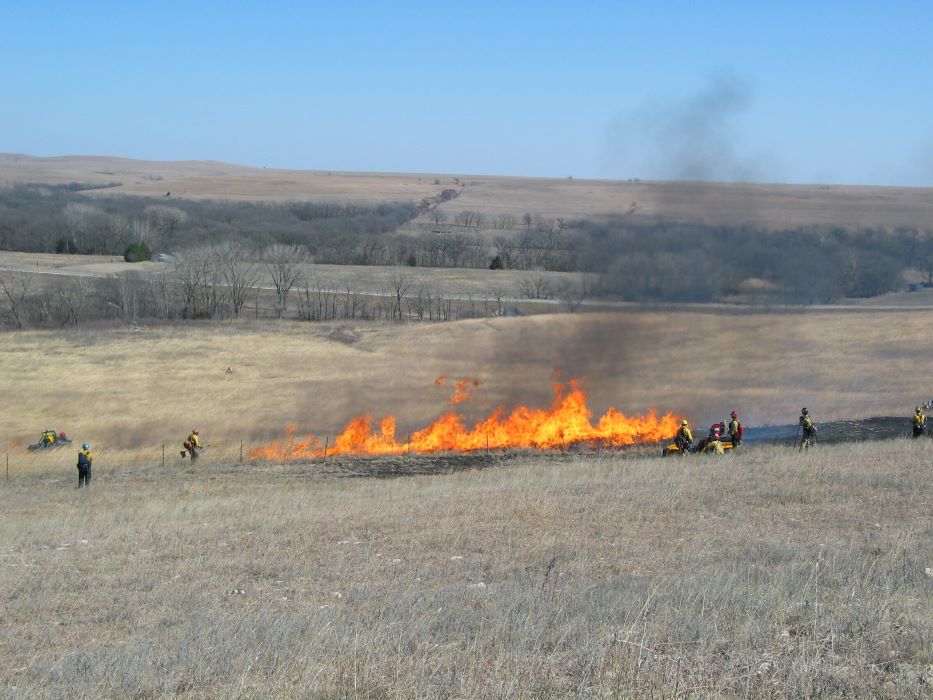

I was raised in a Norwegian Lutheran tradition in the rural Midwest. The “Kýrie” is an important prayer in Christian liturgy. Like a prairie fire, Kýrie disrupts and awakens. With song like a prairie, Kýrie is a call for healing and rebirth.
In Iowa, a couple small sections of prairie have been restored. From a birds-eye perspective, they appear like bookmarks for the millions of acres of prairie that used to be here. They are signals that remind us to find our place again. Hemmed in by corn and beans, they say, “This is who I am meant to be.” And a prairie only exists because of fire.
Before my ancestors arrived, members of the Lakota Nation used fire to manage prairie grass. Fire helped retain ecological balance, provided pastures for grazing, and it propagated medicinal plants. There’s a deep relationship between First Nations people here and the prairie burn. But it’s not my place to be near wisdom from their culture.
My ancestors were frightened by the sight of burning prairie. After the Americans forced the Lakota Westward, the prairie grasses grew as tall as walls in a house. My ancestors didn’t know how to manage this kind of land. So they drained its wetlands and tore up the turf for European crops. Their descendants – and some of my relatives – still do this today.
But for me, growing up in pastures and woodlands, I decided to listen to land differently than my cousins did. I found kinship with land and prairie fire is a part of my life. It’s in my memory.
Burning the prairie usually happens in Spring but it feels like a conversation between seasons instead. Where there’s fire, there is no single place in time. It’s as if past, present, and future align in it. A memory of last year’s Cone-flower or False Indigo is now a dry stalk of kindling. It comes to life again in the fire. And watching the prairie burn connects me backward to a time when I longed for Fall’s killing frost or a memory from last Spring when I couldn’t wait to see the first leap of green.
Prairies are noisy places; lots of birds. My words for prairie birds are Red Wing Blackbirds, Blue Birds, Starlings, Sparrows, Skylarks, Kestrels, Wrens, Chickadees, Great-horned Owls and Red Tail Hawks, Meadowlarks, Blue Herons, and Egrets. When I see Egrets, I love to crack a joke and say, “Live like you have no egrets.”
Grasshoppers, cicadas, crickets, and frogs clamor like ocean waves rising and falling. It’s like they all try to get quiet at once to hear what their neighbor is singing. And when they get quiet, they realize nobody is singing anything, so they decide to fill the lull with their rattling song again like people trying to fill the silence with polite chatter.
Even in wintertime, a prairie is loud. Canadian Geese honk, Chickadees rattle, Crows banter and swoop. An Owl releases a soft sentence of assurance. Coyotes cry and Fox chatter. Through a blanket of snow rise millions of flaxen stalks of prairie grass. In winter winds, they tap each other. Put your ear close and you hear them collide. And the flowers from last year hang their heads scattering toasted seeds across snow’s face. Their stems are delicate straws of gold. My words for the prairie flowers are Bergamot, Milkweed, Spiderwort, Lead Plant, False Indigo, Chicory and Brown-eyed Susans.
In the Fall, I’m anxious for the first frost; the killing frost. Like a hurt that wasnts a cool touch, Canada’s veil of cold can’t come fast enough. I want to awaken to a sparkling coat on every blade of grass and fragile leaf. I want to hear the last grasshopper sing in her lonely chorus and then pause to see if the others are still there.
In nature, there are events called “disturbances”. Floods, fires, storms, insect outbreaks, and livestock grazing are disturbance events that maintain ecological balance and harmony. Some eco-systems – like a prairie – require “disturbance” for survival.
It’s normal to reject disturbance in our lives. I don’t like it at all. I’m a creature of routine and same-ness. But my life has been filled with constant change and disturbance. It is the way of my life. And I’ve discovered that when I resist change, I’m miserable. But when I go with it, I’m dynamic.
I’m not the only one who rejects disturbance or change. For many, it’s a reaction to childhood trauma. Nothing is better than a peaceful, predictable adulthood after a young life spent in hardship. Even though we crave routines, those difficult childhoods can gift us with strength and resourcefulness in the face of disturbance and change.
And then there are those who reject disturbance and change because their lives are so good; their lives have always been easy. For them, change is usually a choice they get to make. But when change and disturbance happens to them – when it’s out of their control – they have no resilience or strength to cope.
A prairie without fire is like those people who have an easy life. It disappears under invasive plants – my words are knapweed, velvet leaf, and garlic mustard. Beetles will devour native plants. Prairie flowers won’t return. Birds can’t find food. Butterflies disappear. And then, one year, Tree of Heaven and Siberian Elm come; they are the trees that harm plants and native prairie trees. And the soil becomes weak. To the untrained eye, a disappeared prairie might look “natural,” but what you’re actually seeing is ecocide, a place where disturbance was eliminated.
Walking toward change – accepting disturbance – can make us strong, noisy, and beautiful like a prairie. And a prairie fire isn’t a fire of destruction. It is a fire for rebirth. The animals, insects, and plants of a prairie eco-system thrive because of disturbance. And so do we. We find out who we are meant to be – who we are meant to become – in times of change. We are like the land we live on; a small prairie – one surrounded by a sea of corn and beans – calls out loudly, ‘I know who I am… because of the fire.’

Discover more from Three-Fifths
Subscribe to get the latest posts sent to your email.

 Three-Fifths