

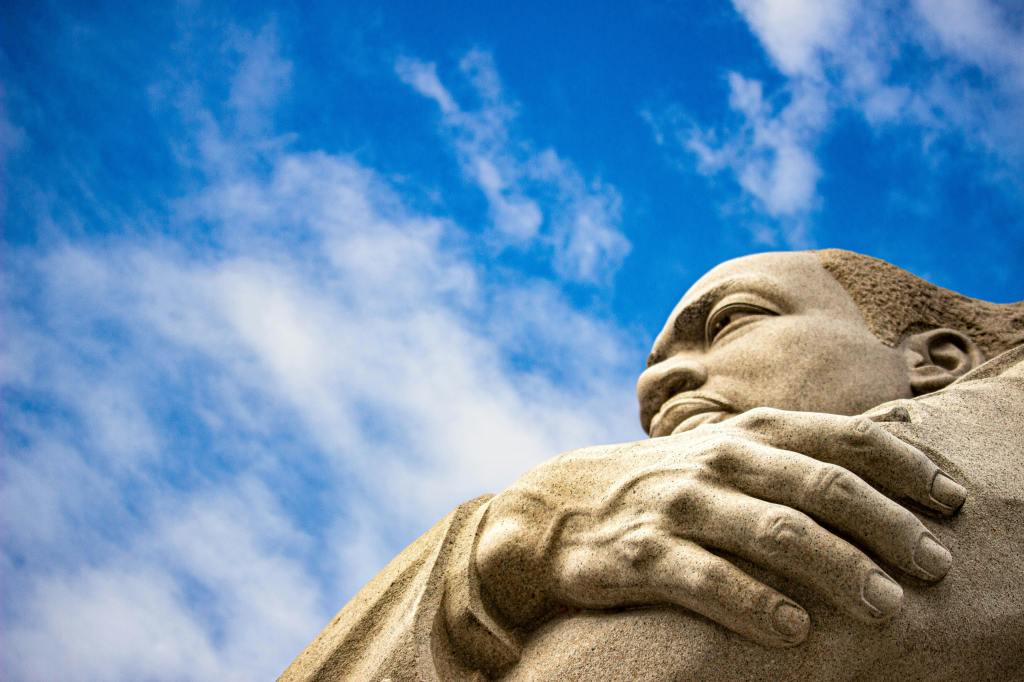
It is perhaps not well known, but the Sunday after Dr. King was assassinated, he planned to give a sermon entitled “Why America May Go to Hell.” In this sermon, he states that “America is going to hell if we don’t use her vast resources to end poverty and make it possible for all of God’s children to have the basic necessities of life” (source). His message in this sermon was in keeping with his increasingly strident criticism of the United States of America, which hit a tipping point in his famous address against the Vietnam War titled “A Time to Break Silence,” given exactly a year before he was assassinated in Memphis fighting for the rights of Black sanitation workers.
In “A Time to Break Silence” King states that he can no longer refrain from speaking out against the war in Vietnam and against “the greatest purveyor of violence in the world today—my own government.” In this speech, King also warns against the spiritual death of America when he states, “If America’s soul becomes totally poisoned, part of the autopsy must read: Vietnam” (source). King’s bold condemnation of America’s war in Vietnam broke his relationship with the Johnson administration and moved him from a “central” to what Richard Lischer calls a “peripheral” prophet. Lischer, in his book The Preacher King, notes that in ancient Israel, central prophets “operated within the power structure” but peripheral prophets “like Jeremiah, [were] outsider[s] who identified with the poor, taunted the monarch, and railed against war” (source). King, who wrote a paper in seminary that praised Jeremiah as “one of the bravest men in Judah” (source), did not relish his status as an outsider, but he argued that he could not oppose violence in the fight for civil rights if he did not oppose America’s wanton violence abroad. Yet, after he had been disavowed by the Johnson administration and even many other civil rights leaders, he stated that it was not too late for America to give up its wicked ways and be redeemed.
Said differently, King’s condemnation of America is in keeping with the long tradition of the Black jeremiad. Frederick Douglass, who was one of King’s heroes, used the Black jeremiad to simultaneously denounce the evils of America and call America to live up to its highest ideals. For Douglass, America was caught in a paradox. On the one hand, it espoused freedom and equality for all, as found in documents such as the Declaration of Independence. On the other hand, America committed great evils such as its denigration of Black people and attempt to turn them into property. Douglass held out hope that justice would prevail in America, but he knew that justice would only become a reality if people were willing to fight for it. King continued in the tradition of Douglass. Even his most stringent critiques of America contained hope for a better future.
In my best, though thoroughly flawed, attempt to emulate Douglass and King, I maintain hope for a better future. As a progressive, it is often easier for me to talk about what we must change in our nation and our world. But, there are also things worth conserving, things that are present now that can help us move towards the Beloved Community to which King dedicated his life. Here I will briefly name two. First, while America falls short of being what I would call a true democracy—a true democracy being a political system where each person has equal political agency—the ideal of democracy is still upheld, at least in most of America. Those of us who believe in democracy still can make it a reality in America. Second, like Douglass and King, I believe that America’s founding documents ought to be interpreted in a way that points us in the direction of freedom and equality. In her excellent book Our Declaration, political scientist Danielle Allen argues that the Declaration of Independence upholds the concept of equality. Further, she argues that, “Equality is the foundation of freedom because from a commitment to equality emerges the people itself—we, the people—with the power both to create a shared world in which we all can flourish and defend it from encroachers.” (p. 269) Such ideals, when put into practice, make our world a better place.
The path to more fully realizing these ideals in America is that of continuing critique and the building of better alternatives to what we have today. King sought to bring systems of injustice to an end, and he did so by building the Beloved Community. In a sermon, he noted “Evil is not driven out but crowded out… through the expulsive power of something good.”1 Thus, it is not enough merely to name evil and critique it, though that is an important task. Connected with our critique must be the positive force of building a superior alternative. We as Americans still have the power to embrace the best of our ideals and build a better country together.

- Taylor Branch, Parting the Waters: America in the King Years 1954-63 (New York: Simon & Schuster, 1989), 99. ↩︎
Discover more from Three-Fifths
Subscribe to get the latest posts sent to your email.
 Three-Fifths