
Growing up, I swallowed the school stories hook, line, and sinker. Thanksgiving was supposedly a lovely feast where Pilgrims and Native Americans held hands and sang “Kumbaya” over a table full of turkey. Christopher Columbus? Oh, he was the fearless hero who “discovered” America, as if it was lost. And Abraham Lincoln? He was the perfect superhero who single-handedly vanquished slavery. These fairy tales were fed to us as historical facts, but boy, were they far from the whole truth.
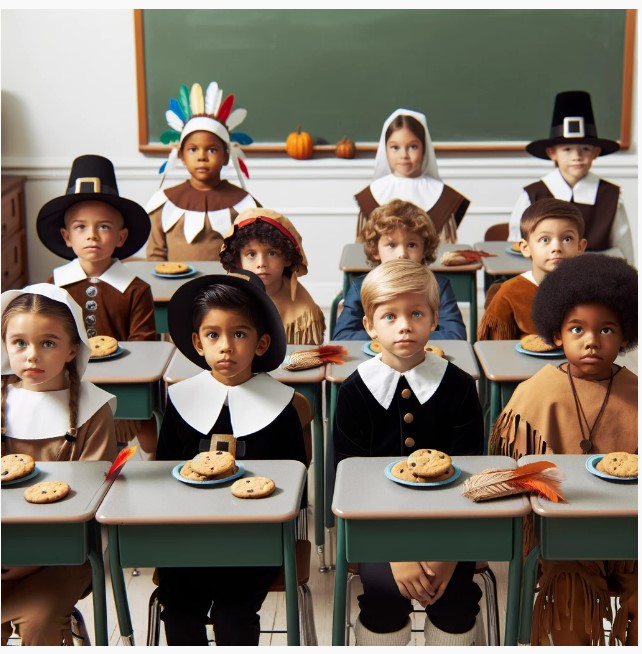
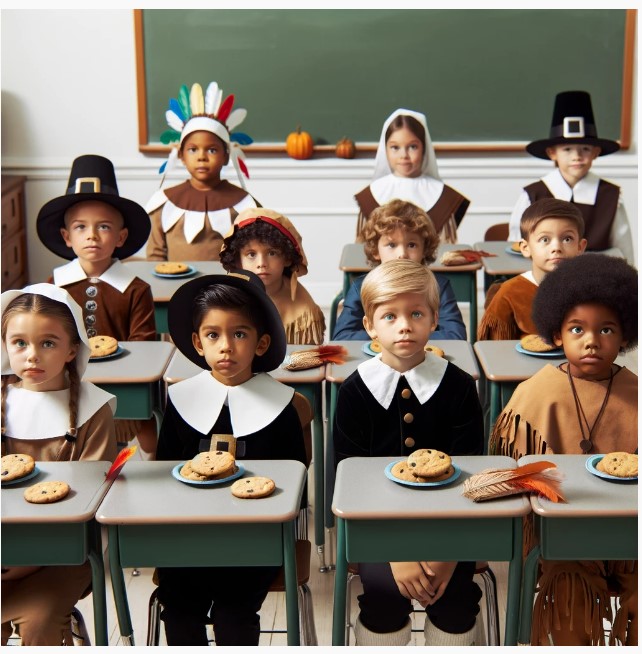
I remember in elementary school, our teacher had us dress up—some as “Indians” and some as Pilgrims—and we ate cookies together at our desks. Looking back, it’s almost laughable how simplified and sanitized these stories were.
As I got older and started to peel back the layers of history on my own, I realized my education was filled with gaps and distortions. This rude awakening was one of the main reasons I became a high school teacher—to make sure my students got the full story, so they could make up their own minds about what really happened.
In my classroom, truth is everything. We dive into the complexities of historical events, exploring multiple perspectives and sources. One day, we tackled the difficult history of lynching in America. As we uncovered the brutal realities and widespread impact of these atrocities, I saw my students’ faces change—shock and disbelief etched across them. One student finally raised their hand and asked, “Why haven’t we learned this before?”
That question lingered in the air, heavy with the weight of generations of miseducation. It was a powerful reminder of why I do what I do. I explained to them that history is often written by those in power, and sometimes uncomfortable truths are left out to protect certain narratives. But in our classroom, we face these truths head-on, no matter how painful, so we can truly understand our past. It’s through this honesty that we can start to heal and move forward.
We explored Columbus’ voyages not just as tales of adventure but as the beginning of centuries of colonization and exploitation. We examined Abraham Lincoln’s complex legacy, acknowledging his significant contributions while also discussing his often contradictory views on race and equality. These discussions were challenging but necessary. They allowed my students to see the past in its full, unvarnished form and to appreciate the depth and nuance of historical events.
One of the most rewarding parts of teaching is seeing my students grow as they learn to think critically and question what they’ve been told. Watching them develop the ability to distinguish fact from fiction and appreciate the complexities of history is incredibly fulfilling. I hope they take this critical mindset beyond the classroom and become informed, engaged citizens.
The importance of truth in education goes far beyond the classroom walls. Our country needs to realize that the true beauty of our democracy is like a heatwave building intensity beneath the surface. Just as a heatwave must be acknowledged and addressed to prevent harm, our nation’s history must be fully revealed. By confronting and acknowledging the whole truth, we can begin to heal the deep-seated wounds that continue to divide us.
The path to healing and unity in America lies in our willingness to embrace and teach the truth. By educating our young people with honesty and integrity, we empower them to build a future based on a comprehensive understanding of our past and present. As a teacher, I am committed to this mission, ensuring that my students are always presented with the facts, so they can engage with history and society meaningfully. Through this commitment to truth, we can hope to realize the full potential of our democracy and experience true healing as a nation.

Discover more from Three-Fifths
Subscribe to get the latest posts sent to your email.
 Three-Fifths