
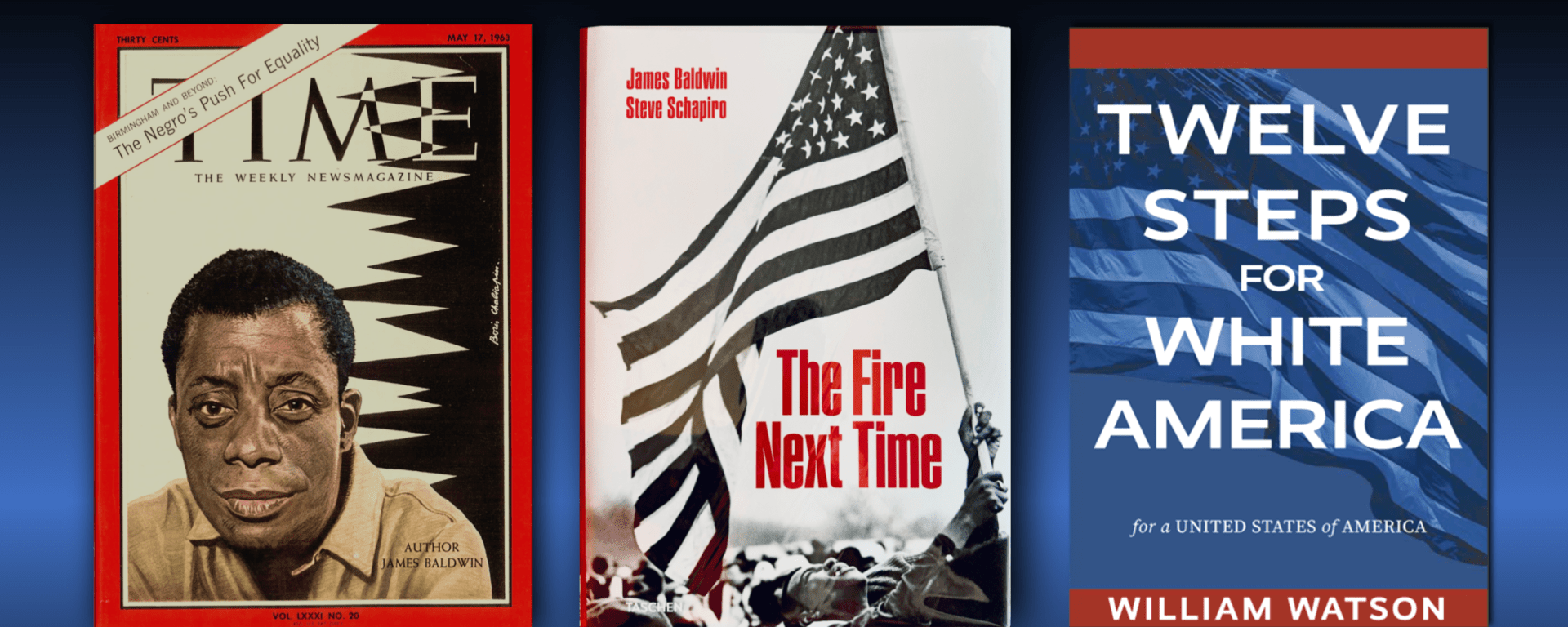
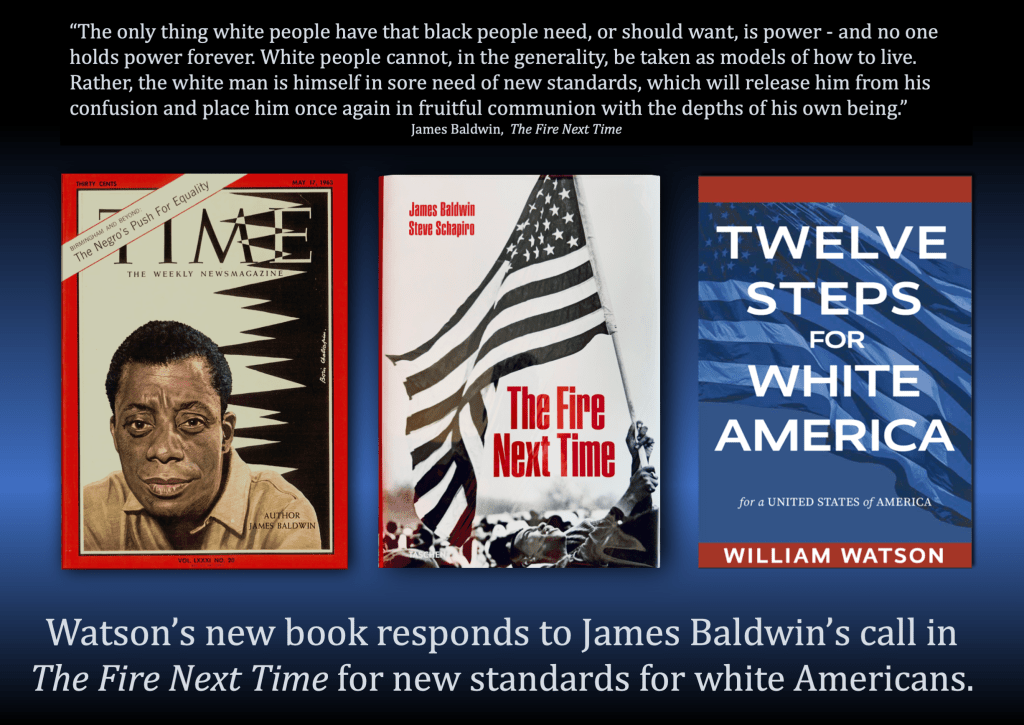
Three Fifths welcomes new contributing writer, William Watson. We decided to have some fun so we asked William to write his own book review! Kevin Robinson
Book Review of William Watson’s Twelve Steps for White America: for a United States of America, Cognella Press, 2023
The new book from William Watson, Twelve Steps for White America: for a United States of America, answers the call of James Baldwin in The Fire Next Time for new standards for white Americans. Part memoir, part manifesto, Watson prescribes a treatment plan for our nation’s dysfunction. This plan is ambitious only in the breadth of its potential to right our course for better days. As something of a trusted sponsor at a nation’s intervention, Watson unfolds a sweeping story intimately out of his lived experience.
Coming of age in Kennedy-era “dirt-road” Mississippi poverty, he watched his parents risk their lives and his to mobilize communities for civil rights despite death threats from the KKK. His story is an atypical intimate narrative, but also a sweeping backdrop onto American history. This intimate to grand sweep stages the the book from the very beginning in his dedication to the Mississippi civil rights trailblazer, Constance Slaughter-Harvey, who eulogized his father.
Slaughter-Harvey became the first Black woman to graduate from the University of Mississippi “Ole Miss” Law School just after James Meredith, who was Black, required the Kennedy administration and a federalized National Guard to get admitted. Slaughter-Harvey dominoed historical firsts across Mississippi history to become the first African American Assistant Secretary of State | General Counsel, serving for 12 years.
Intimate for Watson, this story backgrounds his father’s eulogy. Sweeping for the reader, this story is American civil rights history.
In the book’s dedication, Watson refers to himself as
“an expat of Mississippi for many years” recalling “the stifling inching of Mississippi time as sagas that burnish in memory – a legacy of the price already paid and the debt still due.”
Each chapter disarmingly oscillates between this intimate and grand sweep to present a treatment plan, comprised of nothing more than commonly experienced every day problem-solving principles (branded by Alcoholics Anonymous as twelve recovery principles, which transformed treatment for alcoholism and more).
Before deciding to write the book, Watson’s spiritual yes or no quest determined that the book’s value must derive from a place so personal that another person could not write it. A book about a nation needing recovery had to be rooted in the same rigorous honesty that other twelve-steppers know well – if they sustain recovery. For example, early in the book, readers become immersed in a conversation over coffee at Shoney’s with Big Chris, a truck-driving lesbian who was “baby-sitting” 25 year old William after an AA meeting to prevent his relapse. He writes,
“her company, some will-do coffee poured by a kiss-my-grits bouffant stranger who called me sweetie, and the near or far-muffled utensil clinking of other nighthawk rednecks, kept me sober through a long night of white-knuckling past a drink.”
When he reflects on the story to illustrate a point, he refers to his Shoney’s companion as Big Chris(t) and lauds love’s mercy inferring an old hymn – “When nothing else could help, Love Lifted Me.”
Watson presents a problem and a solution with few terms taken for granted. Specifically, he explicates a precise definition of our problem. Academics could argue that his Rigged Advantage Theory (RAT) is over-simplified – nothing new. He claims no new ingredients. But he does claim a “new recipe.” Reviewing the literature to write the book, Watson discovered that, generally, sociological theories of power have not centered race in explaining how power is historically advantaged in U.S. history. Watson’s RAT centers race.
RAT addresses a gap in the literature which calls for the problem to be explicated simply for a mass audience while being operationalized into a scalable, no-cost treatment plan powerful enough to save our democracy.
RAT is a conceptual framework for everyday people. It does not supplant or compete with Critical Race Theory. If CRT, a critical legal studies framework, presents racialized marginalization and identifies where it is structured across society, RAT is a sociological theory of power in the United States that centers race explaining how and why that marginalization persists. These are two complementary lenses onto the same problem.
How can something constructed in colonial America persist across generations to threaten us today? The truth can be as uncomfortable for those:
- marginalized by Rigged Advantage (Black, Indigenous, and other People of Color specifically) as those
- exploited in Rigged Advantage (exploited whites who have only whiteness in common with the elite whites who coopt their identities and specifically their votes).
Our problem is a whiteness inclusion-collusion delusion. This delusion requires those who are exploited in whiteness to displace their subjective experience of exploitation. As inequality squeezes the middle class in today’s Gilded Age, 2.0, Watson argues that, by design, these exploited white Americans must displace their subjective experience of this exploitation onto “others” using two mechanisms:
- white supremacy – which he describes as an ideology, and
- anti-Blackness – which he describes as the activity of white supremacy.
Both depend on what john a. powell refers to as “othering” and what Eddie S. Glaude, Jr. refers to as “race habits.”
This displacement means that white supremacy and anti-Blackness operate like an app in the background enabling exploited whites to conclude, “There is no exploitation since “We” are supreme allies. Those inferior “others” are the problem and “they” have to be managed.
This is the abusive trap of delusional dysfunction that needs a treatment plan.
The house of cards sustaining rigged advantage, which relies on an unnatural alliance of uncommon interests based on a made-up social construct we refer to as race, will not last forever. How far must we go before we hit bottom?
Watson centers his prescription in the transferrable steps he has taken for 37 years to stay sober. Here, the authenticity of the storyteller impacts the story. Since Watson has personally risen from the ashes: he refuses to let you tell him that democracy cannot do the same. Our healing will include long overdue remedy / reparations for the marginalized (necessary), but it will also unshackle exploited white Americans from their junkyard dog duties that serve wealthy elites (sufficient).
This happens throughout the book. Just when you thought it was story time rocking gently on his Mama Burnham’s back porch, Watson’s searing truths singe at the edge of what is possible.
(In Part 1 Repentance) Steps 1 – 4 outline precisely how to reckon with this truth.
(In Part 2 Atonement) Steps 5 – 8 map a path to remedy that leads to reconciliation.
(In Part 3 Redemption) Steps 9 – 12 lead to a renewal that charts a nation’s course to better days ahead for all.
While the book stands alone, a companion user-friendly, graphic-rich workbook guides the reader to learn each step and achieve each step’s learning outcome. Advanced mastery exercises challenge the reader to practice fundamental change principles, counter ideological impermeability, discern the difference between and an idealized and realized USA, quantify racial wealth inequality, dismantle the whiteness Presumption of Whereabouts Authority over Black Americans, practice loving-kindness meditation and implement a daily program of personal practice to consecrate liberty free from rigged advantage.
Contributing to the companion workbook, National Academy of Education member Christine Sleeter, Ph.D., contextualizes family history specifically to account for how the power dynamics of the past facilitate power and wealth in the present. She contributes her Critical Family History Assessment to Step Four.
Twelve Steps for White America may be deceptively digestible, but the treatment plan is rigorous if taken seriously. Watson’s folksy “erudition” may disarm you like a bowl of Red Beans & Rice at Mama’s house; but, make no mistake, the James Baldwin love in this memoir manifesto delivers the prescription our nation urgently needs.
“Love takes off the masks we fear we cannot live without and know we cannot live within.” James Baldwin
Twelve Steps for White America: for a United States of America is a manifesto of hope, a love letter to a beloved nation full of hope and promise. If a Mississippi redneck, a teenage alcoholic reading James Baldwin and a college vice president with a CRT doctorate walked into a bar in this book, they would not only see themselves in each other, they would know that, like Watson himself, out of the many, one. Unfortunately, e pluribus unum is an abyss away from a white knee on a Black neck. Until these repeating templates of advantage, rigged for some, exploiting many and marginalizing others are uprooted, talk of “best days ahead” mocks hope. But hope comes easy for a nearly dead alcoholic who lives another 37 years of twelve step spiritual awakening “carrying this message to alcoholics” and “practicing these principles in all his affairs.”
In Twelve Steps for White America: for a United States of America, we have a treatment plan for both individual white Americans and, structurally, for all of White America (dependence + co-dependence). Imagine a democracy where race no longer predicts outcomes. Get off the porch, America . . . take the first step.

Discover more from Three-Fifths
Subscribe to get the latest posts sent to your email.

 Three-Fifths
12 Steps…
RAT…
Looking forward to reading your book, Dr. Watson!
LikeLike
Thank you, Pastor McRoy. It’s my honor to join you here at Three-Fifths! Thank you for your interest in my book. I welcome your feedback on what I present. I hope you will tell me about your experience reading it. In case additional material interests you, my website is http://www.williamwatson.org
Thank you, again!
LikeLike