
“We hold these truths to be self-evident, that all men are created equal, that they are endowed by their Creator with certain unalienable Rights.”
When all doesn’t mean all
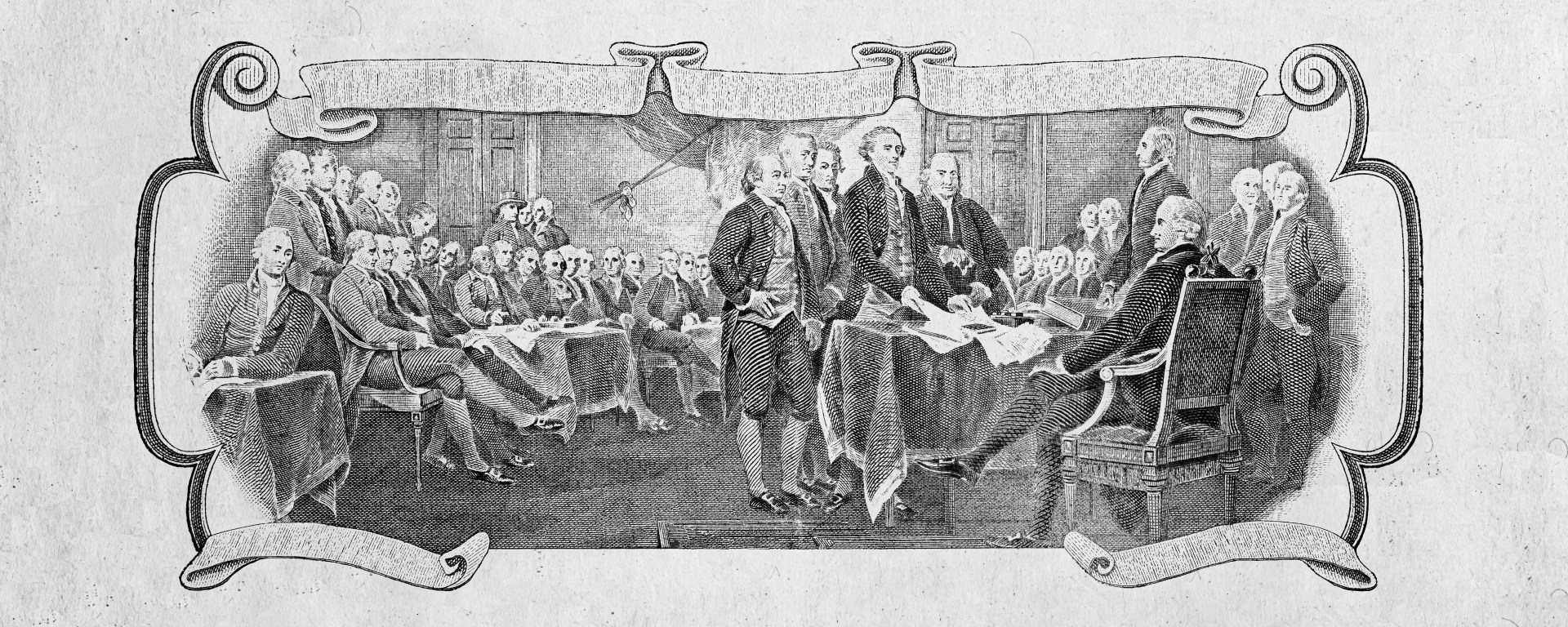
Some argue these words formed the basis of a color-blind meritocracy. Whatever validity that may have, a closer look reveals color-based forms of kleptocracy and slavocracy. The Declaration of Independence wasn’t written as a tweet, a bumper sticker, or a news headline. It was drafted as a legal document that qualified what was meant by “all men” through what it included and excluded. The same revolutionary declaration about all men being “created equal” describes the Indigenous peoples of North America as:
“…merciless Indian savages, whose known rule of warfare, is an undistinguished destruction of all ages, sexes, and conditions.”
This inclusion of “Indian savages” illustrates how America has excluded some from its promises to all. The enlightened “Founding Fathers” saw Native Americans as savages, not men. That’s why powder-wigged penmen, from John Adams to George Wythe, denied rather than endowed Natives with unalienable rights. This racist root has born deadly fruit, such as The Trail of Tears under Andrew Jackson to The Long Walk under Abraham Lincoln to the SCOTUS ruling against the Navajo Nation over water rights in June 2023.
Closing the door on conscience?
We also learn a lot about the Fathers from what they excluded from the Declaration of Independence:
“he [King George III] has waged cruel war against human nature itself, violating its most sacred rights of life and liberty in the persons of a distant people who never offended him, captivating and carrying them into slavery in another hemisphere. . . this piratical warfare. . . of the CHRISTIAN king of Great Britain.”
This excoriation of King George III over the issue of slavery was in the Declaration’s original draft, but expunged from the parchment we pontificate about on July 4. Not surprising, since the majority of the signers were slaveholders and slavery was legal in all 13 colonies at the time. What is surprising is Thomas Jefferson’s strong condemnation of a slave trade he never relented or repented of himself.
The Founders’ real dilemma wasn’t over the morality of slavery, but that England was promising freedom to slaves who revolted against the colonists. Americans would also promise freedom to slaves who fought the British. Some were freed indeed, while others were free to return to the plantations afterward.
Products or producers of the times?
Some argue that we shouldn’t judge these men’s actions of the past by our standards of the present. Is it presentism to judge their deeds by their own words? Doesn’t that show that they weren’t just products of their times, but producers of their times? Why should we defend what their own consciences condemned?
Consider the words and deeds of George Washington. In 1774, the cherry-tree-chopping general said the reason the colonists needed to break free from Britain is to avoid becoming slaves themselves:
“we must assert our rights, or submit to every imposition that can be heaped upon us. . . and. . . will make us as tame, and abject slaves, as the blacks we rule over with such arbitrary sway.”
Where’s the Christian exercise of “the Golden Rule” in that?
In later years, George Washington used all his presidential powers to recapture those who escaped his tyranny in pursuit of their own Lives, Liberties, and Happiness. However, three got away: Henry “Harry” Washington, Ona “Oney” Maria Judge, and Hercules Posey. Learn their stories and you’ll learn how dependent he was upon their labors for his independence.
What about women?
Not only did “all men” exclude some men, it excluded all women. Not until 140 years after the Declaration of Independence did America elect Jeanette Rankin as the first female US Congressman in 1916. Not until 144 years after the Declaration of Independence did America endow White women with federal voting rights in 1920 (Black women and men had to wait until 1965). Not until 156 years after the Declaration of Independence did America elect Hattie Caraway as the first female US Senator in 1932. Not until 205 years after the Declaration of Independence did Sandra Day O’Connor became the first female justice on the U.S. Supreme Court in 1981. Not until Vice President Kamala Harris was sworn into office did America elect a woman into proximity of the White House. That’s 245 years after the Declaration of Independence! Do you want to talk about taxation without representation?
The Irony of American History
Amazing irony: a nation that chastises African Americans for living in the past goes pyromaniacal about an old document that denigrates the people whose land the founders invaded. A nation that insists on peaceful gradualism for minority groups lights up the sky to honor their violent overthrow of the British government. A nation that some profess is as lamblike as Jesus often acts like his adversary, the dragon (Rev. 12:9-11 & 13:11).
If we seek to displace this hypocrisy with harmony in these yet to be United States, we must halt the hagiography of its Fathers and fix the fragmentation they built into this nation of our cohabitation.
Promise without compromise?
Borrowing from the urban poet, Propaganda, we “don’t hate America, just demand she keep her promises” without all the exceptions, excuses, and exclusions.
When America overcomes her racist roots and keeps her promises without compromise, the Staples Singers questions will no longer be answered with skepticism:
“Will we ever be proud of ‘My country, ’tis of thee?’
Will we ever sing out loud, ‘Sweet Land of Liberty?‘”

By Carl McRoy
Discover more from Three-Fifths
Subscribe to get the latest posts sent to your email.

 Three-Fifths