


If you forget your roots, you’ve lost sight of everything.
Walter Payton
Whenever you meet someone new, it’s common to ask them, “Where are you from?” It’s just a natural thing to ask. It gives people an idea of who you are and guides the conversation. Down South, people often ask, “Who are your people?” After you tell them a familiar name, they tell you stories about your ancestors. There is a sense of connection when you hear those stories. Family members are like walking griots that connect the past with the present and give voice to the stories of our ancestors. As long as we have DNA, our ancestors will continue to guide us toward discovering our roots.
The award-winning miniseries Roots aired in the 1970s. In the Roots series, author Alex Haley traces his family’s lineage from enslavement to emancipation and beyond. Kunta Kinte, the main character, is based largely on stories he received from family members. I watched Roots in the 1980s. I was in middle school at the time. I remember my family sitting in the den in front of our Zenith floor model TV. My mom made us popcorn the old-fashioned way by heating it on the stove. We took our bowls of popcorn to the den, eagerly awaiting the start of the show. We had no clue what we were about to see. My brother and I knew very little about our identity or culture. We didn’t know anything about the Roots television series. All we knew was that Black people were on TV, and we wanted to see them.
The scene where Omoro is holding up his newborn son Kunta Kinte to the night sky is seared in my memory. I remember the words Omoro spoke to his son as he held him up, “Behold, the only thing greater than yourself.” What a powerful way to make an entry into this world. I never considered the birth of a child sacred until I watched this miniseries as a young girl. The birth of a child signifies the continuation of a lineage and legacy, a new branch on an ever-expanding tree. The sacredness of that is beyond measure. Watching the Roots television series helped me to understand the significance of the word “roots” in a familial context. It planted a question mark in my spirit about who I was, and I needed an answer. Others also influenced me on my journey. Some of them are family members, but many of them are individuals who are unaware that they played an important role in lighting the torch and guiding me to learn more about my heritage and the importance of fighting for justice for all.
My journey to discovering my roots continued while working at the Auburn Avenue Research Library on African-American Culture and History (AARL) in Atlanta, Georgia, in the 90s. I worked in the Programming Department. I absolutely loved it! I am proud to say that I was there in the early days after the building was erected. Thanks to the excellent programs we held at the library, I met civil rights activists like Dr. C.T. Vivian and Attorney Donald Hollowell. The archives allowed me to work with rare historical documents and objects. It wasn’t until later in life that I realized the importance of these opportunities.
There was a book in the AARL collection that influenced my love for history and genealogy. The book was called Going Against the Wind: A Pictorial History of African Americans in Atlanta by Herman “Skip” Mason, Jr. I remember feeling so proud when I looked at pictures of my people―Black people. For me, it was a unique experience. It would be great if I could get another copy of that book. The Auburn Avenue Research Library was a place that nurtured my quest for knowledge about Black history, culture, and social justice even after I relocated to another state. There is no doubt that people, places, and things shape and influence us, and the library had a significant influence on my life. The Auburn Avenue Research Library of African American Culture and History planted a seed of discovery that continues to blossom in my life today.
In 2009, I watched the PBS television series African American Lives, hosted by Dr. Henry Louis Gates, Jr. After watching this show, I became an amateur genealogist. You couldn’t tell me nothing! This television series made me feel like my ancestors were still present, waiting for me to discover them and tell their stories. In 2010, I began building my family tree. I conducted my research the old-fashioned way by using microfilm, interviewing family members, and visiting graveyards and county courthouses. I found my great-grandparent’s marriage certificate on the dusty shelves of the Butts County Courthouse in Georgia. The experience of being directed to search for my ancestors within the colored section of court records was surreal. I thought, “Even in official records, we are still segregated.” As part of my investigation in Jackson, Georgia, I knocked on doors and visited graveyards. I looked at rows and rows of weathered headstones to locate suspected members of my family. My mother joined me on one of my journeys, and it was truly an experience, especially at the graveyard. My mother said, “I’m not going out there. There’s snakes out there!” When I think about it now, it still makes me laugh. Even though she had reservations about going on this journey, she still supported me. Watching the African American Lives series on PBS ignited a fire in me, and I was ready to fan the flames.
My family has been a rich source of history in my journey of discovering my roots. My research has mainly consisted of researching my father’s side of the family. I assumed exploring my father’s side of the family would be easy because of our unique last name, but that was not true. My trail stopped at my great-grandfather on my family tree. I couldn’t find anything beyond that. So, that led me to start exploring my mother’s side of the family. I did sporadic searches on Ancestry, but I wasn’t consistent. However, that all changed last year. My mother told me a story about her great-uncle Carl Genius Souder, who is my great-granduncle. This is what he used to say:
There is no night too dark that I won’t come and see about you.
Carl Genius Souder
Hearing that quote from my ancestor left a lasting impression on me. I began asking questions about him and why he was named Carl “Genius” Souder. My research included interviews with my first cousins, Donald Souder, an Army veteran, and Joyce Pritchard, a retired educator. Their father was Carl Genius Souder. It was a pleasant surprise to hear about his legacy of community service, passion for education, and fight for justice for Black people in Clayton County, Georgia.
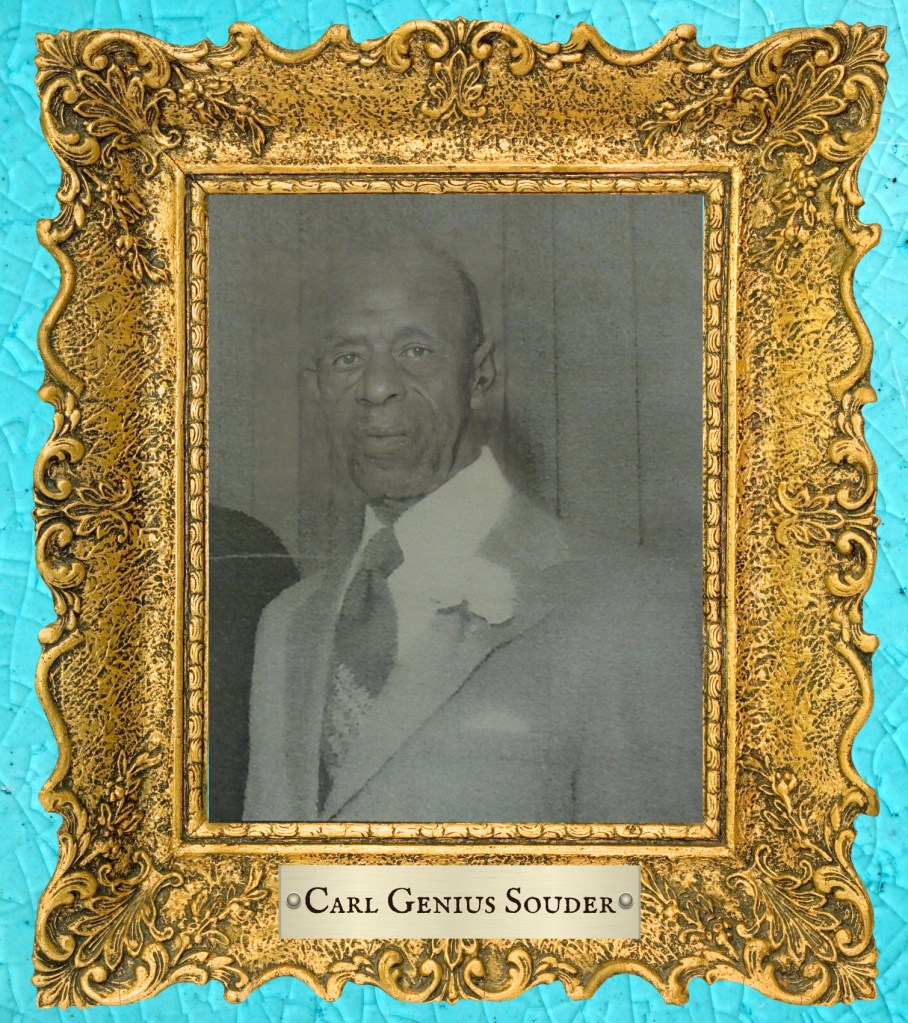
Carl Genius Souder was born in 1902 in Jonesboro, Georgia. He was a section worker on the railroad for 35 years. He was married to Annie L. Freeman, who was also a community activist and educator for 44 years. Mr. Souder was the second African American to serve on the Jonesboro City Council and the second elected official to serve as a City Councilmember in Clayton County. He was also a District Steward in the Methodist Church and a longtime volunteer for the Clayton County Economic Opportunity Authority. His children described him as a man of his word, bold, courageous, and unafraid to speak truth to power.
This description was evident in his desire to see a black school for the children who lived in Jonesboro, Georgia. Mr. Souder lived during the time of segregation. During that time, schools in Jonesboro were segregated. His children were attending Jonesboro Elementary, a rundown school that was poorly maintained at the time. Mr. Souder was so dissatisfied with the quality of the schools for black children that he decided to do something about it. He didn’t protest or march outside the school. He went directly to the Superintendent of Schools at the Board of Education and demanded they build a better school for black children. This behavior was unheard of in the segregated South. Undoubtedly, it was a genius move, but it was also dangerous. The racial climate in the South at that time did not deter him. Justice and equity fueled him to act in the best interest of black children. His actions, along with others, were the catalyst for building a new school in Jonesboro, Georgia, called J.W. Arnold Elementary.
Carl Genius Souder and his wife, Annie L. Freeman, were pillars of the community and honored
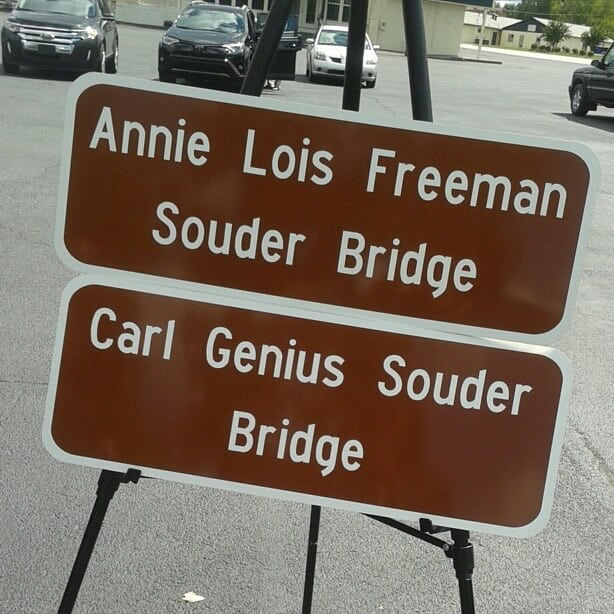
for their service. Their names were memorialized at a bridge dedication in 2018. Two bridges were erected in their honor on McDonough Road. There is also a street named after my great-granduncle in Jonesboro called Souder Way. My great-granduncle definitely made a mark in Jonesboro, Georgia, that cannot be erased! As a result of learning about my mother’s side of the family, I developed a more profound sense of why I entered the field of education and why I am committed to serving my community. It’s in my DNA. My roots are deep!
From Genesis to Revelations, Africa is a central part of the Christian message.
Rev. Dr. Otis Moss III
My journey of discovering my roots would also affect my spiritual walk with God. The most enlightening part of my discovery occurred ironically during the pandemic. Usually, when you think of the word “journey,” you think of movement. However, the pandemic acted as a spiritual stop sign causing the day-to-day activities of the world to come to a grinding halt. During this worldwide pause, I tuned in virtually to a ministry on the South Side of Chicago. Trinity United Church of Christ (TUCC) is a congregation that is Unashamedly Black and Unapologetically Christian. Through the sermon series The Truth about the Black Church, I could see myself in the Scriptures for the first time. As a result, I am no longer reading the Bible from a Eurocentric perspective. The series took me to the Book of Acts, where people from Ethiopia, Cyrene, Libya, Egypt, and other parts of the world were present on the day of Pentecost. Africa is a central part of Christianity. Coming from a large non-denominational church in Georgia, I was unfamiliar with this message. The Truth About The Church 10-Week Bible Study Class illuminated my knowledge of God, the scriptures, the origins of the church, and its diversity.
I am always amazed by the synchronicity of life. Everything happens for a reason. Every aspect of life is interconnected. The journeys we embark on in our lives have a purpose and a meaning. Discovering my roots is an ongoing process that will never end. Every day, I learn something new that strengthens and waters the roots of what makes me who I am today, making me stronger and wiser. You will never be uprooted when you know who you are.
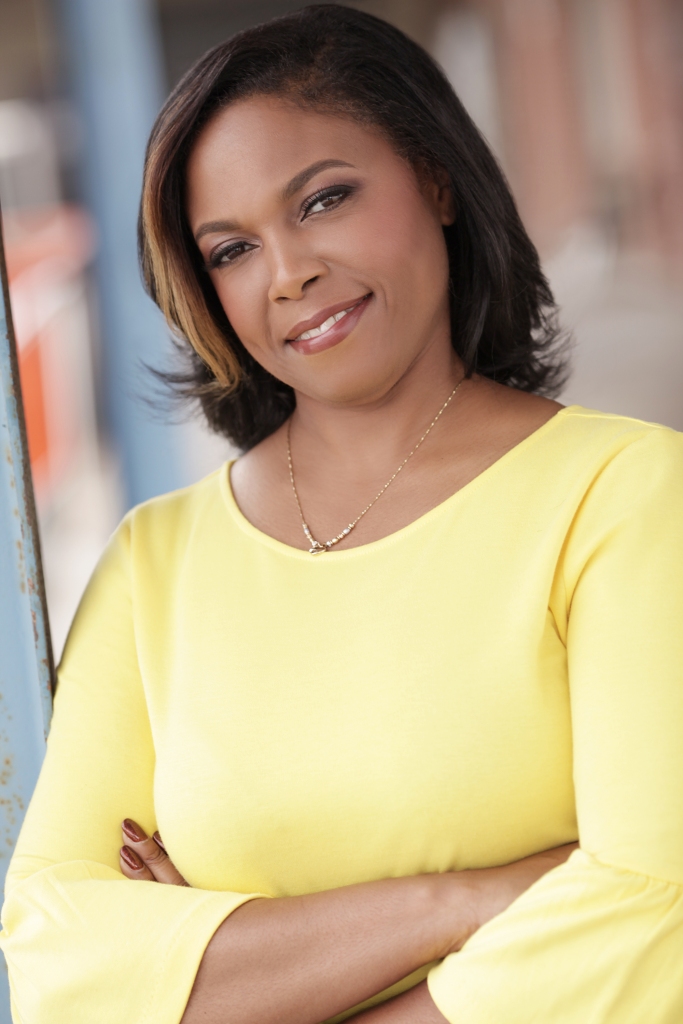
By Carliss Maddox
Discover more from Three-Fifths
Subscribe to get the latest posts sent to your email.

 Three-Fifths